
Hauser & Wirth is pleased to present Calder: François Premier a solo exhibition by Alexander Calder, in Paris.
October 19 – December 19, 2026
In the summer of 1953, Calder and his wife Louisa returned to France after 20 years, urged by the painter André Masson and his wife, Rose, their neighbors in Connecticut during the Second World War who had recently settled outside of Aix-en-Provence. The Calders rented a home known as Mas des Roches in the rural hamlet of Les Granettes near Aix, setting up in a house without running water or electricity. It was during this time that Calder and his wife acquired the rural property of François Premier in the hamlet of Saché, deepening their recommitment to life and work in France, a country they regarded as a second home.
Back in Les Granettes, at a nearby blacksmith shop, Calder began a series of large outdoor standing mobiles. Rather than his standard process of working from a maquette, he chalked forms directly onto steel plates, then cut and welded the elements together in an unconventional method. This mode of working was risky, as mistakes could be costly and time-consuming. The process yielded the large-scale standing mobile ‘Les Granettes’ (1953), which later became a fixture in the private courtyard of François Premier.
Bold but graceful, with suspended polygons in red, white and black, this outdoor sculpture will anchor the ground floor of the exhibition at Hauser & Wirth Paris, where it will be publicly shown for the first time since it debuted in Paris in 1954. Suspended above, the delicately interlocking wires and white forms of ‘The Putney Mobile’ (1954) and ‘Guava’ (1955) will float in a dynamic dialogue with ‘Les Granettes.’ The three works are a testament to Calder’s rare mastery over the interplay of aesthetics and physics, equilibrium and disparity, stasis and motion.
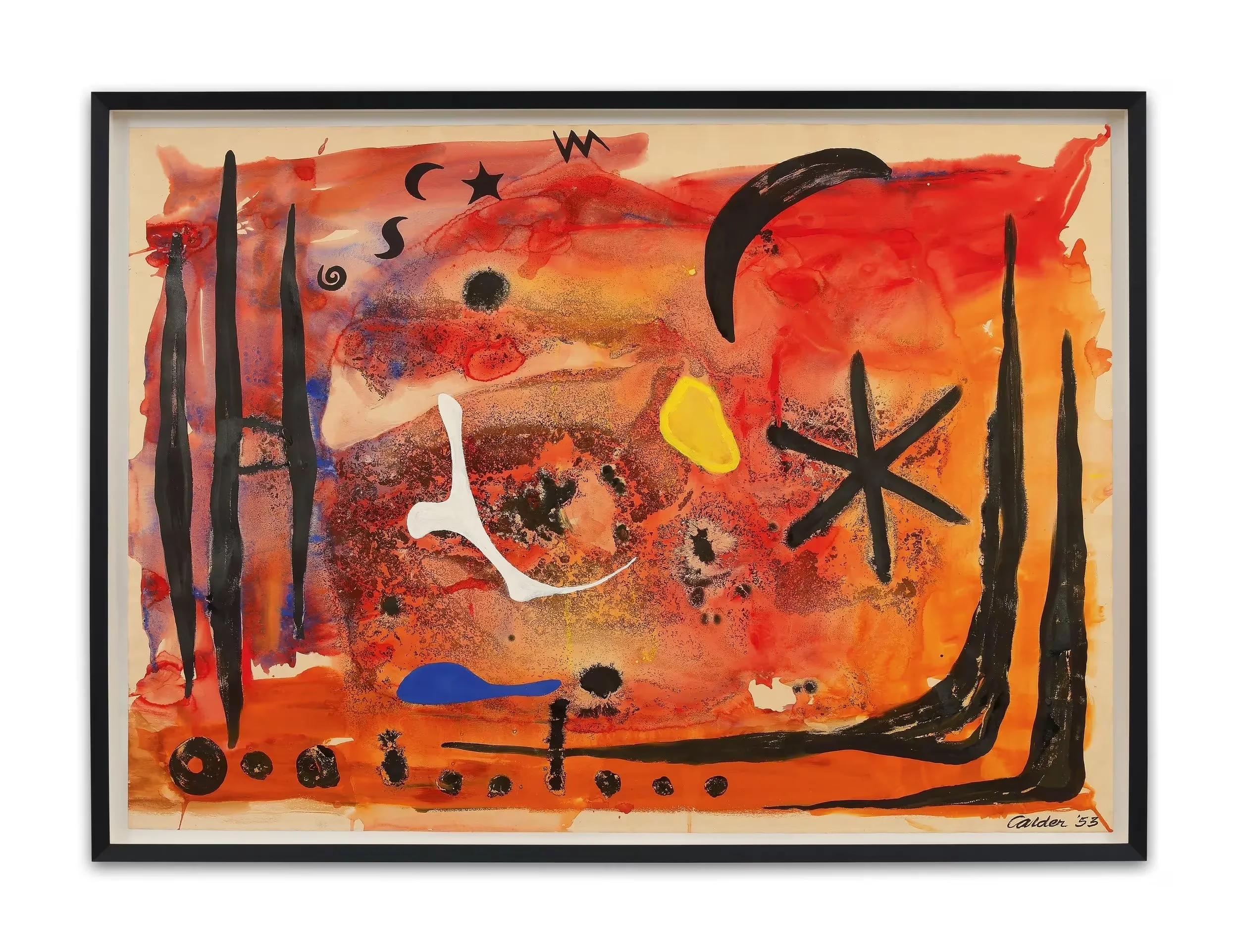
Using the carriage shed at Mas des Roches as a studio, Calder began to concentrate on ink and gouache paintings that paralleled the movement of his sculptures, echoing the forms and lines of the three-dimensional works in metal while establishing a bold yet enigmatic language of their own. The second floor of the exhibition at Hauser & Wirth Paris will focus on this extraordinary body of work. These paintings, striking and diverse, range from richly hued compositions created by mixing ink liberally with water such as ‘The Black Star’ (1953) to abstracted landscapes such as ‘Untitled’ (1953) and a series of monochromatic, crosshatched figures such as ‘Portrait de famille’ (1953). ‘I was practically doing nothing but gouaches and concentrating on them,’ Calder wrote of this time. ‘I seemed to develop something new.