
JEAN DEWASNE: UNTITLED
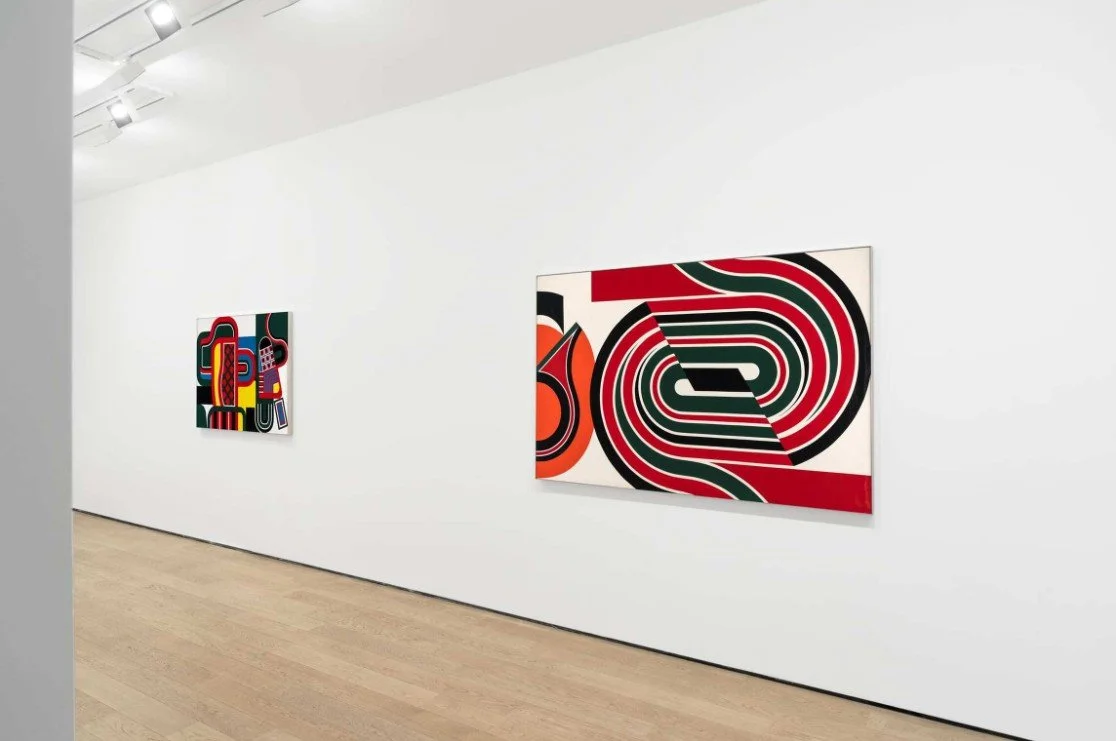
ALMINE RECH PARIS, Matignon is pleased to present Jean Dewasne’s first solo exhibition with the gallery.
January 10, 2025 - March 14, 2026
A major figure of the revival of geometric abstraction, in the 1950s Jean Dewasne established himself as one of the most daring artists of his generation. In post-war Paris, he conceived of pure geometry and colors as symbols of a new humanism underway, incorporating the scientific thinking and technological progress of the time. Although his early work followed in the footsteps of the pioneers of abstraction, he quickly asserted a resolutely new vision based on the use of industrial materials and a monumental approach to creation.
After extensive studies in music, he attended the Beaux-Arts where he studied architecture, before turning to abstraction in 1943. Laureate of the Prix Kandinsky with Jean Deyrolle in 1946, later that year he became involved in the founding of the Salon des Réalités Nouvelles, which played a fundamental role in the recognition of abstract art on both an institutional level, and in terms of the general public. He worked alongside Herbin, Sonia Delaunay, Arp and Pevsner: leading figures of a generation in search of direction and knowledge in the post-war period. Early paintings by Dewasne, influenced by a Cubist heritage, are characterized by a sustained material rhythm and a vehement touch. His work at the time was supported by the gallery Denise René, and little by little, his painting style became lighter and clearer. He participated in the dissemination of geometric awareness in France and beyond alongside Vasarely, Poliakoff, Jacobsen and Mortensen. A great campaigner and theorist at heart, Dewasne wrote the le Traité d’une peinture plane in 1949, and one year later opened the Atelier d’art Abstrait with Edgar Pillet — a pedagogical laboratory which aimed to promote abstraction construite. He taught the theory of form, colorimetry and the chemistry of colors to students who had arrived from across the globe, notably to GI scholarship students sent by the US Embassy.
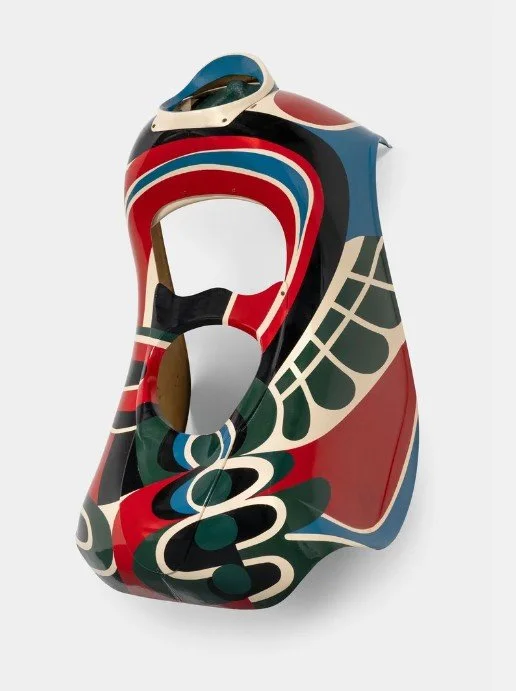
It was at this time that Jean Dewasne’s painting saw a radical transformation, which can be seen clearly in the foundational work L’Apothéose de Marat (1951). From here on, he began using industrial enamel paint (lacquer, glycerophthalic paint) applied to hardboard panels, homogenizing surfaces and accentuating the divisions between the geometric areas of bright colors through the use of a ruler and compass, giving his works a smooth, almost manufactured appearance. At the same time Dewasne elaborated a highly personal artistic language which he would go on to endlessly replenish over the ensuing decades, mixing hexagons, squares, semi-circles, ellipses, checkerboard patterns, concentric shapes and their derivatives. This evolution, which sets him apart from those who went before him, notably Auguste Herbin, was marked by a decisive step when he began making his “anti-sculptures”. Dewasne himself recounts the inception of this invention, inaugurated by the Tombeau d’Anton Webern (1951-1952), acquired by the Centre Pompidou while the artist was still alive: “In 1951, I found the back of a pre-war race-car, and its shape was interesting to me. I sawed off the bottom and stood it upright, and I realized I could paint both the interior and exterior at the same time. I worked on it and it became my first anti-sculpture.”1 This ready-made support, with its hollowed-out and curved surfaces, animated by a brilliant and colorful geometry, heralds the visual effects of American hard-edge painting. The dynamic cut-outs in his works reflect his enthusiasm for the industrial world; he described “its relationship to the steelworks, the rolling mill! What extraordinary competition for a sculptor!” 2 A committed communist, Dewasne saw abstract creation as an instrument for social renewal that he sought to put to the service of the improvement of society. This profoundly utopic conception of the role of art set him apart from the new realists to whom his is often compared, notably to César and his Compressions.
Terminating his contract with Denise René in 1954, Dewasne joined the gallerist Daniel Cordier, a fervent supporter of his since the start of his career. In the 1960s, when Lyrical Abstraction reigned supreme, the former resistant ardently defended him, as we can see in the following statement. Dewasne's “work, bursting with determination, energy and tension,” celebrates "the spirit of contemporary life, saturated with mysterious and familiar inventions that transform both the hearts of men and the framework of their existence. In contrast to nostalgic painting, which feeds on faded emotions, here is a resolutely idyllic painting that constructs the most exhilarating and truest image of the great revolutions that man has brought about over the last hundred years.” 3
International recognition for Jean Dewasne was soon to follow: after a retrospective at the Kunsthalle Berne in 1966, he represented France at the Venice Biennale in 1968. The artist continued his experimentations with new manufactured forms, such as motorbike engine covers, initiating the series Cerveaux Mâles in 1972. These works are animated by forms that brush up against one another, that run after one another without ever cutting across one another, creating syncopated rhythms that give way to stripes, curves and baroque details.
Throughout his career Dewasne ceaselessly reflected upon his work, in the 1970s he theorized in writing the transition from a flat painting practice to a spatial practice, using industrial painted forms to create an innovative topological complexity based on curvature. This evolution attests his embrace of non-Euclidean geometries and contemporary scientific research, where the concepts of relationship and transformation take precedence over those of measure and stability. Thanks to a collaboration with Renault undertaken in 1972 (which would endure until the 1980s) he produced 24 “anti-sculptures” made from lorry chassis of around 2-metres long. He received a number of commissions for monumental-scale works, including La longue Marche (1968, for the Lycée Haubourdin, 88-meters long), gigantic frescos for the Olympic Games in Grenoble (1968), and a piece for the Hanover metro (1975, 110-meters long). He exhibited these works across the globe, from Europe to North America (notably at The Carnegie Museum of Art in Pittsburgh). A visionary artist, Dewasne directly influenced the polychromatic structure of the Centre Pompidou, which he called his “largest ever anti-sculpture”. In 1986 the architect behind the Grande Arche de la Défense, J. Otto von Spreckelsen commissioned a series of enormous murals (100 meters tall and 70 meters wide) from Dewasne for which he applied his theory of graphs and lattices, tree-like combinations representing “the complexity of the relationships between ideas.” (Dewasne)
A few years prior to his death, in 1993, Dewasne was elected to the Académie des Beaux-Arts to the seat of his friend Hans Hartung. In 2014, the Musée Matisse du Cateau Cambrésis produced an important retrospective dedicated to the artist, while in 2012 a considerable donation of his work was made to the French state by his widow Mythia Kolesarova Dewasne, allowing for his work to be distributed across numerous French museums (including the Centre Pompidou, Musée d’Art Moderne de Paris, LAAC Dunkerque, LaM Villeneuve d’Ascq, and MAC VAL). Dewasne’s oeuvre contributed decisively to the birth of a new kind of geometric art, which bears witness to the desire to blend art and life through never-seen-before monumental and in-situ creations, which gave his work a profoundly generous and social dimension.