
JOSEF ALBERS: DUETS
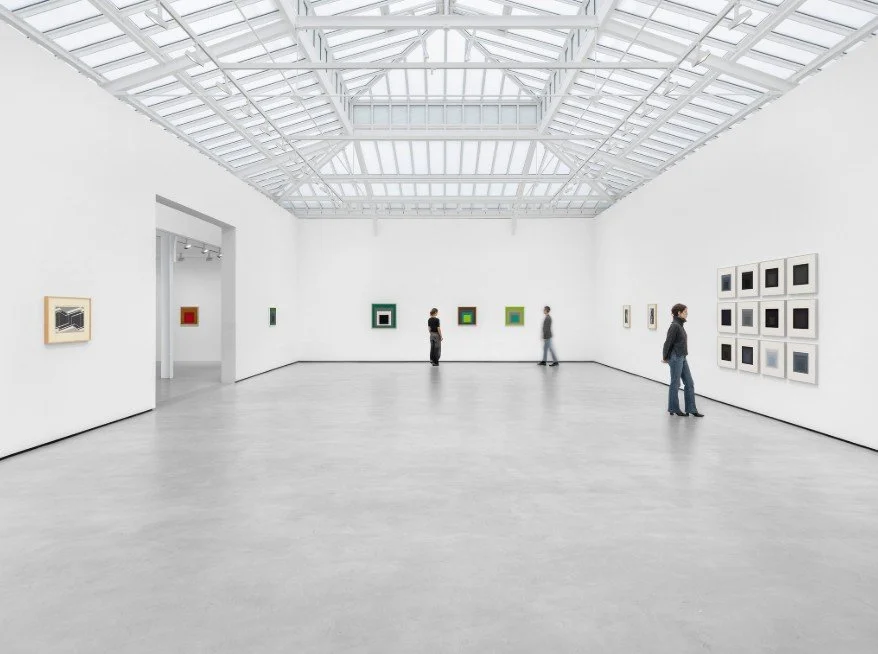
DAVID ZWIRNER is pleased to present Josef Albers: Duets, on view at the gallery’s Paris location. The exhibition is organized in collaboration with the Josef & Anni Albers Foundation.
January 15 — March 21, 2026
It is the first solo show of the artist’s work in Paris since the widely acclaimed Josef and Anni Albers: Art and Life, which was held at the Musée d’Art Moderne de Paris in 2021–2022, and the permanent installation of a gift of more than fifty works from the Albers Foundation to the museum.
“Albers delighted in pointing out that ‘in math and science, one plus one is two; in art, one plus one is two and also many more’.... To juxtapose closely related forms enabled Albers to give you, the audience whom he cherished, a visual feast.”
—Nicholas Fox Weber, executive director, Josef & Anni Albers Foundation
Organized in collaboration with the Josef & Anni Albers Foundation, this exhibition features significant paintings and works on paper from the 1930s through the 1970s in which two related forms are played against one another.
Albers was fascinated by such dualities. He guides us to recognize first that either two disparate paintings or two disparate elements within a single painting are in many ways the same but also vary from one another because of shifts in color or their internal structures.
Paintings and works on paper from Albers’s groundbreaking series Homage to the Square (1950–1976), in which he experimented with endless chromatic combinations and perceptual effects set in precise formats, are featured. These include Study for Homage to the Square: Starting Anew (1964) and Study for Homage to the Square (1968), whose shared palette of greens and grays demonstrate how Albers returned to resonant colorways over the years, here in large 40-by-40-inch scale.
“The square is just a vehicle for [Albers’s] experience of the colors. What he wanted to show with this series was that ... you never experience a color the same way twice. It is always conditioned by the context in which the color is seen. The color functions like a human being.... We are not the same.”
—Julia Garimorth, curator of Anni and Josef Albers: Art and Life, Musée d’Art Moderne de Paris
“[The colors] are juxtaposed for various and changing visual effects. They are to challenge or to echo each other, to support or to oppose one another … in order to make obvious how colors influence and change each other; that the same color, for instance—with different grounds or neighbors—looks different.”
—Josef Albers
Nearby, Study to Homage to the Square: Budding (1958) and Study for Homage to the Square: Spring Out (1962), apply earthen greens and browns that allude to the natural world and the changing seasons.
“Albers liked the dynamic of learning through repetitive doing. He had the patience and the curiosity for it, which made him an avid student and a tireless teacher. He enjoyed craft—the manipulation of forms and materials—as an end in itself.”
—Holland Cotter, critic, The New York Times