NICOLE EISENMAN: STY
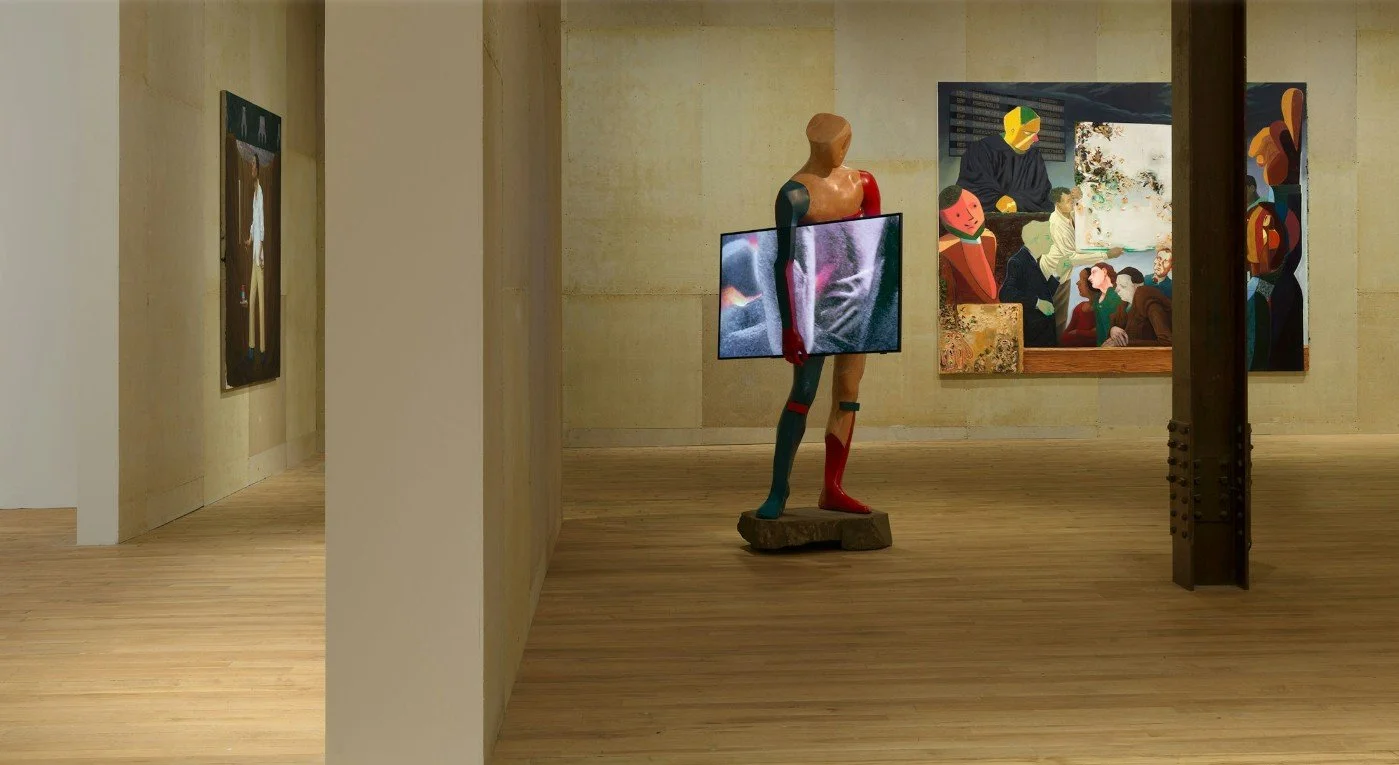
52 Walker and DAVID ZWIRNER is pleased to announce its seventeenth exhibition, STY, featuring the work of New York–based artist Nicole Eisenman. The show presents a new sculptural group with video elements and a selection of paintings, which include those realized for the exhibition and important loans from public collections.
October 30, 2025 January 10, 2026
In a prolific career spanning over thirty years, Eisenman has become known for expressive figurative canvases and sculptures that capture moments of contemporary life with élan, humor, and gravitas. From the late 1990s onward, the artist has pursued a practice that centers perspectives peripheral to dominant narratives, lacing intimate subject matter with cues from attendant political and social milieus. Paying homage to twentieth-century interwar styles and movements such as the Neue Sachlichkeit while exercising a distinct visual language, Eisenman wryly deploys allegory and genre to survey the spirits and tensions that mediate our broad experience of history and culture.
Eisenman’s monumental sculpture Fixed Crane (2024) was recently on view through March 2025 at Madison Square Park in New York. From 2023 to 2024, the major institutional survey Nicole Eisenman: What Happened traveled from Museum Brandhorst, Munich, to Whitechapel Gallery, London, and the Museum of Contemporary Art Chicago.
STY is housed in a built-out gallery situated entirely within 52 Walker, which is conceived as a total space that projects the thinking process of an artist, mapping out the brain‘s various orbits. This space envisions the arc of an unfolding narrative, both piecing together a story and offering a glimpse into the artist‘s state of mind. By entering inside, viewers engage the premise of being “in the room,” physically and in terms of the expression‘s expansive meanings and possibilities. As in an artist‘s studio, the space is generative and personal, subject to the creator‘s whims and feelings. Likewise, the space exists in relation to what is happening in the world and how the artist registers affect through times of crisis; STY seeks to prompt the somatic experience of living in wartime and under fascism.
The paintings on view draw eerie parallels between a recent past and the events of the present day, while acknowledging in turn the material and emotional strains artists are confronting. Depicted above a crowd in Archangel (The Visitors) (2024) is the titular Prussian Archangel , a papier-mâché effigy of a German soldier with a pig‘s head that was hung from the ceiling at the First International Dada Fair in Berlin in 1920—subsequently drawing mass controversy and charges of defamation by the state military. The porcine dummy (whose presence harks back to the exhibition‘s title) presides over a contemporary vernissage, a display of curvilinear, abstract sculptures; illumined by candlelight, a loft stores a stack of stretched canvases.
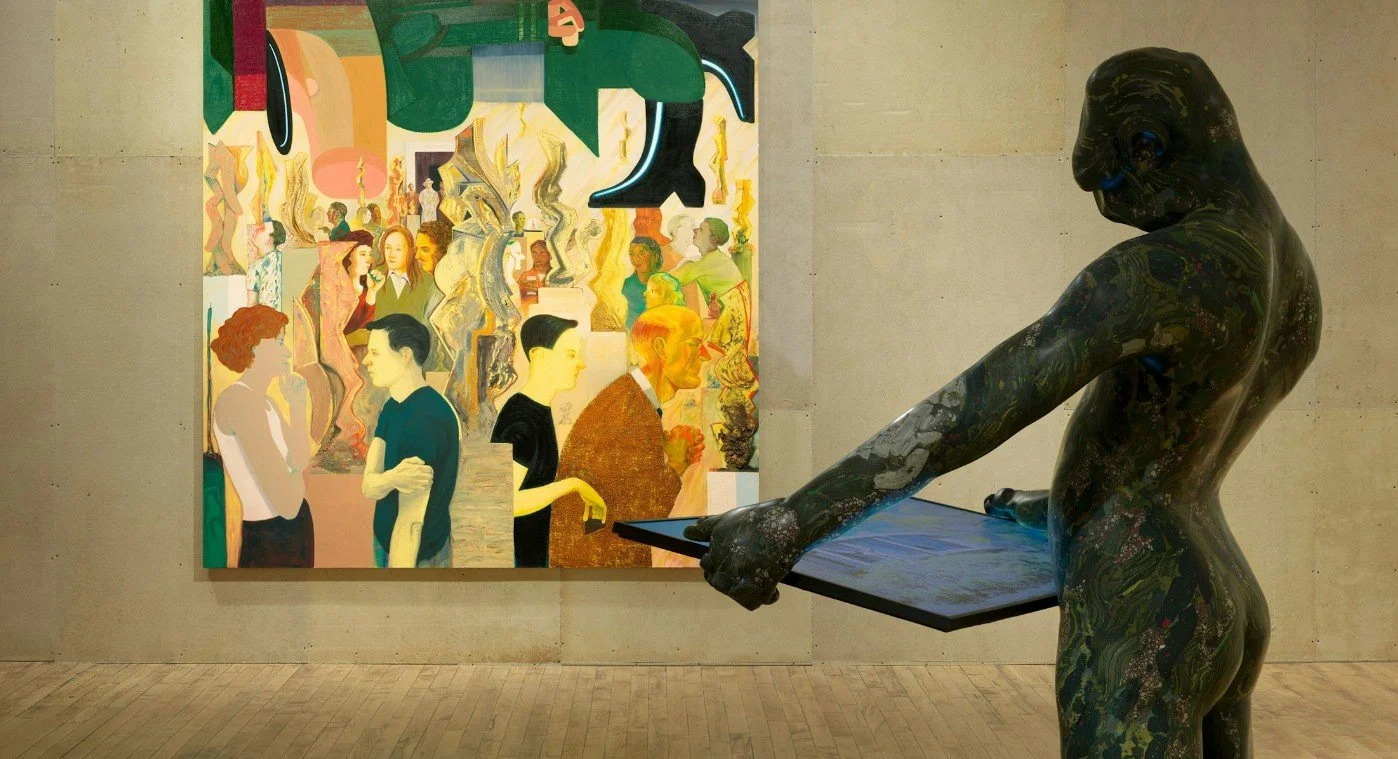
In The Auction (2025), Eisenman pictures a group of eager art buyers who bid under an ominous baroque sky. A board behind the imposing auctioneer, who is clothed in dark robes like a magistrate, lists currency conversions in real time. Surrounded by nondescript piles, an archetypal artist in The Bunker (2025) dons a black beret and sticks their thumb out—to assess perspective, perhaps, or to find a way out like a hitchhiker. Similarly situated in a bunker-studio, the protagonist of Fiddle V. Burns (2024, private collection) pores over a painting as military machinery closes in. Anvil (2025) presents an optical illusion as well as a portrait of an artist under pressure. Works on paper, sketches, and other preparatory materials are also pinned to the gallery walls, further situating the environment as one of reflection.