MILEN TILL: WIENER AKTIVISMUS (VIENNESE ACTIVISM)
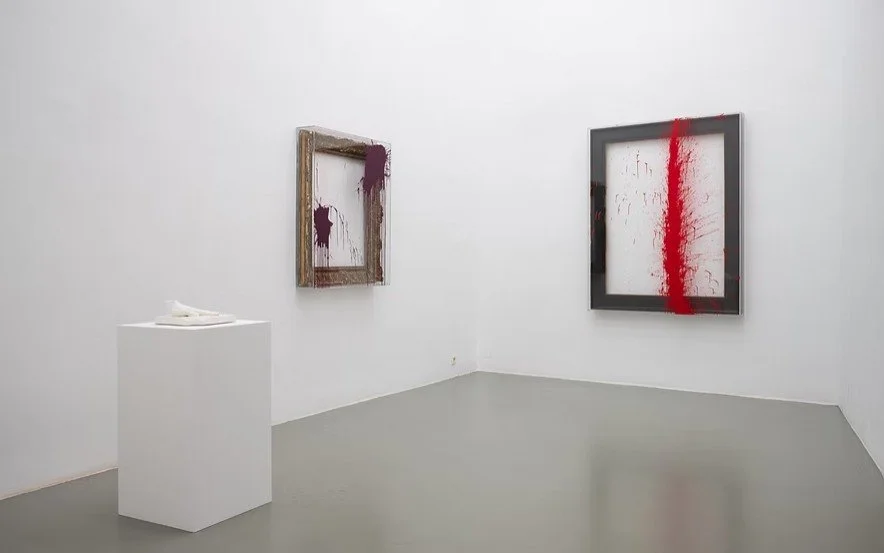
GALERIE CRONE is delighted to present the exhibition Wiener Aktivismus (Viennese Activism) by German-French artist Milen Till in our gallery space. On display is a new corpus of works, which combines the visual language of protest culture and action art.
November 21, 2025–January 17, 2026
Milen Till‘s works are characterized by astuteness, lightness, and a subtle sense of humor. He combines object art, ready-made art, and conceptualism with art-historical research and precise observations of our present. He repeatedly draws on iconic works by renowned artists and gives them new meaning. In doing so, he examines their visual codes and modes of operation. He recreates Malevich‘s black square out of folding rulers, forms a solar panel out of Yves Klein-blue postcards, or stacks teacups into an endless column à la Constantin Brâncuși. Christmas tree baubles are transformed into hand grenades, refrigerator doors become works of art, and beer coasters become sculptural objects. In this way, Till sharpens our perception of everyday objects—and at the same time questions our ideas about the value and nature of art.
In his recent works for the exhibition Wiener Aktivismus (Viennese Activism), he combines the visual language of two movements that turned the body into a place of political urgency and the street into a stage for their protest. He links the radical forms of expression of Viennese Actionism with the uncompromising gestures of climate activism, drawing attention to parallels in image creation.
The tomato soup dripping from the museum glass on van Gogh‘s sunflowers, or the black oil stain on Klimt‘s painting Tod und Leben(Death and Life) – the actions of activist groups such as Letzte Generation (Last Generation) or Just Stop Oil consciously or unconsciously employ a formal language that was already being explored 60 years ago. Viennese Actionism, founded in the 1960s by Günter Brus, Hermann Nitsch, Rudolf Schwarzkogler, and others, sought liberation from repressive, authoritarian social structures, thereby breaking the boundaries of painting. Hermann Nitsch became particularly well-known for his large-format Schüttbilder (splatter paintings), which were created through the gestural application of paint.
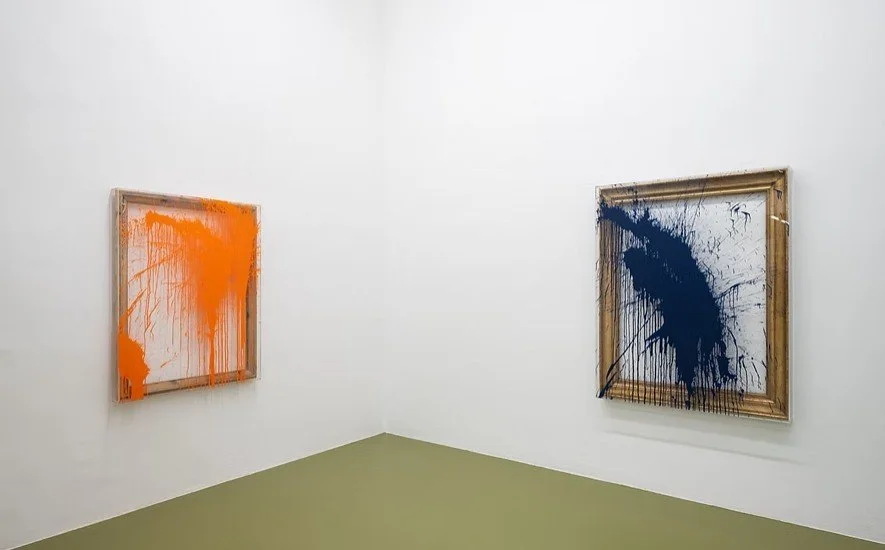
Milen Till now combines these two poles in his series Viennese Activism. For this purpose, he uses historical picture frames protected by acrylic glass covers. Their interiors, where works by Wassily Kandinsky or Gabriele Münter once hung, now remain deliberately empty. Instead, Till pours paint onto the previously untouched acrylic glass in an expressive gesture. Red, blue, or black streaks cover the transparent surface. The boundary between image and frame, and between two- and three-dimensional objects, becomes blurred.
The use of the body went far beyond simply pouring paint, both in Viennese Actionism and in climate activism. Günter Brus, in particular, made his body the central tool of his art. He painted, tied up, injured, exposed, and presented himself to a shocked audience. In his body-object constellations, he staged instruments of torture such as nails, knives, razor blades, or scissors alongside painted body parts such as his head or hand. While his body remains unharmed in these photographic arrangements, climate activists go one step further. They glue themselves to picture frames or street intersections, accepting injuries as a consequence. Their images circulate in real time on social media. They show haunting moments: hands stuck to the asphalt or freed by jackhammers, with concrete residue stuck to them in an almost sculptural form. Milen Till contrasts them with Günter Brus‘ timeless black-and-white photographs. With their sober objectivity, they stand in contrast to the fleeting snapshots of media coverage. The image carrier made of polished aluminum Dibond echoes the metallic materiality of Brus‘ torture instruments. The sequence of images is reminiscent of a roadblock. The rhythmic juxtaposition translates the symbolic power of Viennese Actionism into the brutal reality of the present.
In his works Selbstbeklebung (Self-Adhesion), Till takes the final step and now also incorporates his own body into the complex of works. He develops a cast of his own hand, whose radiant white color is reminiscent of Günter Brus‘ paintings. Fixed on a white base, it becomes a symbol of the uncompromising actions of climate activists. Only the yellowed epoxy glue breaks the integrity of the white and is reminiscent of the morbid stagings of the Vienna Actionists.
Till revisits this theme in his series of Handgranaten (hand grenades), in which Christmas tree baubles become museum-like visual works. The humorous and at the same time precise play on words refers to protest actions in which Christmas tree decorations filled with paint become projectiles. Till creates a field of tension between pacifist festivity and violent protest gestures, in which viewers can situate themself in a reflected form.
Sixty years after its inception, Viennese Actionism continues to spark critical debate. In this context, Till deliberately refrains from referring to Otto Mühl, who was sentenced to several years in prison in 1991 for sexual abuse and rape. In his works, he deals with the hidden logic of image creation that has linked action art and activism over the decades. Being a perceptive observer, he draws our attention to connections that would otherwise stay hidden and translates them into his own, humorously pointed, artistic language. He explores the diverse mechanisms of visual communication—and creates a space for resonance where questions stay open and keep echoing.
Milen Till was born in Munich in 1984. Together with his brother Amédée, he formed the legendary DJ duo Kill The Tills before turning to visual arts in 2016. He studied at the Munich Art Academy under Gregor Hildebrandt, graduating in 2020. He has participated in numerous solo and group exhibitions, including at Galerie Crone, Berlin; Galerie Ruttkowski;68, Cologne; Galerie Klüser, Munich; Baumwollspinnerei Leipzig; Kunstverein Heppenheim; Galerie Suzanne Tarasieve, Paris; Avlskarl Gallery, Copenhagen; Villa Schöningen, Potsdam; Villa Stuck, Munich, Kunstquartier Bethanien, Berlin, and the Romanian Cultural Institutes in Berlin and Paris. Till‘s first book, Till Now, was published in June 2023 by Hatje Cantz Verlag.