TOBIAS PILS: STILLLEBEN
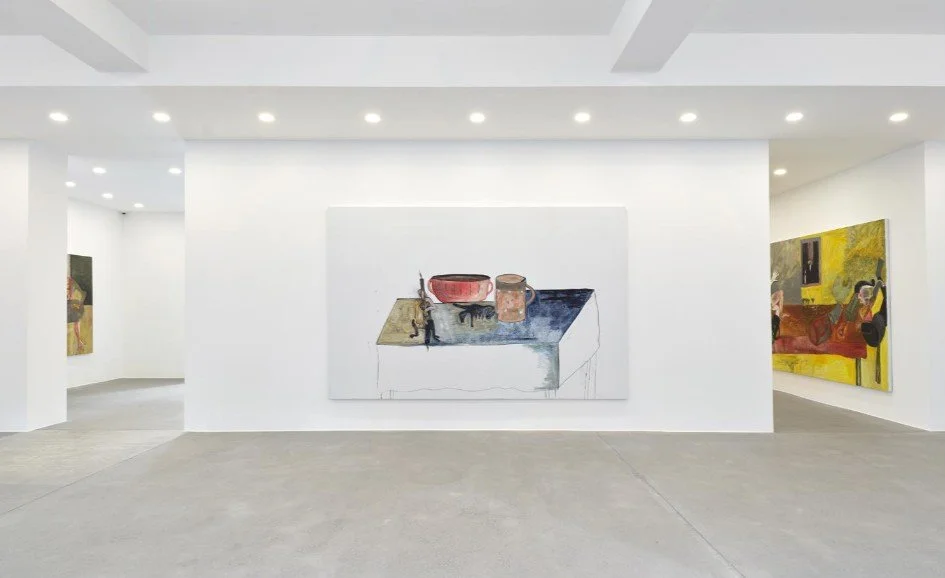
GALERIE GISELA CAPITAIN is pleased to announce the exhibition Tobias Pils - Stillleben. This marks the fourth exhibition with the gallery.
November 06, 2025 - January 31, 2026
Still life is one of the oldest and most enduring genres in painting. Tobias Pils deliberately works within this tradition—not in order to renew it, but to discover something personal within its familiar form. What interests him is not the novelty of the motif, but an individual perspective: a moment, a state of being. In his recent works, color also comes to the fore—something Pils notes was always present in his work, even in its absence
I wasn't interested so much in the classical aspect as the genre painting aspect. The fact that it's nothing special; that it's something that's been done a thousand times before. There’s a kind of truth in that. In my version, there's this glass from Ikea, a dried-up rose that my father left behind, and these candles that I had in my studio. Just these mundane things that are kind of remnants of me. But at the same time, this mundanity, this simplicity, contains everything all at once. We've seen it a thousand times before, it's been done a thousand times before, yet somehow my painting is still something completely new.
— Tobias Pils, conversation with Manuela Ammer, 2025 —
Still life is one of the oldest and most enduring genres in painting. Tobias Pils deliberately works within this tradition—not in order to renew it, but to discover something personal within its familiar form. What interests him is not the novelty of the motif, but an individual perspective: a moment, a state of being. In his recent works, color also comes to the fore—something Pils notes was always present in his work, even in its absence.
In Pils’s hands, the still life does not become a symbol of transience, but ratherbut rather a way of contemplating the present. His objects are neither mementos nor vanitas motifs, but traces of everyday life: a glass, a dried rose, candles. They do not speak of endings, but of existence. In their simplicity, they reveal that meaning lies not in the extraordinary, but in the ordinary.
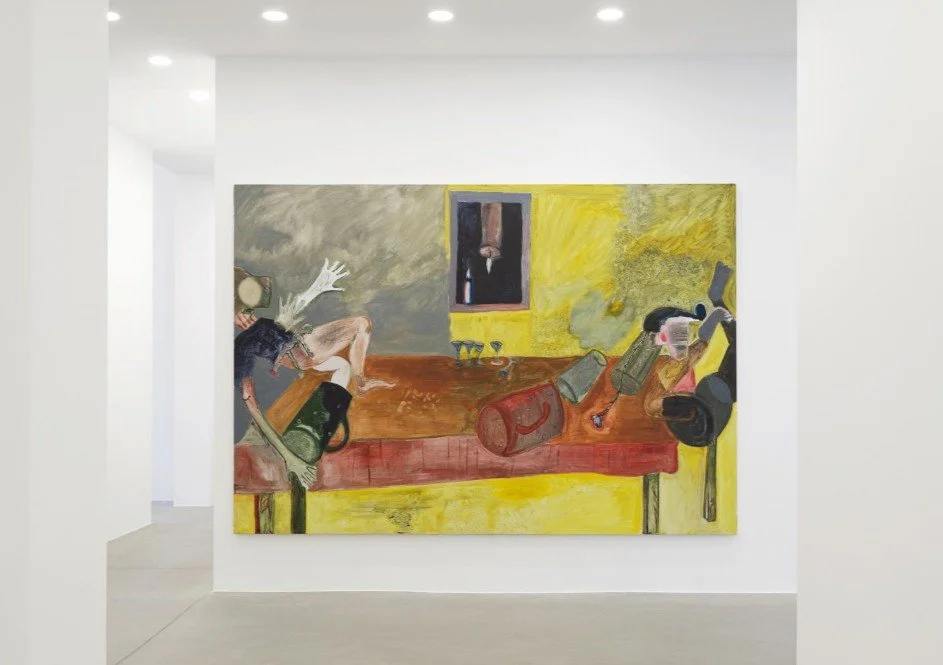
Silence also plays with this tension between stillness and movement. A table, seen frontally and filling almost the entire picture plane, becomes a stage for scattered objects—a red cup tipped over, a greenish jug, several glasses, some fallen. Nothing appears ordered; something seems to have happened. At both ends of the table, figures appear. Their bodies are twisted, caught in motion: on the left, one stretches across the edge; on the right, another tumbles backward over the surface. With them, movement breaks into the stillness.
Without impatience I shall dream,
I shall set myself to the work
that can never end,
and little by little, toward the end,
arms will reach out to other arms,
again will open the helpful hands,
light will return to the living eyes
within their sockets,
and you, suddenly unharmed,
will rise up; once more
your voice will guide me,
forever I shall see you again.
–– Giuseppe Ungaretti ––