WILLIAM N. COPLEY: X-RATED (1972–1974)
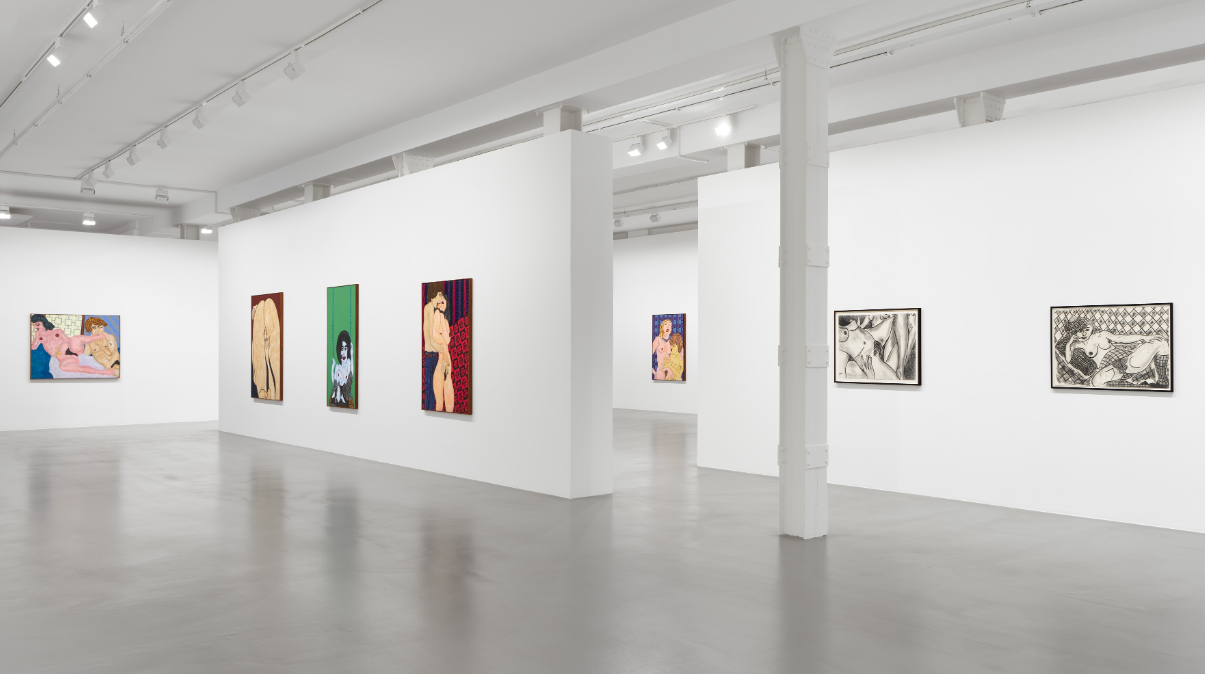
GALERIE MAX HETZLER, Berlin, is pleased to announce X-Rated (1972–1974), a solo exhibition of paintings and works on paper by William N. Copley. This is the fourth presentation of the artist’s work at the gallery.
March 13 – April 22, 2026
Copley came to painting from an unusual position. He had ambitions to become a writer before becoming a painter, and, for a brief period in the late 1940s, he co-founded and operated a gallery in Beverly Hills that focused on the Surrealists. The Copley Galleries – which he ran with his brother-in-law, the artist John Ployardt – brought him into close contact with exiled Surrealists such as Man Ray, Max Ernst and Marcel Duchamp, as well as the dealer Alexander Iolas, who encouraged him to pursue his nascent art practice. Adopting the signature CPLY around the time the gallery closed, he debuted his first exhibition at a bookstore in Los Angeles in 1951, shortly before he moved to France.
Even though he was a generation younger than the Surrealists, Copley’s work is deeply informed by the movement on a conceptual and personal level. While his bold black outlines and self-taught figurative style recall comics and Pop art, Copley approached painting with a literary sensibility, using narrative strategies that both embodied Surrealist principles and drove the structural evolution of his compositions. Like many Surrealists, Copley embraced humour, psychology and eroticism as fundamental to his creative process, yet his engagement with overtly sexual subjects went far beyond the playful eroticism of his peers.
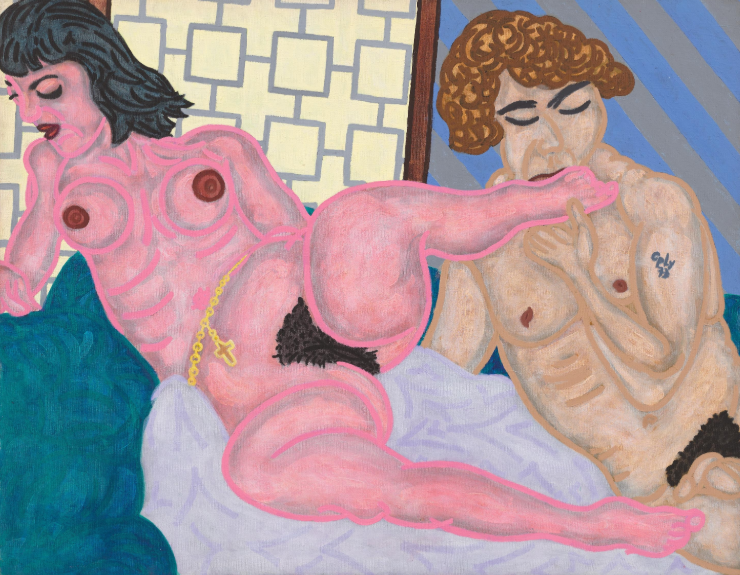
On view in the exhibition are works from Copley’s prolific ‘X-Rated’ series, created between 1972 and 1975, and first exhibited in 1974 in an eponymous show at the New York Cultural Center. This body of work draws on erotic imagery and ritualised motifs from adult magazines, seeking, in the artist’s own words, to ‘break through the barrier of pornography into the area of joy.’ 1In a decade when the sale of hardcore pornography was still illegal in the United States, Copley would buy ‘adult magazines’ under the counter, using them as a source for inventive figurative and narrative paintings that explored eroticism, sexual politics and the pursuit of pleasure. The artist was able to convey a wide range of tone in the ‘X-Rated’ paintings: some, such as The Seven Year Itch, 1973, are tender; others, including Viridiana, 1973, are exuberant; and almost all of them are openly humorous. Underscoring the open-endedness of sexual expression, Copley stated: ‘That’s what makes sex so much fun: since nobody really understands it, the possibilities for originality are endless.’ 2
Copley typically produced two stages of preparatory drawings before starting a painting: an initial, small-scale study, followed by a larger version in which he refined the composition, introduced changes, and heightened the work’s pictorial dynamism. The resulting paintings maintain a deliberately slapdash style, with figures treated loosely rather than meticulously rendered. The exhibition makes this developmental process visible through multiple pairings of preparatory drawings and completed paintings, including Calcutta, 1973, and its counterpart Untitled, 1973.
Scenes of copulations and orgies are set against vivid, brightly coloured backgrounds animated by bold, geometric patterns, making them almost ‘too artful to be libidinous, let alone lascivious’, as critic James R. Mellow has remarked. 3 It is both this treatment of the backgrounds and the contorted, entwined bodies with their attenuated limbs and schematic outlines that has prompted critics to draw a link between Copley and Henri Matisse more than once. Yet, while depictions of the nude and sexual imagery throughout art history have traditionally relied on suggestion and idealisation, Copley presents the sexual act directly, leaving nothing to the imagination.
With titles borrowed from Hollywood movies such as Les Quatre Cent Coups, The Exorcist or Tobacco Road, Copley tempered the shock of the pornographic image through comic playfulness and pop cultural sensibility. Manifesting a Surrealist disjunction, the movies rarely align explicitly with the images’ content, but the titles nevertheless set in motion a cascade of associations for the viewer. The title of the series, likewise, draws on terminology from the film industry: until the 1990s, the film-classification term ‘X-rated’ was used in the US for films only suitable for adults. Despite the cautionary notices that some visitors might find the subject matter offensive, the 1974 exhibition at the Cultural Center – curated by the newly appointed and strikingly progressive director Mario Amaya – received a notably positive critical response. Art in America writer Peter Schjeldahl hailed the presentation as a ‘uniformly gorgeous exhibition,’ noting that it marked ‘a highly satisfying development in Copley’s work’. 4
The ‘X-Rated’ series represents a singular chapter in Copley’s oeuvre, deliberately set apart from the prevailing currents of the early-1970s art scene. Even in today’s uncensored and image-saturated world, Copley’s suggestive canvases retain a subversive charge. By merging art and eroticism, Copley challenged conservative norms and rejected the notion of artistic neutrality, clearing away moralistic constraints in favour of directness and humour.
William N. Copley (1919–1996), known by the name CPLY, lived and worked in Paris, New York, and Roxbury, Connecticut, among other places. Copley’s works have been exhibited in renowned institutions worldwide, including the Philara Collection, Düsseldorf (2023); Institute of Contemporary Art, Miami (2018); The Menil Collection, Houston, travelling to Fondazione Prada, Milan (2016–2017); Museum Frieder Burda, Baden-Baden, travelling to Max Ernst Museum Brühl, Hannover (2012); Bonnefantemuseum, Maastricht (2001); L.A.C. Lieu d'Art Contemporain, Sigean; Herning Kunstmuseum; Forum of Contemporary Art, St. Louis (all 1999); Ulmer Museum, Ulm (1997); Kestner-Gesellschaft, Hanover (1995); The New Museum, New York (1986); Künstlerwerkstatt Lothringerstrasse, Munich (1981); Kunsthalle Bern, travelling to Centre Pompidou, Paris; Stedelijk Van Abbemuseum, Eindhoven; Badischer Kunstverein, Karlsruhe (1980); New York Cultural Center (1974); Stedelijk Museum, Amsterdam (1966); and Institute of Contemporary Arts, London (1961), among others.
Copley’s work is held in major public collections worldwide, including the Art Institute of Chicago; Centre Pompidou, Paris; Denver Art Museum; Fondazione Prada, Milan; Los Angeles County Museum of Art; The Menil Collection, Houston; Moderna Museet, Stockholm; Museum of Contemporary Art Chicago; The Museum of Modern Art, New York; Museum Ludwig, Cologne; Museum Moderner Kunst Stiftung Ludwig Wien, Vienna; Philadelphia Museum of Art; Power Institute, Sydney; Städel Museum, Frankfurt; Stedelijk Museum, Amsterdam; Tate, London; and Whitney Museum of American Art, New York, among others.
1 W. N. Copley, ‘CPLY: An Interview by Sam Hunter’, in William N. Copley: Selected Writings, Cologne: Verlag der Buchhandlung Walther König, 2020.
2 W. N. Copley, ‘A Conversation with William Copley by Alan Jones’, in ibid.
3 J. R. Mellow, ‘The X-Rated World of William Copley’ in The New York Times, 30 March 1974.
4 P. Schjeldahl, ‘William Copley at N.Y. Cultural Center’, in Art in America, May–June 1974.