JORGE MACCHI: NAVIGATION PRIVÉE
GALLERIA CONTINUA is pleased to present Navigation privée, Jorge Macchi's first solo exhibition in its Paris Marais space.
January 16 – March 10, 2026
The exhibition presents a new constellation of works that unfolds as a subtle and unsettling investigation into perception, absence, and the fragile mechanisms through which meaning is constructed. Conceived as a sequence of interruptions, suspensions, and rhythms, the exhibition invites the viewer into a space where what is missing becomes as active as what is present. The title Navigation privée suggests a double interpretation. On the one hand, it evokes an intimate journey, a private navigation - almost secret and introspective. On the other, it draws directly from contemporary digital language: private browsing, or incognito mode, a function designed to erase traces, suspend memory, and momentarily escape the accumulation of data.
Jorge Macchi's work consistently challenges the relationship between the world and our perceptual systems. Through absences, deviations, and modulations, he dismantles the linearity of understanding, subverting a vision shaped by cultural conditioning and mechanical repetition.
It is within this lack that the gaze acquires creative power. Visitors are invited to engage in an active and personal reading.
The exhibition opens with the text «Envoie une lettre de menace à toi-même tout en dissimulant ton identité» ("Send a threat letter to yourself while trying to hide your identity") displayed in the vitrine. The quote by the artist comes from the digital book do it (2004) by Hans Ulrich Obrist, developed in collaboration with e-flux. do it is an exhibition conceived by Obrist in 1993, based on artists' written instructions that can be realized differently each time they are enacted, revealing the nuances of human interpretation. The installation is an invitation to provocatively engage with our own consciousness, with the obliqueness of the self, and with the intimate act of hiding parts of ourselves.
La lettre volée is a deceptively discreet work: a postcard cut and partially embedded in the corner of a wall, as if trespassing on the architecture itself. Hidden in plain sight, the postcard sent from Paris to Buenos Aires. reveals only fragments of the information it carries, whether the address or the stamps, embodying the contradiction between intimacy and exposure, memory and circulation, permanence and disappearance.
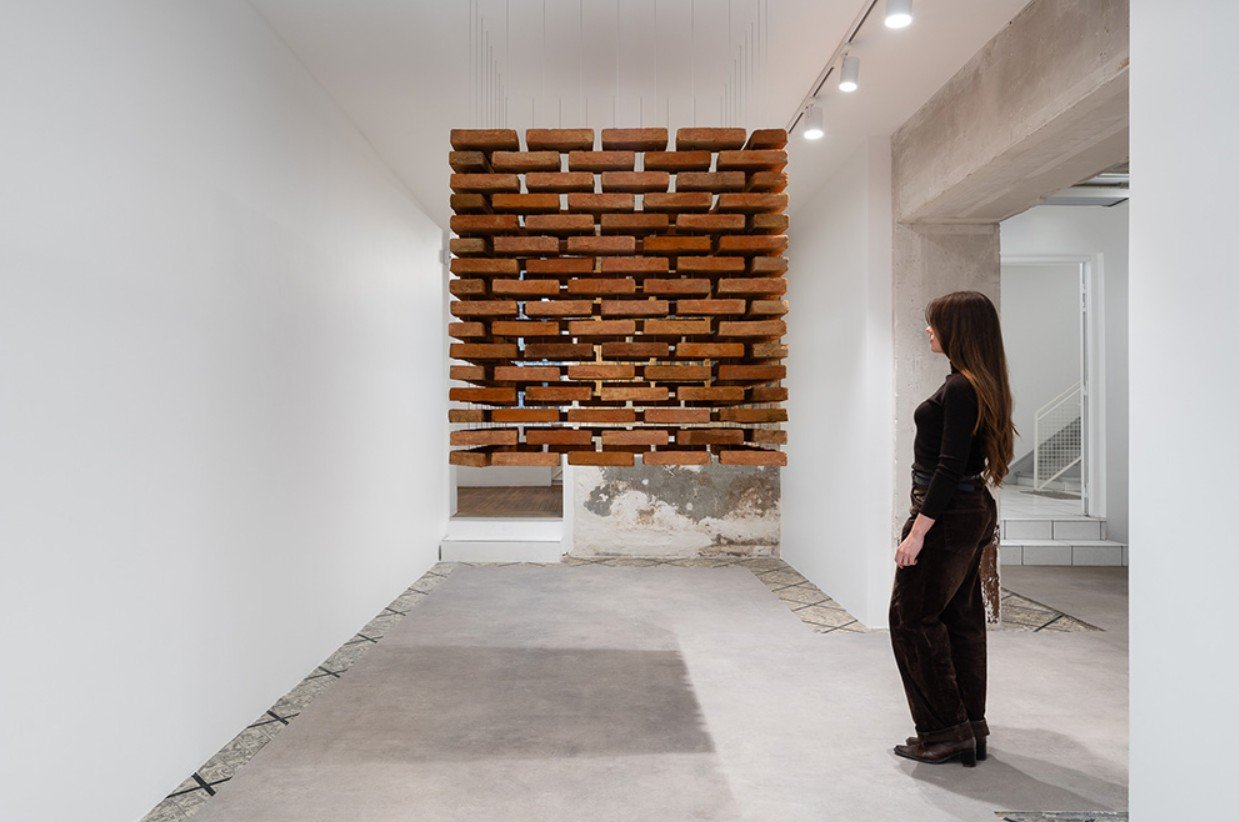
Throughout the exhibition, dialogues multiply, echoing and mirroring one another across the works. L'espion, a cubic structure made of bricks, invites the viewer to enter and observe the exhibition from an apparently protected vantage point. Through the floating bricks, one can spy on the surrounding space in a voyeuristic and intimate act. Yet this position reveals itself to be illusory. The work operates like a panopticon an 18th-century ideal model of surveillance that allows those in power to observe without being seen. Here, however, while spying, one becomes the object of sight. The see-through walls and the visible lower part of the body expose the observer, exploring the dynamics of power and transforming surveillance into vulnerability.
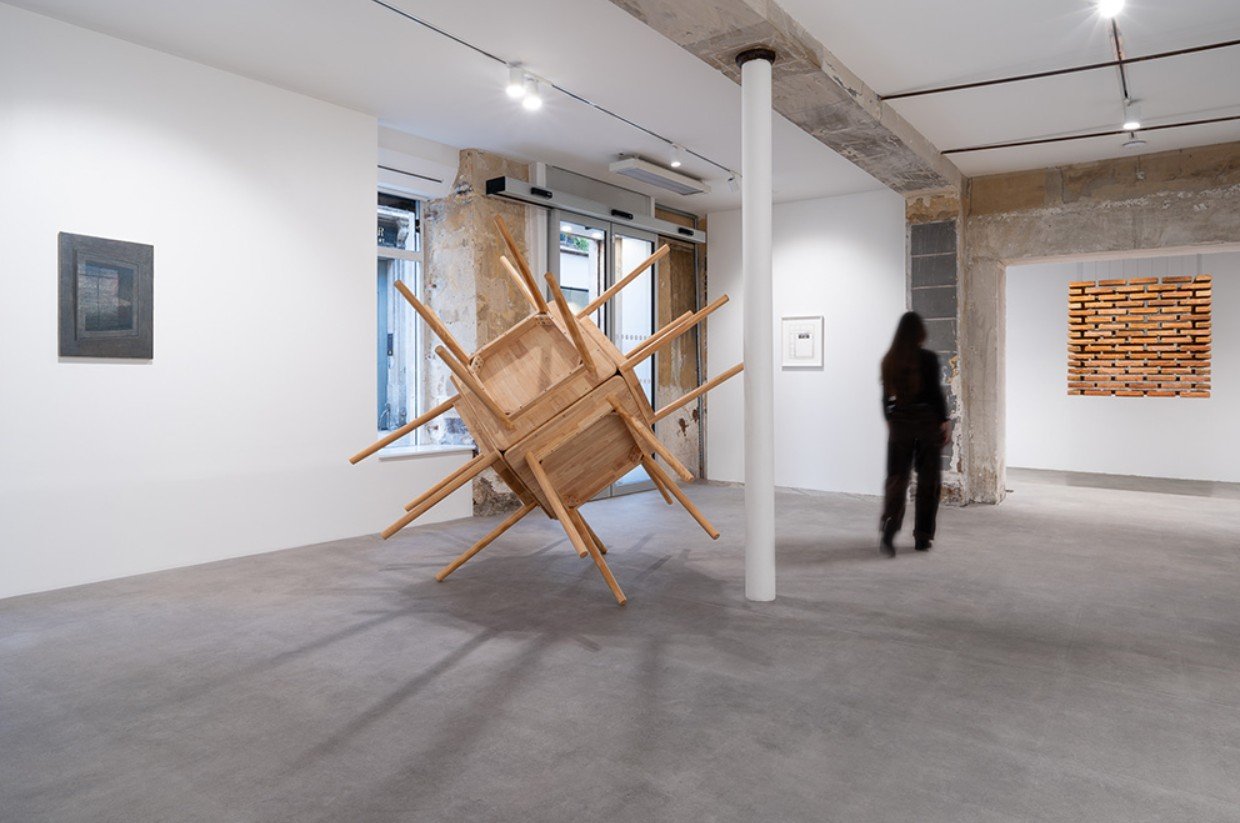
At the center of the space, Sur la table
presents a sculptural enigma structured around an invisible core. Six identical tables interact in such a way that what should be "on the table" remains concealed. The work rests on only three legs and maintains a deliberately unstable balance, highlighting the tension between what physically supports its stability and what, on a conceptual level, remains absent and inaccessible. Here resonates a subtle echo of Michelangelo Pistoletto's Metrocubo d'Infinito (Cubic Metre of Infinity), resonates here, suggesting infinity not through volume, but through what cannot be accessed.