JR: KALEIDOSCOPE
GALLERIA CONTINUA is pleased to present 万花筒/ Kaleidoscope, the first solo exhibition in Beijing, China, by the French artist JR, who for over twenty years has been transforming the architecture around the world into spaces of vision, public engagement, and collective imagination.
November 18, 2025 – March 03, 2026
The exhibition brings together a selection of JR's most emblematic projects from around the world, including his optical illusions, monumental pastings, and participatory public installations. Each image and installation functions like a fragment in a "kaleidoscope," interacting with the others to create a grand poetic dialogue between his public art and iconic public architecture, reshaping our perception of urban space. The exhibition highlights how JR treats architecture not as a frame, but as a living interlocutor-a body that breathes, opens, wounds, and heals through shared observation. His works reveal the power of imagery to redefine the relationship between reality and representation, memory and contemporaneity, suggesting that architecture itself can become an important medium to narrate the present moment.
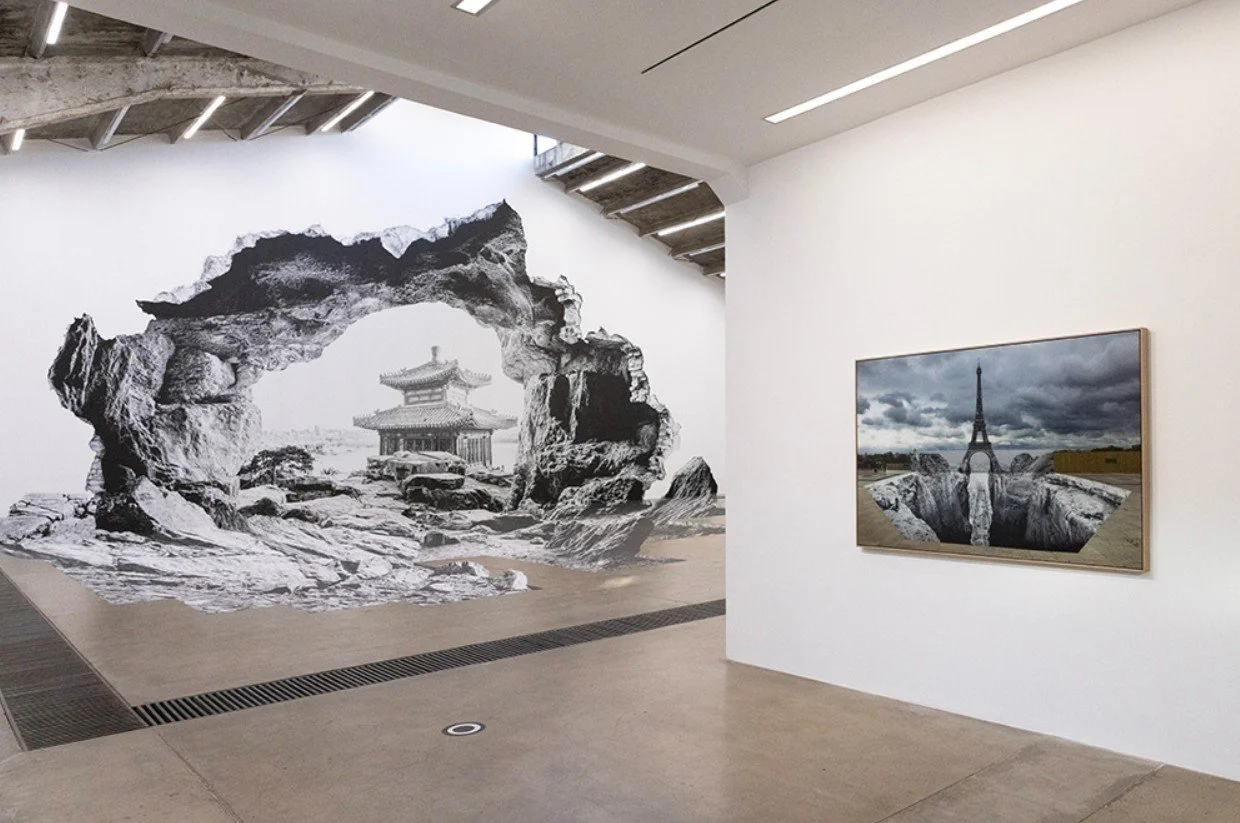
At the heart of the exhibition stands a monumental, site-specific anamorphic installation,通往颐和园之径/ The Pathway to the Summer Palace. The gallery floor appears to fissure open, creating a passage that cuts through the wall and gradually reveals the image of a pavilion from Beijing's Summer Palace. Its optimal viewing point aligns precisely with the actual geographic direction of the historic site. By weaving together the immediacy of contemporary artistic experience and the timeless resonance of an ancient civilization, the installation transforms spatial perception into a contemplative, immersive journey.
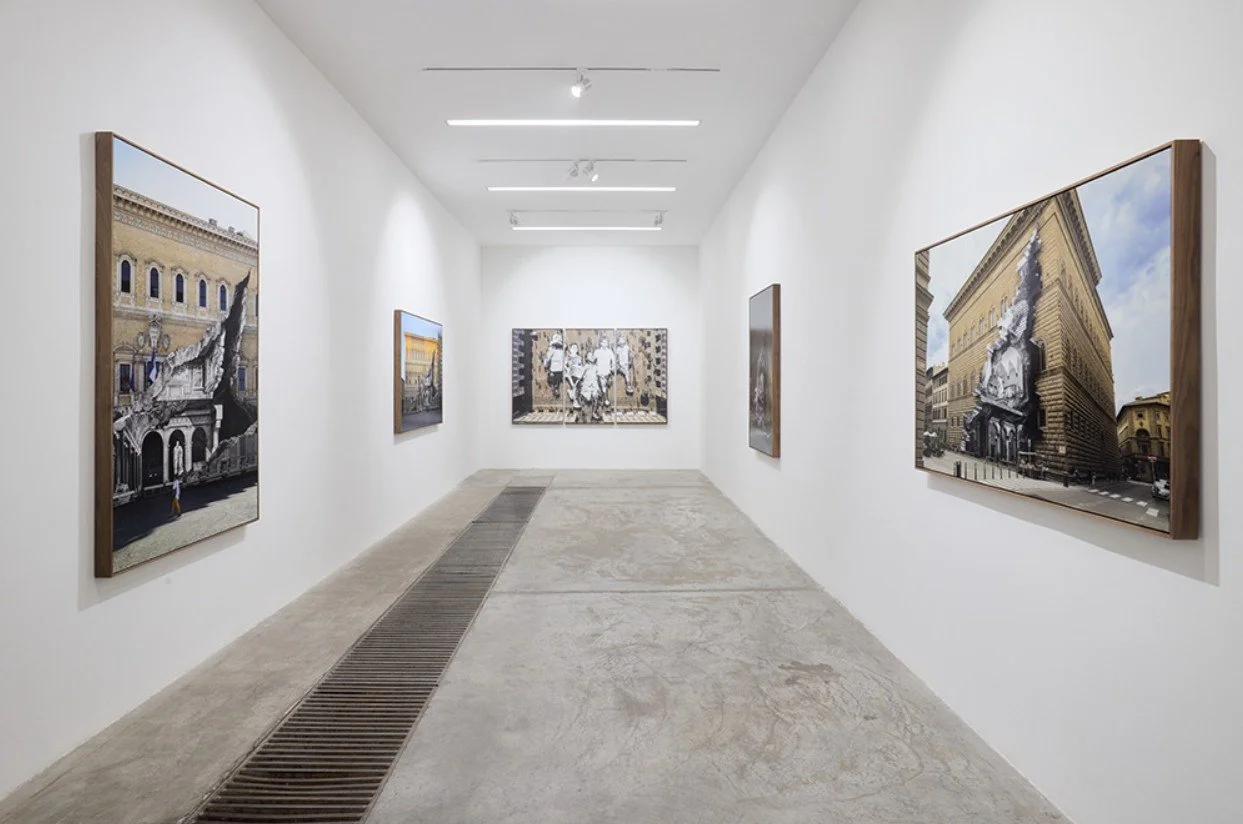
On the ground floor, visitors encounter a sequence of works that reinterpret some of Europe's most iconic façades through trompe-l'œil illusions. These includes Punto di Fuga at Palazzo Farnese, Rome, where a surface exceeding six hundred square meters is transformed into layered perspectival illusions, evoking the the spirit of the Renaissance and inviting reflection on its heritage through a new frontal perspective; La Ferita at Palazzo Strozzi, Florence, where the crack on the façade reveals glimpses of the palazzo's inner courtyard and some of the city's iconic artworks, turning the image of a wound into a symbol of cultural vulnerability during the pandemic; and Les Falaises du Trocadéro in Paris, where the esplanade at the foot of the Eiffel Tower transforms into a fictitious abyss, inviting visitors to reconsider the visual and symbolic relationship between monuments and the urban landscape.
In dialogue with these architectural visions, the series Déplacées expands the reflection on space as a place of welcome. JR produces large-scale portraits of refugees and displaced children, installed on banners. carried in procession by hundreds of people through the streets of various cities. Viewed from above, these vast images of collective human figures make the displaced visible once again, conveying a powerful sense of hope and solidarity.
On the first floor, the three exhibition halls feature works in various forms that testify to JR's poetic yet strategic relationship with paper. He treats paper both as a medium for transformation and a vehicle for storytelling. It captures the pulse of urban life-magnifying or fragmenting it-and becomes a bridge between JR's artistic language and public space. The central hall showcases a series of plaster works titled "Paperblocks". Among them is Omelia Contadina (San Gimignano, 2020), a project created with director Alice Rohrwacher, enacts a symbolic "farmer's funeral": villagers carry giant portraits as they process through the fields, using their bodies to speak for the land. This solemn and poetic farewell ceremony honors the increasingly fading traditions of agriculture.
One of the side halls presents the project La Nascita (Milan, 2024). JR overlays the rocky façade of mountains excavated to build the Simplon passage onto Central Station. A deep fissure opens across the station's façade, inviting reflection on the station's history of grandeur and hardship, as well as the unstoppable human impulse for exploration, exchange, and migration. It is also a reference to JR's project on the Venice-Simplon Orient Express. The other side hall shows Greetings from Giza (2021), in which JR places a trompe-l'œil in front of the Pyramid of Khafre, reconstructing its visual alignment as if it were an open postcard in real space. The illusion plays with scale and perspective while questioning the symbolic continuity between ancient architecture and today's gaze, subtly altering perception without changing the pyramid's material reality.
On the top floor, the exhibition concludes with a selection of emblematic, nostalgia-laden. works presented on raw wood. Here emerges The Wrinkles of the City, a project JR developed in cities worldwide to document the "wrinkles" of both humans and architecture-traces of time inscribed on façades and faces. From Cartagena (2008) to Shanghai (2010), Los Angeles (2011), Havana (2012, in collaboration with José Parlá), Berlin (2013), and Istanbul (2015), each stop intertwines the memory of buildings with the lived experience of their inhabitants, transforming urban surfaces into sensitive archives of stories and gazes.
The exhibition ultimately demonstrates the universal reach of JR's work, which unites architecture, community, and image into a singular language. His works do not merely occupy space: they open it, revealing both its vulnerability and its strength, transforming collective vision into constructive material.