PETER SAUL: PETER SAUL’S ART HISTORY
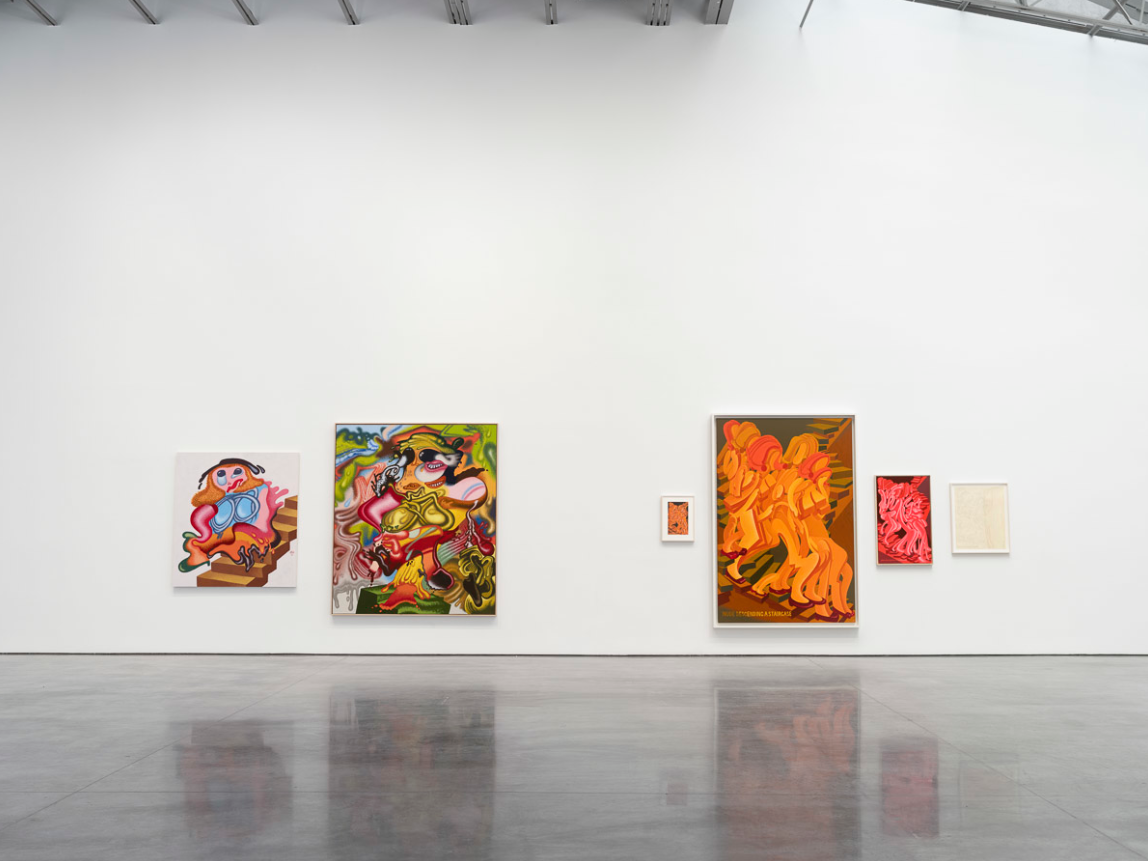
GLADSTONE GALLERY presents an exhibition of 20 new and historic works by Peter Saul, spanning seven decades of the artist’s narrative practice, with many on view for the first time. Saul’s oeuvre has been distinguished by an unflinching resistance to convention, embracing vivid color and a sharp, often satirical approach to subject matter with formal rigor.
March 7 — April 18, 2026
The thematic survey, titled Peter Saul’s Art History, marks his first exhibition with the Gallery since joining its program in 2025, and centers on an ongoing exploration of works by renowned 20th-century artists Salvador Dalí, Willem de Kooning, Marcel Duchamp, and Pablo Picasso.
Declared "one of the most important formalist painters" by fellow contemporary artist Mike Kelley, Peter Saul began to explore the idea of making new versions of Modernist classic paintings in the late 1970s. Anchoring the exhibition is a monumental reinterpretation of Picasso's Guernica (1937), one of the most significant political paintings of its time. Rendered in response to the Nazi bombings of the Basque town of Guernica during the Civil War, Picasso's masterpiece resurfaced after nearly four decades in public consciousness during the Vietnam War, remaining a powerful symbol of protest and resistance. Deeply disturbed by the state of the political climate, Saul completed Little Guernica "Liddul Guernica" in 1973, reimagining Picasso's anti-fascist iconography in his own visual language. Reflecting on the process, Saul recalls, "I painted a picture of Picasso's Guernica, but after a while I felt it was a little too tame, so I painted Guernica 2, which is more cartoony and has a 'worse,' less respectful attitude towards anything artistic than previously." The work pays homage to the political urgency of Picasso's original while asserting Saul's distinct satirical flair and will be on view for the first time in 40 years at Gladstone.
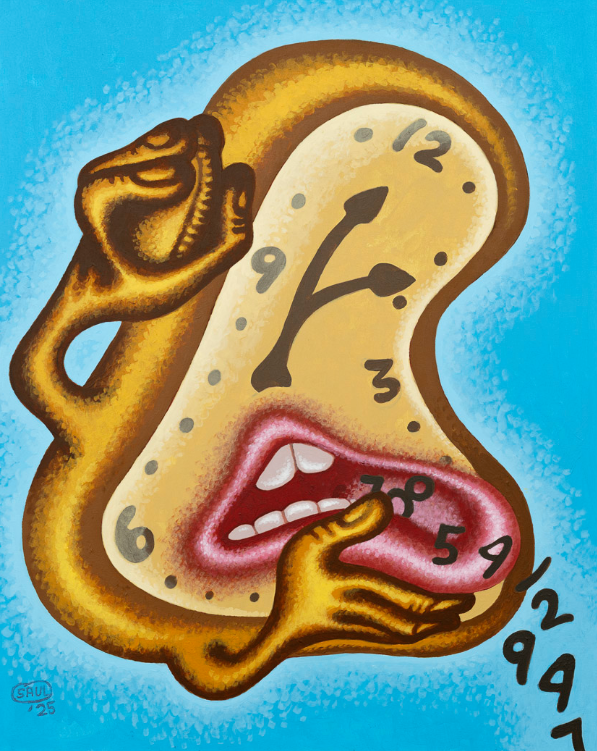
Saul continues this practice of reinterpreting masterpieces while challenging the conventional rules of art history. In addition to the historic 1973 work, the survey exhibition represents the artist's return to this subject matter with a group of new paintings and preparatory drawings. Saul reimagines Duchamp's Nude Descending a Staircase, No. 2 (1912), reworks de Kooning's Woman / (1950) and Woman and Bicycle (1952-53), and Dali's The Persistence of Memory (1931). He carefully selects his subjects, and these artworks are no exception. While Saul's homages to Western art history may seem like simple flexes in technical proficiency, they each reflect a deeply nuanced understanding and criticism of 20th-century history and its heroes.
"Peter Saul reveals the lie of the dominant painterly theories of compositional order of his period. Compositional foregrounding, abstract motivation, is a game that renders signification, and thus moral readings, meaningless. Yet Saul does this in an overtly desublimated, unapologetic way. In Saul's hands formalism, the exemplary 'socialized' mode of aesthetic production at that moment itself is rendered as a cruel, dehumanizing practice-yet he partakes in it."
-Mike Kelley, Artforum, 2002
About Peter Saul
Peter Saul (b.1934, San Francisco, California) attended the California School of Fine Arts in San Francisco, and the Washington University School of Fine Arts in St. Louis. In 2020, the New Museum of Contemporary Art mounted "Peter Saul: Crime and Punishment," the first retrospective of Peter Saul's work in New York. In 2019, les Abattoirs, Toulouse presented "Peter Saul: Pop, Funk, Bad Painting and More," a major retrospective of Saul's work, which traveled to Le Delta in Namur, Belgium. His work has been the subject of numerous international solo presentations, including recent exhibitions at the Deichtorhallen Hamburg; the Schirn Kunsthalle, Frankfurt; and The Arnold and Marie Schwartz Gallery Met, Metropolitan Opera House, and Lincoln Center, New York. Saul's work is frequently featured in major group exhibitions at institutions both stateside and abroad, including recent presentations at the Crystal Bridges Museum of American Art, Bentonville; The Met Breuer, New York; the Whitney Museum of American Art, New York; the Musée d'Art Contemporain, Marseille; the National Centre for Contemporary Arts, Moscow; MoMA PS1, Long Island City; and the Wexner Center for the Arts, Columbus. His work is held in the permanent collections of numerous public institutions, including the Art Institute of Chicago; the Berkeley Art Museum and Pacific Film Archive; the Carnegie Institute, Pittsburgh; the Centre Georges Pompidou, Paris; the Dallas Museum of Art; the Los Angeles County Museum of Art; the Metropolitan Museum of Art, New York; Moderna Museet, Stockholm; the Museum of Modern Art, New York; the San Francisco Museum of Modern Art; the Smart Museum of Art at the University of Chicago; the Smithsonian American Art Museum, Washington, D.C.; the Stedelijk Museum, Amsterdam; the Yale University Art Gallery, New Haven; the Walker Art Center, Minneapolis; and the Whitney Museum of American Art, New York. In 1993, Saul received the John Simon Guggenheim Memorial Foundation Fellowship. In 2008, Saul received the Artist's Legacy Foundation Award. In 2010, Saul was elected to the American Academy of Arts and Letters. Peter Saul lives and works in New York City and Germantown, New York.