
GUSTAV KLIMT: WOMEN
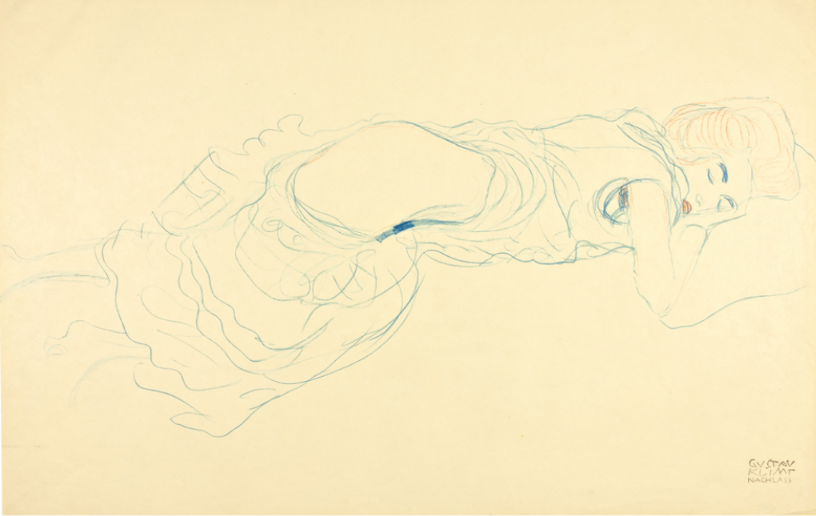
GLADSTONE and Richard Nagy Ltd. present Women, an exhibition of studies and drawings by Gustav Klimt.
May 15 – June 17, 2026
Both sublimely sensual and modern, the exhibition is an overview of Klimt’s mature style of drawing, one that owes more to the Austrian artistic movement Jugendstil than the academic. Notably, Klimt’s extensive collection of erotic drawings, which sparked controversy both during his lifetime and after, remains a significant aspect of his oeuvre.
Today, the preparatory drawings related to his paintings are regarded as some of Klimt’s finest works. The start of the exhibition is a study for the Beethoven Frieze (1902), a turning point between his academic work and his mature period. It was at this time, circa 1902/03, (the so-called golden style), when Klimt began producing drawings not necessarily linked to his paintings, allowing them to be appreciated as standalone works of art. By 1905, his drawings evolved further, and he began to use a refined Japan paper of slightly larger dimensions, seen in Reclining Semi-Nude Lying on Her Front (1910).
Klimt’s late period, beginning around 1912, is characterized by bolder lines, daring perspectives, and an intensified focus on physical and psychological expression — particularly in his studies of the nude. His genius as a draughtsman lay in his ability to convey a striking immediacy through minimal yet expressive lines. The power of his drawings stems, in part, from their complete spontaneity.
While his paintings epitomised Jugendstil, his drawings possess a modernity that transcends their era and speaks to us in a contemporary voice, seen in Reclining Nude to the Right, with. Right Knee pulled up (circa 1912) and Reclining Nude with Splayed Legs circa (1913
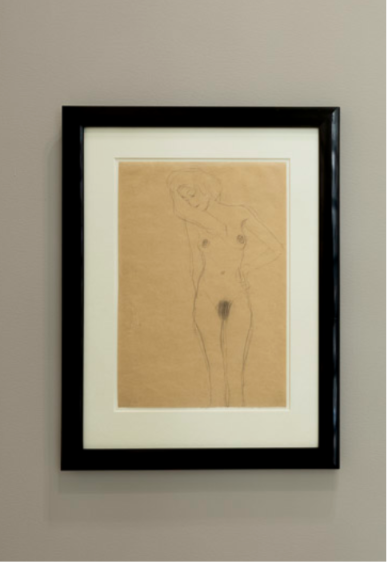
Notably, his extensive collection of erotic drawings, often controversial both during his lifetime and beyond, remains a significant facet of his oeuvre. Klimt’s faculty paintings, intended for the University of Vienna, provoked public outcry, leading to their rejection. Today, the related preparatory drawings are regarded as some of his finest works, including Study for Jurisprudence, (1902).
As a financially independent artist, Klimt had the freedom to devote time to drawings he never intended for public display. Few of his drawings were exhibited during his lifetime, which include his erotic works. They are frank and unpretentious, lacking the detachment seen in Toulouse-Lautrec’s works. He had a unique rapport with his models, who often were lovers and therefore at ease in his presence. He saw no part of the human body as shameful or ignoble.
Over a century after his death, numerous exhibitions have illuminated this deeply private side of Klimt, often subjecting his work to fashionable critiques and pop-psychological interpretations. Nevertheless, to fully grasp the essence of the artist and his legacy, one must consider not only his celebrated paintings but also his preparatory sketches and private drawings.