JANA EULER: THE CENTER DOES NOT FOLD
GREENE NAFTALI is announcing Jana Euler new exhibition, The center does not fold.
Through January 10, 2026
The center does not fold suggests that clear endpoints or extremes of any kind cannot be folded into a single center. Yet an abundance of variations can extend far beyond those obvious limits. In the act of painting itself, this unfolding occurs naturally: a single painting can give rise to any number of versions that ultimately find their place on the wall. There is an infinity in an unfolded center.
This exhibition of mine consists of very different paintings. What they share is not so much their style or technique, but an investment in recurrence. Throughout this new body of work, motifs and protagonists invented previously reappear—rethinking themselves, amplifying certain traits, or generating new outcomes.
Before entering the gallery, two paintings are visible through the large windows at street-level: a pair of familiar subjects, reconceived or transformed for this new context and present tense. To one side is a work called Where the energy comes from, connected. It is a portrait of a power outlet in this building, located behind the gallery desk. When I came for a site visit earlier this year, the gallery's Wi-Fi router was plugged into it. I liked the frightened eyes, the association of a pacifier it evoked in me, and the combination of the two: a picture that is plugged in, constantly connected yet very alone, staring fearfully into the exhibition space.
The idea of connection runs through the entire exhibition—connection with oneself, with others, or as the illusion of never being alone. The camera on the adjacent wall is also a variation of another painting: Camera becoming painting from 2024, which I showed in the exhibition Oilopa at WIELS in Brussels. In that earlier work, the camera lens was pointed at the viewer; now, the camera has been turned around and is painted from the photographer's perspective—moving away from somewhat paranoid notions of being observed to the responsibility of deciding what to photograph. It’s one way of thinking about the creative act, which was on my mind when preparing the exhibition—participation in that act, or envy of it, or the possibilities it opens up.
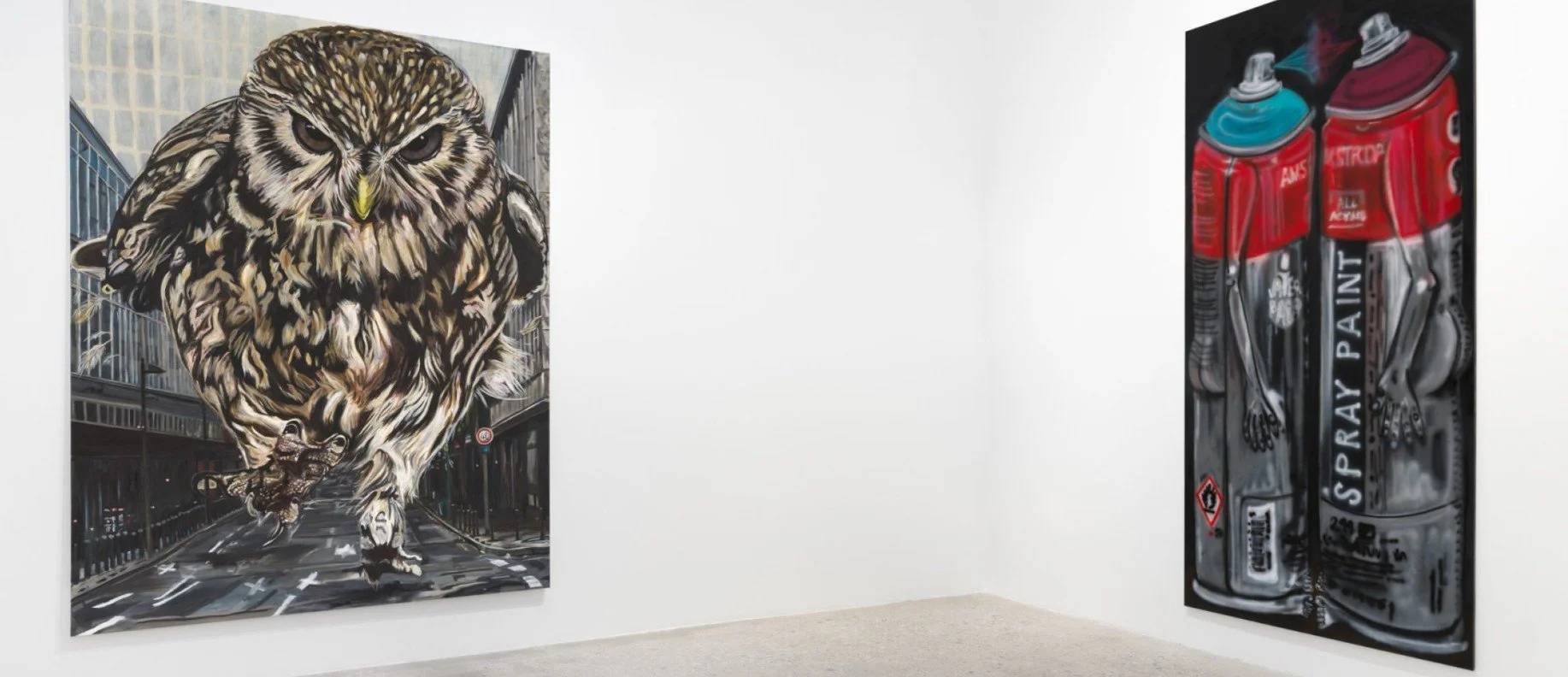
When you enter the main space of the gallery, an owl runs toward you from the end of a long corridor. The painting, On the way to the studio, shows the road I cycle along every day on my way to the studio. It is a fantasy of something so powerful in its attraction that it draws me there, and at the same time, the fear that it has already left before I arrive and is coming toward me with all its drive.
Unfolded Dollar is a new series of paintings that depict increasingly large dollar bills, unfolded. Here, the material fact of paper money becomes both motif and muse. I have tried to emphasize the painting itself as much as possible—how it is painted rather than what it represents. At times, the painting takes over, covering the folds of the paper. Infinity appears in an unfolded center.
In Dog Walking I draw on themes from my earlier work: the humanized animal, and a reversal of control and dependence. The painting’s style is determined by its subject. In this specific case I tried to paint the brushstrokes with a coldness and keep a distance to the source material that I used for assembling the image, in a way I assumed AI might have done it. As a result, the dog parading through the streets of New York is a composite of many dogs, including my cousin’s dog Mitra, who modeled for the middle part. A leash and a poop bag dispenser are shown—but who is being walked is left open to interpretation; and clearly, they are not obeying any traffic rules! I came up with this work using my own artificial intelligence, which—like the painting—might keep me on a rather short leash.

The multihorned creature in More Morecorns stems from my last exhibition in New York at Greene Naftali, The Traveling Legends of the Morecorns, in 2021. Then the fictional mythical creature appeared on its own, in more or less charged situations, grotesque with its long nose and many phallic horns that burst with individuality. Now two of them, painted with glittery pigments, unite in a creative act: they have left Route 66 and are walking while mating through the open countryside toward a cactus giving the middle finger. In More Morecorns, as in the Unfolded Dollar paintings, there is an idea of exponential and infinite growth––both of which I consider impossible and the focus on them senseless.
The theme of horse-like creatures continues. The fantasy of a highly potent creative act with little participation of human mankind, and the sheer multitude of packages that fly back in return is the self-explanatory title of another painting, which reveals itself to be an illustration of the reality described. Many of the works on view deal with the paradigms of making art. How does the muscle memory of past ideas end up producing new ones? When is the creative act as such conceived, and how does it feel to perceive it from the outside?