
PHILIP GUSTON: LIFE WITH P
HAUSER & WIRTH presents ‘Life with P.’ illuminates intimate and rarely observed aspects of Philip Guston’s art.
April 21 – July 10, 2026
The groundbreaking 20th century master is best known his for raw, painterly explorations of sociopolitical power and sobering inspections of human nature. This exhibition will showcase a selection of Guston’s more intimate paintings and works on paper in which the artist ruminates on his marriage to poet Musa McKim and their lives together in Woodstock. Among works on view will be a collection of Guston’s ‘Poem Pictures,’ drawings that respond to his wife’s poetry, as well as three large-scale figurative paintings that have never been shown in a gallery or museum before.
The presentation coincides with the release of a new book from Hauser & Wirth Publishers by the same title. ‘Life with P.’ is an illustrated compilation of Musa McKim’s previously unpublished journals from 1966 – 1976, edited and contextualized by the couple’s daughter, Musa Mayer.
During the mid-sixties, Guston was intently focused on his drawing practice, putting his painting aside to devote himself to the exploration of spare line and form between 1966 and 1967, resulting in what he referred to as his ‘pure drawings.’ Following their move from New York City to Woodstock in 1967, the couple’s artistic focus turned increasingly toward the pleasures and symbolic charge of the everyday. In their rural seclusion, ordinary objects assumed an intensified presence, becoming sites of scrutiny and exchange. And Guston’s drawings began to take on the quotidian sensibility that animated many of McKim’s writings, in works such as ‘The Leaves Have Turned’ and ‘Awakened by a Mosquito’ (c. 1972–1975). It was also during this period that Guston began to paint a series of deliberately simplified, yet unmistakable, images of books, bricks, furniture and license plates that would eventually appear on his canvases.
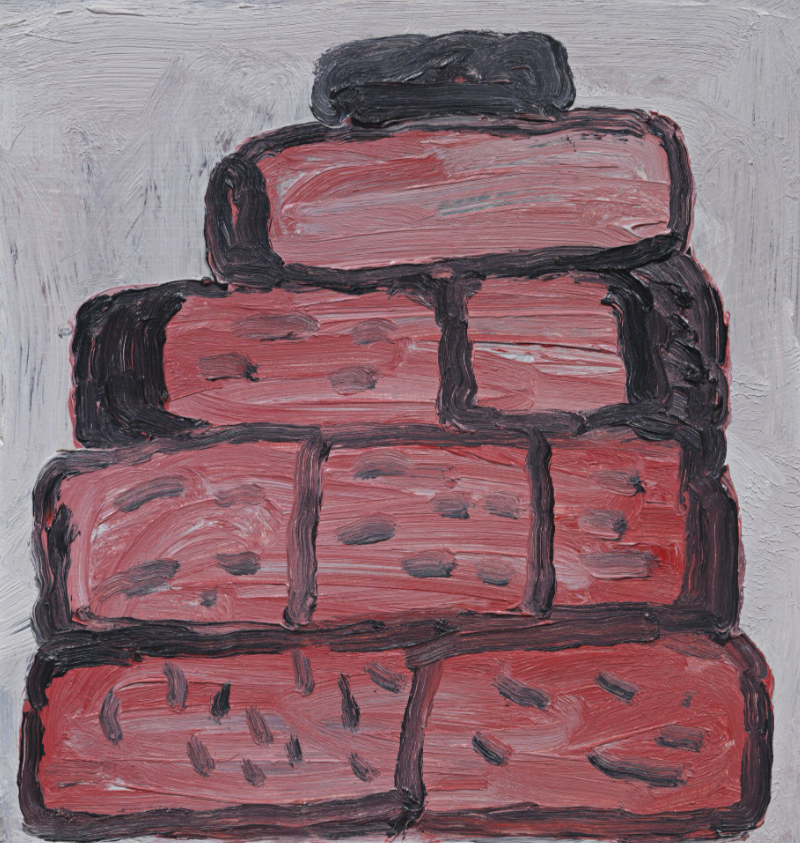
These prosaic and emblematic motifs crystallized into a private lexicon that undergirds Guston’s late figurative work. For both artists, the domestic sphere functioned as a shared field of perception, a space in which looking became a mode of knowing. As McKim observed in 1969, ‘I always automatically notice the table in the kitchen, the counters, and stove, to see what P.’s been up to, what he’s been eating, reading, etc.; he does the same with me, he says.’ In an untitled drawing from 1975, depicting the top of McKim’s head looming over an open book, Guston renders such a scene of wordless understanding.
Family was not a new subject for Guston, as evidenced by an abstract painting on view titled ‘The Three’ (1964). By 1972, his art had become even more autobiographical. The works made during his time in Woodstock are uniquely rich in their personal iconography and emotional vulnerability, picturing tender scenes of togetherness between the artist and his wife and child, alongside images drawing on his fears related to aging and mortality.
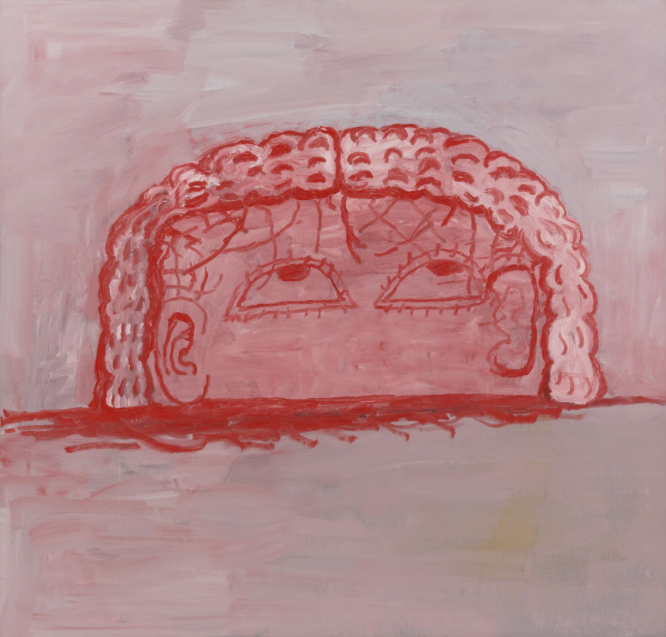
In three paintings exhibited together for the first time, Guston renders their marriage symbolically. Two wounded, limp hearts stand in for the couple in ‘Two Hearts’ (1978). In ‘Blue Cover’ (1977), they reappear as block-like bodies, bound together within the confessional intimacy of their shared bed, while McKim is distilled into a near-caricature of curly hair and large eyes that gaze upwards contemplatively in ‘Untitled’ (1976). Reflecting on the paintings made during this period, Guston wrote: ‘There is nothing to do now but paint my life; my dreams, surroundings, predicament, desperation, Musa—love, need.’