
IFEYINWA JOY CHIAMONWUM: ANUSCRIPTS OF TRADITION
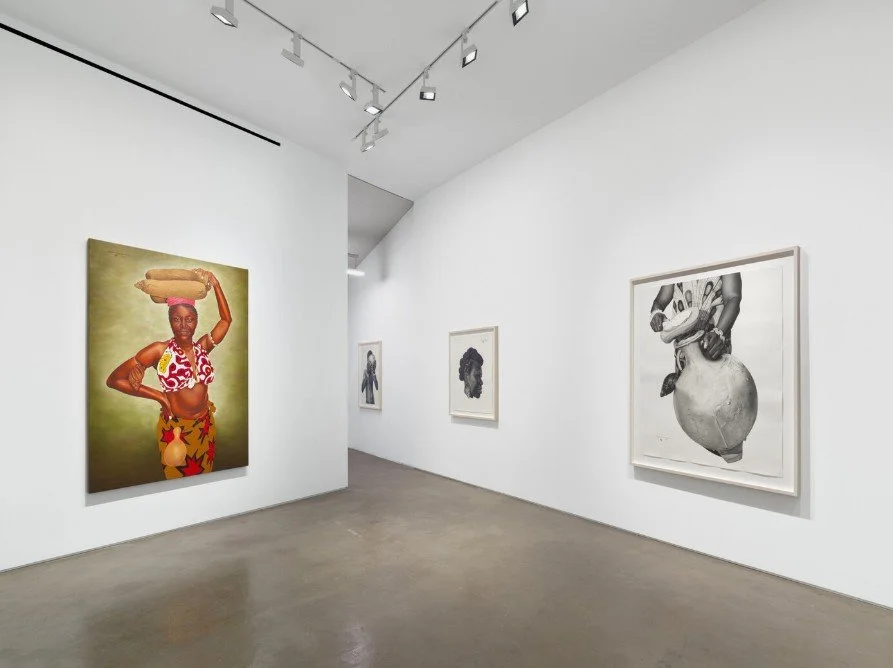
JACK SHAINMAN GALLERY is pleased to announce Manuscripts of Tradition, an exhibition of new work by Ifeyinwa Joy Chiamonwu, the artist’s second solo presentation with the gallery.
February 20 - March 28, 2026
Bringing together works on paper and paintings in oil, the exhibition sees Chiamonwu continuing her engagement with the Igbo community in which she was raised in the Anambra state of Nigeria while exploring the contemporary relevance of its cultural and mythological forms. Alongside this continuity of subject matter is Chiamonwu’s broader emphasis on the social and political implication of representation itself, as she understands these works as necessary counterpoints to stereotypes about Africa and the great diversity of people that live on the continent. Manuscripts of Tradition will be the first solo exhibition held at 346 Broadway, the gallery’s newest space allowing for focused presentations of innovative and significant work.
Chiamonwu’s depiction of her Igbo community has for years been a pillar of her art, as she grounds her paintings in the most intimate spaces of her life. Earlier works took the community—its youth and elders, its symbols and rituals—as a stand-in for the complexity of life in Africa while at the same time preserving the importance of local custom and identity. In portraits rendered with exacting detail and bold, graphic color, Chiamonwu transformed those familiar to her, from family members and friends, into deities and mythological figures. This transmutation of the familiar into the eternal represented her attempt at universalizing her subjects, seeing them as being emblematic of what is enduring and miraculous within the contingency of everyday life.
In her new works, Chiamonwu has continued to use those closest to her as the models for her paintings, though rather than elevate them to the realm of myth they retain their marks of Igbo identification. The joy and self-assurance evident in the faces of her sitters, coupled with the vibrancy of color and sharp, vividness of form overall, is a testament to Chiamonwu’s desire to portray her community as one that is flourishing while it continues to maintain connections to its past. In contrast to so many popular portrayals of the African subjects as being impoverished or underdeveloped, Chiamonwu puts forward a style of representation that is both confident and celebratory, one that appreciates the inherent value of this world rather than comparing it to western standards.
Chiamonwu’s work has been defined by the striking verisimilitude of her forms, from portraits to still-lifes and architectural spaces alike. Her figures have so often seemed multi-dimensional in spite of their two-dimensional reality, with artifice giving way entirely to illusion. In these new works—whether in acrylic, oil or charcoal—Chiamonwu has begun to juxtapose the hyperreality of her forms with more expressionistic spaces surrounding them, where brushwork is visible and atmosphere is paramount.
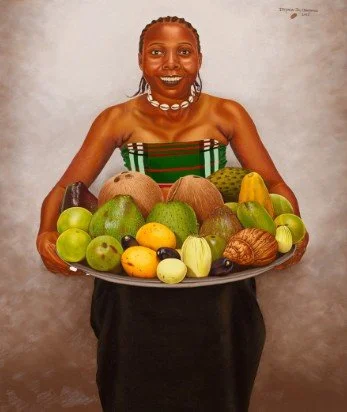
In “Nwanyi Mkpulu-Osisi” (The Fruits Woman) (2025), an overflowing plate of fruits and vegetables is carried towards us by a generous woman proud of the abundance in her hands. The sea shell at the edge of the plate that just nearly comes to the edge, signals an Igbo ritual of intergenerational connection, as these objects are passed down through time. The precision of these various forms unfolds against an evocative, nearly monochromatic background of grey and white, where Chiamonwu allows her hand to remain visible on the surface of the canvas. The portrait “Adaudo” (Daughter of Peace) (2025) depicts a woman gazing past us beyond the frame of the work, with the background behind invoking the architecture of Igbo homes.
At the heart of Chiamonwu’s artistic project has always been a celebration of the Igbo heritage that shaped her. Throughout Manuscripts of Tradition she transforms the familiarity of her immediate world into archetypal forms, ones capable of challenging both stereotype and cliche.