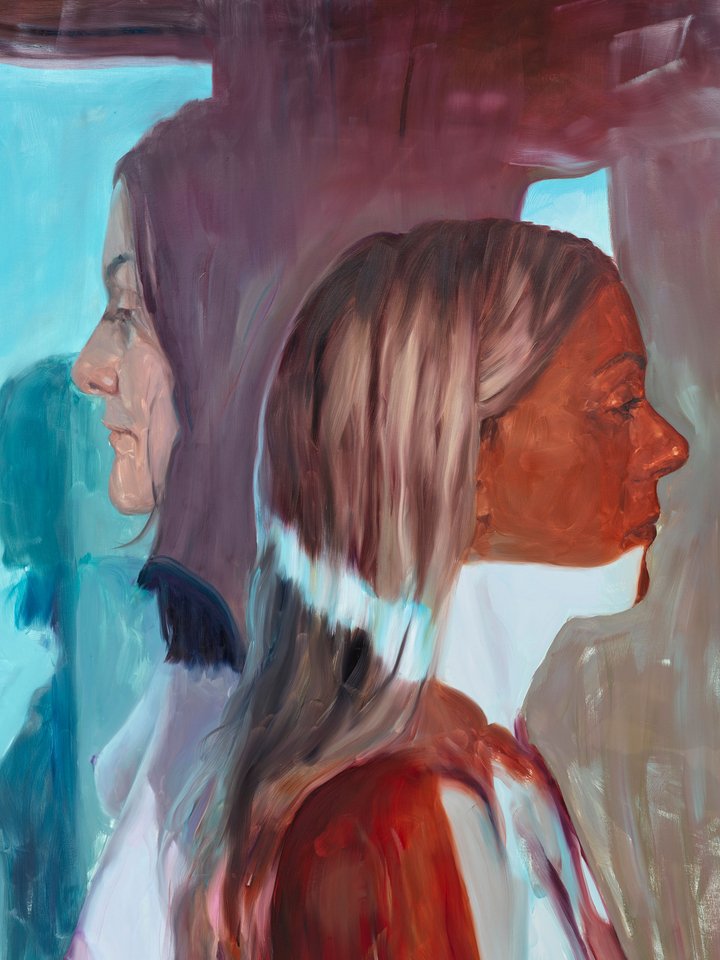
Janus, 2026
David Kordansky Gallery is pleased to present Projections, an exhibition by Jenna Gribbon, in New York.
November 6 – December 19, 2026
Gribbon’s paintings probe the complex interrelationships between looking and performing, between the tangled psychoscape of a romantic relationship and its everyday expression. The larger paintings in Projections constitute an evolution of a series in which the artist creates layered, often borderline-surreal scenes by using a projector to stack photographic images onto each other and onto figures that are physically present in the studio. In these newest works, she turns to the familiar figure of her wife, posed in profile or face-on, lit in glowing projected color.
In the largest paintings on view, layered images of the couple take on mythical personas, their melded figures standing in for the hybrid monsters that populate ancient stories. The nude profiles of Gribbon and her wife repeat into the distance in Artemis of Ephesus (2026), evoking the titular many-breasted goddess; elsewhere their layered forms suggest the feared figure of the harpy or the two faces of Janus. These two-body manifestations of mythical narratives confront the prevalent idea of merging identities within lesbian relationships, directly approaching Gribbon’s own discomfort with the trope by literalizing the stereotype. Images of the two women converge and resolve throughout the series, as if negotiating their identities both separately and together.
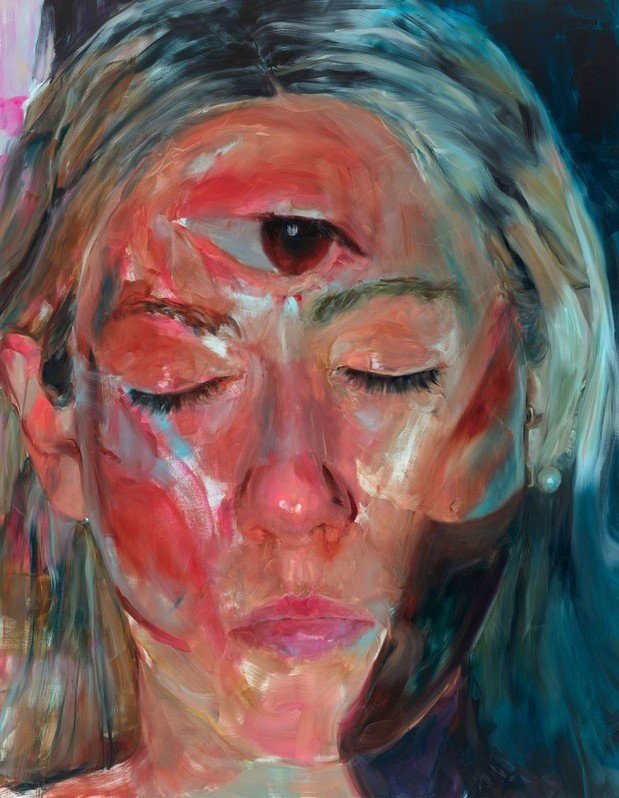
Steropes, 2026
The intensity of light in the projector paintings builds upon a longstanding interest in the manipulation of both natural and theatrical lighting. Gribbon plays with the color and illumination of the projector to create a kind of fantasy space within these canvases, one that is often spatially disorienting and psychically charged. The medium-sized paintings playfully riff on the theme of sight—insight, hindsight, etcetera—by foregrounding the expanded sense of vision afforded their subjects, placing the eyes of projected figures on a forehead or posterior cheek. Through this playful rearrangement and layering of the organs of sight, Gribbon visualizes the extension of vision that comes from the added perspective of the other person.
The projection paintings are accompanied by a series of small works that bring the exhibition out of the realm of spotlit fantasy and back into reality. These documentary-style paintings capture discrete moments or interactions from Gribbon’s domestic life: her wife gesturing mid-sentence, a kitchen table strewn with everyday objects. Here we see the real-world counterparts of the powerful id manifested by the mythical merged figures of the projector paintings. Like the larger works, these are lit by a strange and intense light, which, though natural, results in strong contrasting areas of light and dark akin to the effects of the projector. It is as if we the viewers have stepped back through the looking glass, and the monsters that haunted our dreams are once again just people we know.