GROUP EXHIBITION: COLLECTIONS
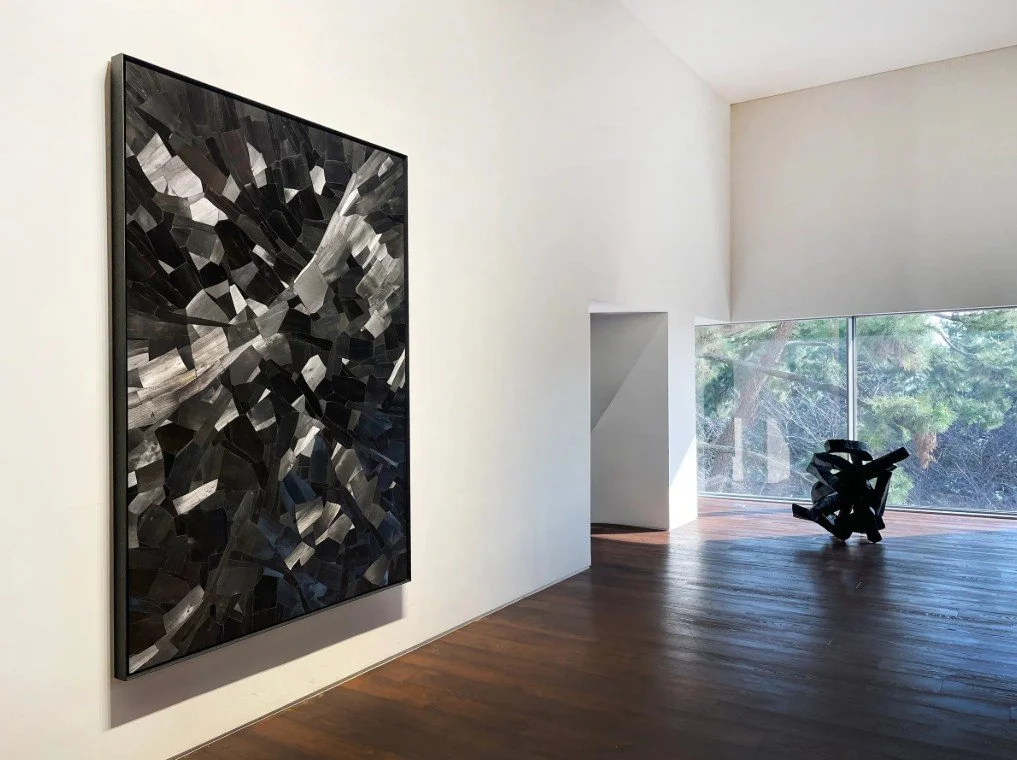
JOHYUN GALLERY is pleased to present a group exhibition, Collections.
January 20 – March 10, 2026
Chung Chang Sup (1927 - 2011)
Chung Chang-Sup, a first-generation master of Post-war Korean contemporary art, pursued a sense of beauty and identity in Korean art through the use of abstractness and Hanji paper. Starting with the 'Informel' art movement and progressing into the 'Monochrome' movement, he steadfastly incorporated Hanji paper into his artistic process. His artworks resonate with echoes of Korean tradition while establishing his unique artistic domain. He perpetually explored the harmonious combination of heterogeneous elements, bridging the traditional and the modern, the East and the West, and the intangible and the tangible. In his art, shapeless frames and hues of yellow, black, and adzuki bean gruel create a profound sense that many years have passed, enveloping viewers in absolute silence and captivation. The Korean traditional mulberry paper work developed from the 1970's series 'Et' which means ' Return', to a series which consists of tapping and shaping of soaked mulberry paper onto a canvas, which was called 'I#' meaning 'Tak', in the 1980's. Following the tions sucha ches destina turns, ta te hi and in eit aio, so exiliterai 965, ando part insertial rena extentions on Korean art history. In 2010, there was a large-scale retrospective at the National Museum of Modern and Contemporary Art, Gwacheon, South Korea. Currently, his works are in the collections of reputable art institutions, such as National Museum of Modern and Contemporary Art, Korea, Gwacheon, South Korea; Seoul Museum of Art, Seoul, South Korea; Leeum Museum of Art, Seoul, South Korea; Tokyo Metropolitan Art Museum, Tokyo, Japan; M+ Museum, Hong Kong, China; and Guggenheim Abu Dhabi, Abu Dhabi, United Arab Emirates.
Yun Hyong-keun (1928 - 2007)
After enduring Japanese colonial rule and the Korean War, Yun Hyong-keun began making art in earnest at forty-five. His works-created by applying a mixture of ultramarine, symbolizing the sky, and umber, signifying the earth, onto raw canvas or hemp cloth—are profoundly simple and modest from process to result, eliminating artifice and technique. Embodying the artist's pursuit of harmony between life and art, his canvases are spirited yet humble, simplet traditional akstetic entre smiater hine of ensemportay ania, our established airseras a represent tre fatre the kites Dansaekhwa on the global stage. His solo exhibitions have been held at the Judd Foundation in New York, the Chinati Foundation in Texas, Palazzo Fortuny in Venice, Hastings Contemporary in the UK, and the National Museum of Modern and Contemporary Art in Seoul. During his lifetime, Yun was invited to major international exhibitions including the São Paulo Biennale (1969, 1975) and the Venice Biennale (1995). His works are held in permanent collections at the National Museum of Modern and Contemporary Art, the Leeum Museum of Art, Tate Modern, the Solomon R. Guggenheim Museum, The Cleveland Museum of Art, Glenstone, and the Museum of Contemporary Art Tokyo.
Kim Tschang-Yeul (1929 - 2021)
Kim Tschang-Yeul devoted over 50 years to exploring the motif of water drops. His iconic droplets, appearing as if seeping through the canvas, transition from tangible presence to transparency, balancing wet and dry, light and dark. This meditative imagery bridges reality and abstraction, reflecting the artist's experiences with Korea's turbulent history, including colonization, war, and division, while offering universal themes of healing and catharsis. Kim studied calligraphy with his grandfather and painting with Lee Quede before graduating from Seoul National University. A leader of Korea's Art Informel movement with Park Seo-Bo and Chung Chang-Sup, he gained international recognition through the Paris Biennale (1961), São Paulo Biennale (1965), and Avant-Garde Festival (1969). A major retrospective of his water drop paintings was held at Galerie Nationale du Jeu de Paume in 2004. Kim's works have been featured in retrospectives at the Gwangju Museum of Art, Taiwan National Museum of Fine Arts, Busan Museum of Art, and the National Art Museum of China. In 2016, the Kim Tschang-Yeul Museum of Art opened in Jeju, Korea, ensuring his artistic legacy endures.
Park Seo-Bo (1931 - 2023)
Park Seo-Bo was a seminal figure in Korean contemporary art. He was one of the founding members of the Dansaekhwa movement, which emerged in the early 1970s post-war Korea and has since gained international recognition. In the late 19605, Park began the 'Ecriture' series by repeating pencil lines over wet monochromatic painted surfaces. Later, he expanded the language through the introduction of hanji (traditional Korean paper) and color. The work is brought into being through the process of repetitive actions of pasting, scraping, scratching, and rubbing. It delicately balances drawing and painting in a quest for emptiness through reduction. Park's work has been exhibited internationally, including: Museum of Fine Art, Boston, United States; the Venice Bina, Brook useum, em orA, nied Sales andrea; Sis, Morea, asa, Sinis work instale in, conti outrite selmen ol, United heim Museum, New York, United States; Mt, Hong Kong, China; Guggenheim Abu Dhabi, UAE; The National Museum of Contemporary Art, Seoul, South Korea; and the K20, Kunstsammlung Nordrhein-Westfalen, Düsseldorf, Germany.
Paik Nam June (1932 - 2006)
Nam June Paik, a pioneering media artist from South Korea, was born in Seoul in 1932 and passed away in the United States in 2006. His remains are interred in Seoul, New York, and Germany. Some of his major works include Moon is the Oldest TV (1965), TV Garden (1974), and Good Morning Mr. Orwell (1984). Despite suffering a stroke in 1996, which left him physically disabled, he continued to create and exhibit his work. In 2000, a major retrospective titled The World of Nam June Paik was held at the Guggenheim Museum, New York, United States, Rodin Gallery, Seoul, South Korea, and the Ho-Am Art Museum, Seoul, South Korea. Paik received numerous prestigious awards, including the Golden Lion at the Venice Biennale, Venice, Italy (1993), the Kyoto Prize, Kyoto, Japan (1998), the Goethe Medal, Germany (1998), and the Order of Cultural Merit (Geumgwan) from South Korea (2000). In August 1997, Capital, a German economics magazine, ranked him 8th among the world's top 100 artists. In 2006, Time magazine named him one of the Asian Heroes.