ALEXANDER WERTHEIM: FUGUE IN OXIDE
KÖNIG TELEGRAPHENAMT presents FUGUE IN OXIDE, an exhibition of new works by Alexander Wertheim. It is the artist’s second solo exhibition with the gallery.
June 13 – July 25, 2026
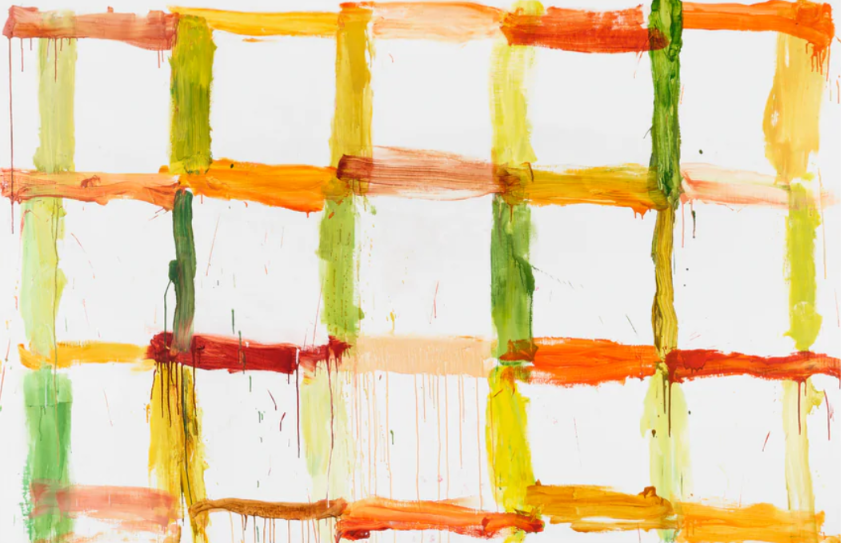
Wertheim’s works feature vertical and horizontal lines that overlap and intersect, forming grid-like and lattice structures. While in previous years he primarily worked with spray paint, he now increasingly applies paint with a brush, introducing a distinctly visible painterly gesture to the works.
The simplicity of the forms is disrupted by a deceptive sense of casualness: the contours of the strokes remain blurred, the spacing between the lines is irregular, splatters and smudges of paint are visible, and the character of the brushstroke is clearly pronounced. As a result, what emerges is hardly a grid in the classical sense, one that imposes order or structure upon the canvas. Rather, it appears as a framework generated by the casually and spontaneously applied strokes themselves, holding them together.
Wertheim’s artistic practice unfolds between these two poles—grid and gesture—both of which are rooted in a long art-historical tradition. For a long time, he grappled with the question of what painting and, indeed, what an image can be. The representation of external reality through figuration increasingly seemed questionable to him. Instead, he sought lightness, spontaneity, and directness. Abstract Expressionism, in particular, and the gesture as an immediate expression of the human condition became central influences. The move toward abstraction and the reduction of pictorial elements to simple forms and spontaneous marks represented both a painterly liberation and a return to the most fundamental elements of painting.
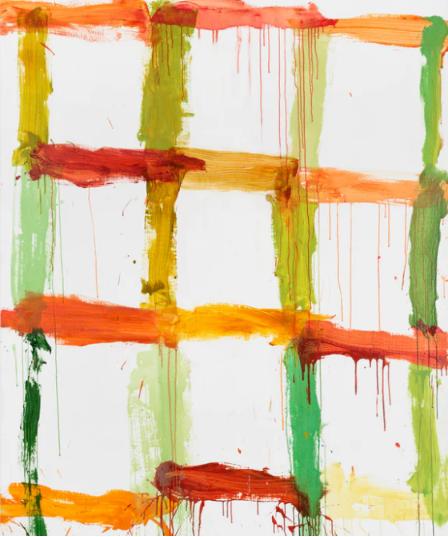
As Rosalind Krauss describes in her essay Grids, the grid was introduced in modernism, among other reasons, as a means of announcing silence, since it resists literature, narrative, and discourse. Despite its rigor and apparent lack of movement or development, it continues to play an important role in contemporary art. In Wertheim’s work, too, the grid signifies openness and silence, yet without being employed programmatically or as a rigid system of order. Rather, it seems to arise almost accidentally from intuitively placed brushstrokes, whose elemental orientation, vertical and horizontal, already contain the basis of the grid. For Wertheim, the grid is neither a negation nor an anti-narrative in the modernist sense; instead, it emerges incidentally and serves the strokes themselves, which stand for freedom, lightness, and spontaneity.
The result is a body of work that explores the space between freedom and constraint. The choice of the grid as the underlying structure of his paintings suggests a desire for order, with each work representing an attempt to attain it. Freedom, constraint, lightness, and unattainability are fundamental elements of Wertheim’s practice, re-emerging as questions with every new painting.