
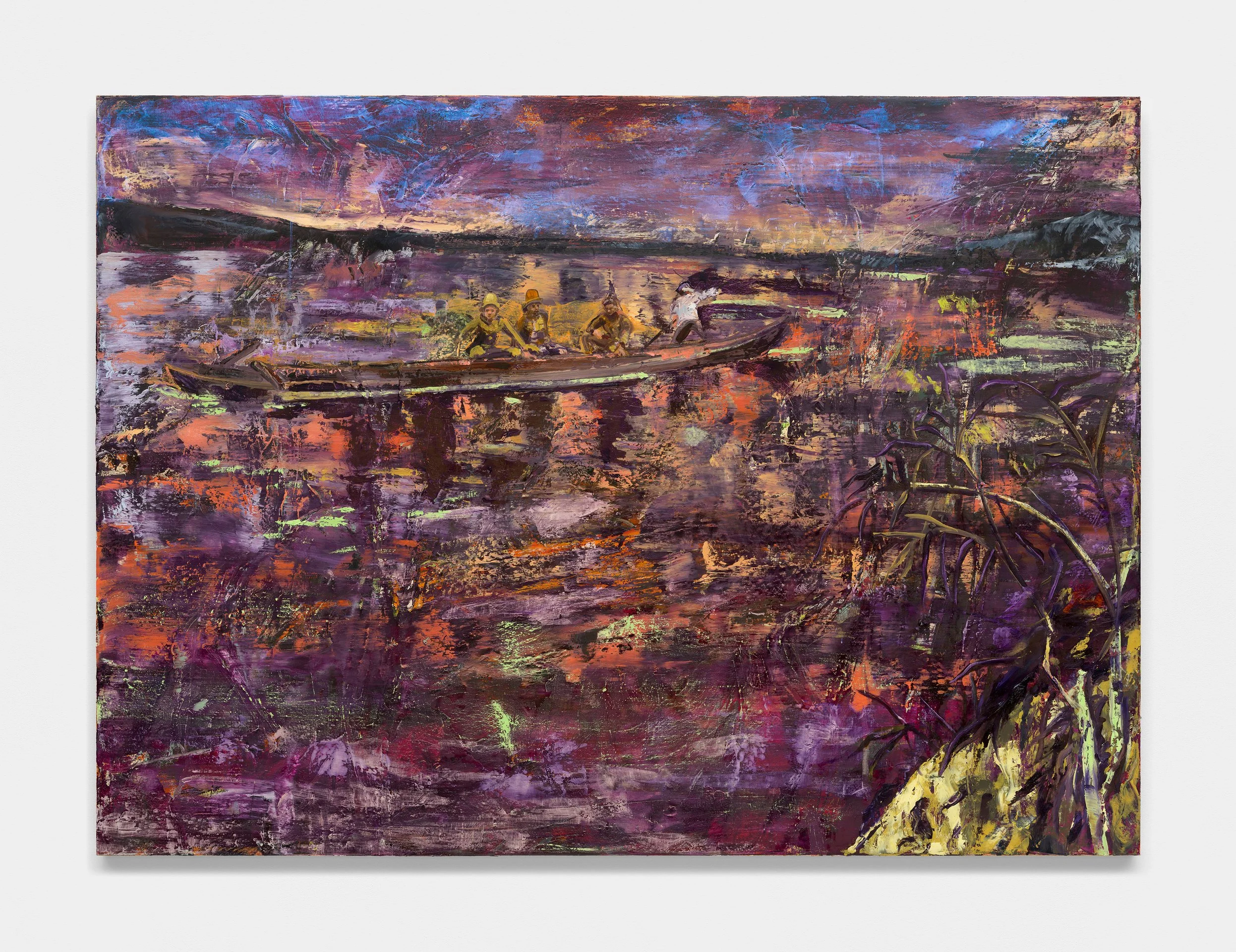
Twilight, 2026
David Kordansky Gallery is pleased to present The World Tangled in You, an exhibition of new paintings by Maia Cruz Palileo, in New York.
September 10 – October 24, 2026
Palileo has structured their project as an ongoing series of questions. Over the course of their two-decade career, they have continually deepened their exploration of the links between their family’s roots in the Philippines and the context in which migrations, colonial violence, and the negotiation of cultural identity have taken place, on a global scale, for hundreds of years. In The World Tangled in You, whose title is borrowed from a poem by Shirley Ancheta, the artist offers a passionate love letter to painting, one characterized by joy and aesthetic discovery as well as confrontation with the stark realities of history.
By deconstructing, layering, and repeating sections of archival photographs, they make the landscapes and people in the images more abstract; any narrative associations that the images engender also become less linear and more cyclical as elements occur more than once in different parts of the composition. This nonlinearity becomes more apparent as the materiality of paint on canvas introduces yet another layer of immediacy, and makes the compositional choices gleaned from the collages operate in three dimensions.

The Magic and the Mundane, 2026
Palileo is interested, in other words, in precisely those moments that feel “off” because they offer possibilities to understand the evolution of their—and their community’s—history in new ways. One of the show’s major paintings, in which an X-like form occupies the center of the composition, provides examples of such possibilities in action. The image on which the painting is based was one of the first the artist encountered during their research in the Philippine archives at the Newberry Library in Chicago. Upon close inspection, the X shows itself to be constituted by the presence of dozens of gun-carrying soldiers marching in a formation that, in Palileo’s rendering, resembles an infinity symbol.
If the results of these inquiries range farthest and widest in the large-scale works on view, it is in the smaller paintings that Palileo demonstrates just how intimate, exploratory, and embodied they can be. It is notable that the artist uses their research as a point of departure rather than a repository of findings to be explicated after the fact. Accordingly, they approach images in the smaller works head-on, often without the kinds of collage-based interventions that define the larger ones. This allows them to meet their subjects with the present moment fully in mind, and to experiment with varied ideas about how paint itself, with its weight, viscosity, and luminosity, can dictate its own stories and reflections about the physical world and the passage of time.