
ALEX DA CORTE: PARADE
MATTHEW MARKS is pleased to announce Alex Da Corte: Parade. The exhibition includes eleven new sculptures presented in a narrative environment. It is the artist’s first one-person exhibition in New York in more than five years.
through December, 2025
Alex Da Corte is known for his work that explores the nuances of contemporary life through a masterful layering of images drawn from popular culture, art history, and modern design. Though his expansive practice includes video, performance, painting, and drawing, this exhibition focuses on sculpture, which Da Corte finds to be the foundation of all his work: “I like to think I favor sculpture because, unlike painting or photography, it has a side you cannot see. And that is uniquely human.”
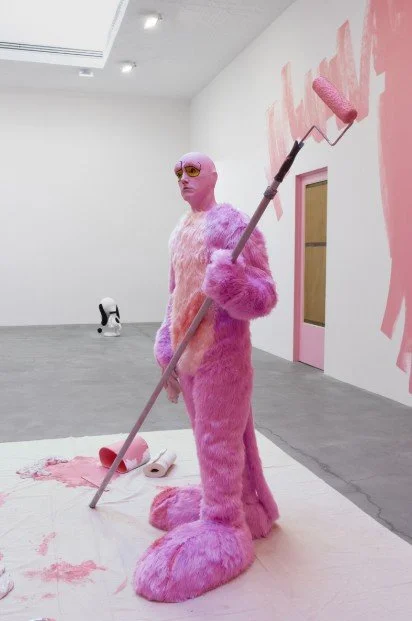
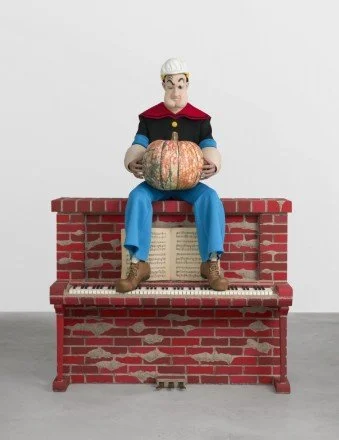
The main gallery is divided into three chambers, a procession from external to internal separated by thresholds of art history. Da Corte appears three times as life-size sculptures. In one, he is the Pink Panther as a house painter, complete with a drop cloth, bucket, and roller, in the process of painting the gallery pink. In another, he is Popeye sitting atop a brick piano with his feet resting on the keys, contemplating a pumpkin. “The need to dress ourselves up is something common, like the need to eat,” Da Corte has noted of his career-long use of costume, quotation, and disguise as an avenue to explore the depths of human experience. “There’s a shared blank canvas that we all have.”
Da Corte appears for a third time inside a recreation of Paul Thek’s The Tomb, which was first exhibited at the Stable Gallery in New York in 1967. Considered one of the great lost artworks of our time, this meticulously researched, comprehensive installation features Da Corte as a figure lying in repose inside a pink ziggurat. Like Thek, Da Corte cast his own body to make the sculpture. “So many of my works ruminate on the poetry of living and dying and a certain balance of joy and sadness,” Da Corte states, reflecting on the complexity and worth of elegy.
An illustrated publication with an extensive conversation between Da Corte and curator Elisabeth Sussman will accompany the exhibition.