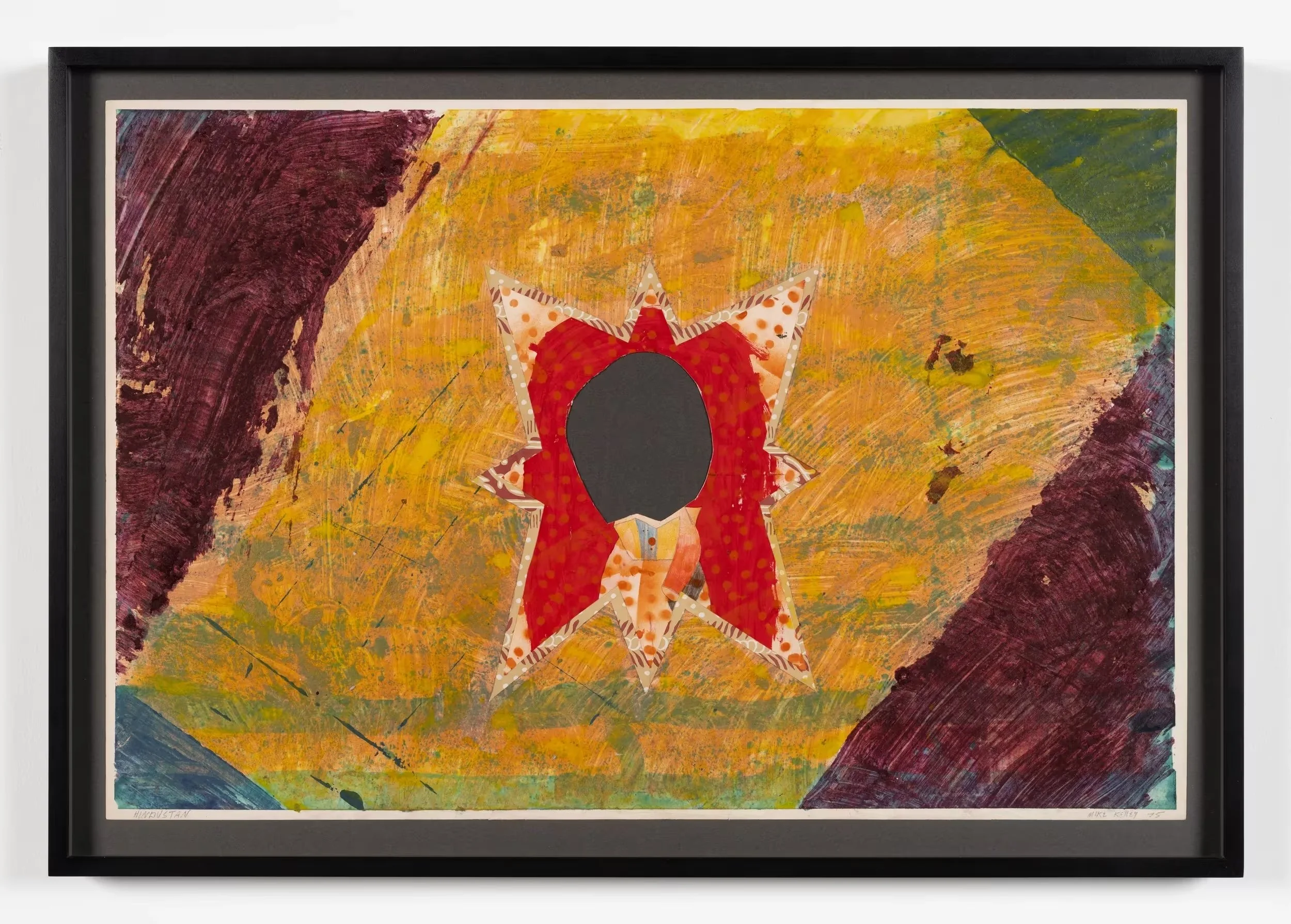
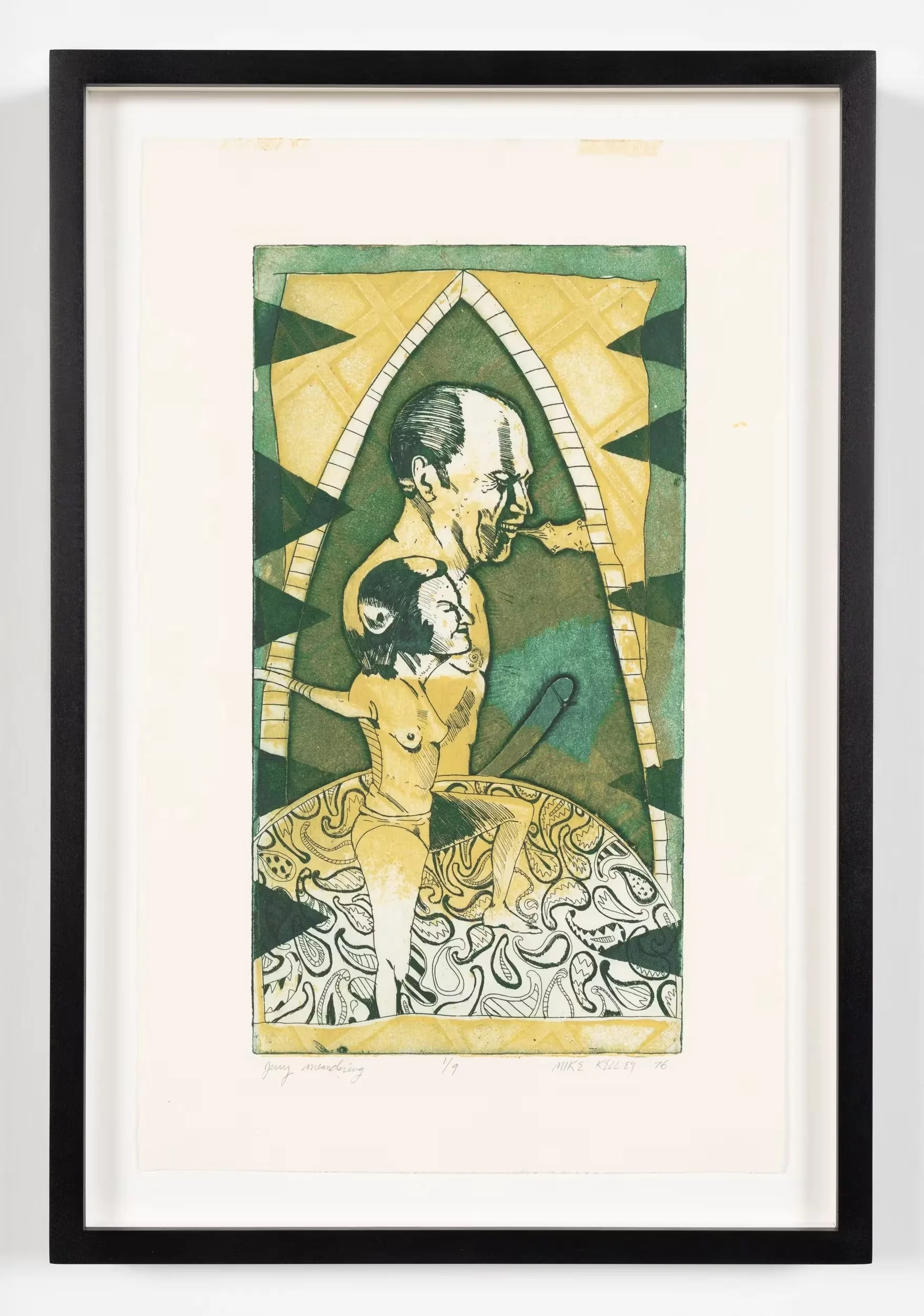
Hauser & Wirth is pleased to present Jerry Meandering, an exhibition by Mike Kelley, in New York.
November 12, 2026 – January 16, 2027
As a student, Kelley worked across a range of mediums and techniques including etching, aquatint, lithography, acrylic, ink and collage. Compositions such as ‘Elegy to the Symbionese Liberation Army’ (1975) demonstrate how he mixed different materials and subjects on a single surface. In a 1995 lecture, Kelley highlighted this work as an example of his interest ‘...in trying to merge popular and subcultural imagery into a kind of formalist painting methodology.’ Drawing on the formal language of modernist abstraction while incorporating politically and culturally charged imagery, works like this one point to Kelley’s early adoption of appropriation and cultural critique.
At the heart of the exhibition is Kelley’s playful engagement with printmaking and interest in repetition, variation and reproduction. In ‘Ascension of Stravinskian Resemblance into a Field of Alice Coltrane Music’ (c. 1975 – 1976), a six-pointed star frames a portrait of the Russian composer. By overlaying the etching with spray paint, Kelley combines the reproducible graphic with the immediacy of a hand-applied gesture. The star motif seen here recurs throughout many of his early works, either framing the picture within the composition or forming the frame itself.
The exhibition follows these ideas back to their earliest manifestations in a vitrine of mixed media drawings from Kelley’s student years (1973 – 1976.) Using impressions of the artist’s own arms and U.S. coins alongside grid-like structures, text and various other symbols, these compositions provide a glimpse into Kelley’s developing visual language and the intellectual and material concerns that would come to shape his practice.
Rather than treating his formative works as fixed points of origin, Kelley repeatedly brought them back into circulation, allowing their meanings to shift over time. This process became central to some of Kelley’s most ambitious projects, including ‘Missing Time,’ in which he used repressed memory theory as a darkly ironic framework for reconsidering his student work, and his seminal installation ‘Educational Complex’ (1995), in which he reconstructed the sites and spaces associated with his education from memory, leaving blank those he could no longer recall.