ZAK KITNICK: PAINTINGS FOR CHILDREN
NINO MIER GALLERY is pleased to present Paintings for Children, the gallery’s second solo exhibition with New York based artist, Zak Kitnick. The exhibition’s opening will be celebrated with two family-friendly events.
March 19 - May 7, 2026
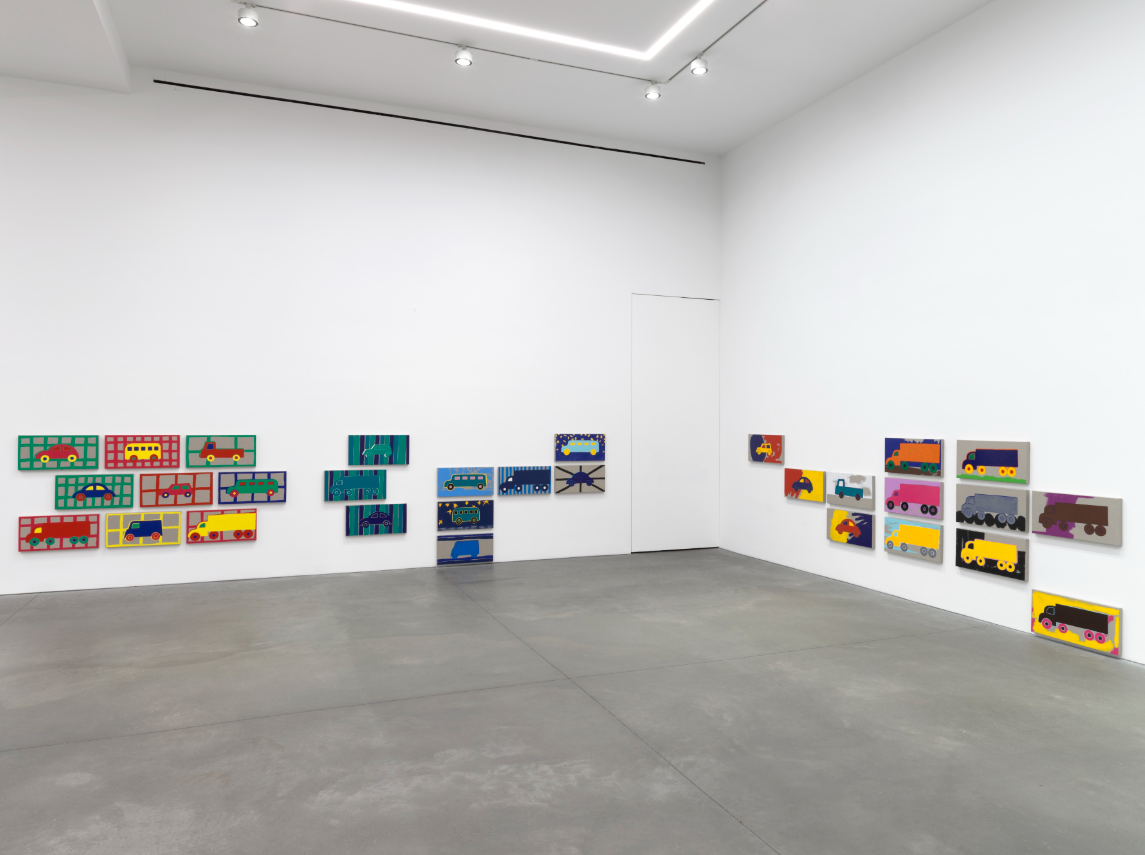
Inspired by a set of Marimekko bed sheets the artist owned as a child and revisited as a new father, the paintings depict cars, trucks, and buses. Originally conceived as paintings for his daughter’s bedroom, they became the basis for a sustained series.
The exhibition’s title is borrowed from Andy Warhol’s 1984 exhibition of the same name, held at Bruno Bischofsberger Gallery in the year Kitnick was born. Warhol’s installation featured paintings of toys hung at the eye-level of elementary-aged children, and adult visitors unaccompanied by children were required to pay admission. Kitnick’s exhibition extends this logic through approximately one hundred small paintings installed at the heights of two, three, and four-year-old children. A portion of all sales will be donated to Wide Rainbow, a New York City–based after-school arts program for children.
The exhibition will be accompanied by a publication with a new essay by Hannah Pivo, a historian of art and design.
Born in Los Angeles, CA in 1984, Zak Kitnick currently lives and works in New York, NY. Recent solo exhibitions include The Weather, Clearing, New York (2022); Shapes, Nino Mier, Los Angeles (2021); 12 Grapes, Clearing, Brussels (2019); Doubles, Clearing, New York (2018); and Craftsman by Sears at Kmart, Ribordy Contemporary, Geneva (2018). Kitnick has been included in significant group exhibitions at MoMA PS1, New York; Queens Museum of Art, New York; and The Power Station, Dallas. The artist’s work belongs to the collections of the Whitney Museum of American Art, New York; Institute of Contemporary Art, Miami; MAMCO Genève, Switzerland; Baltimore Museum of Art, Maryland; and Collezione Giancarlo e Danna Olgiati, Lugano, among others.
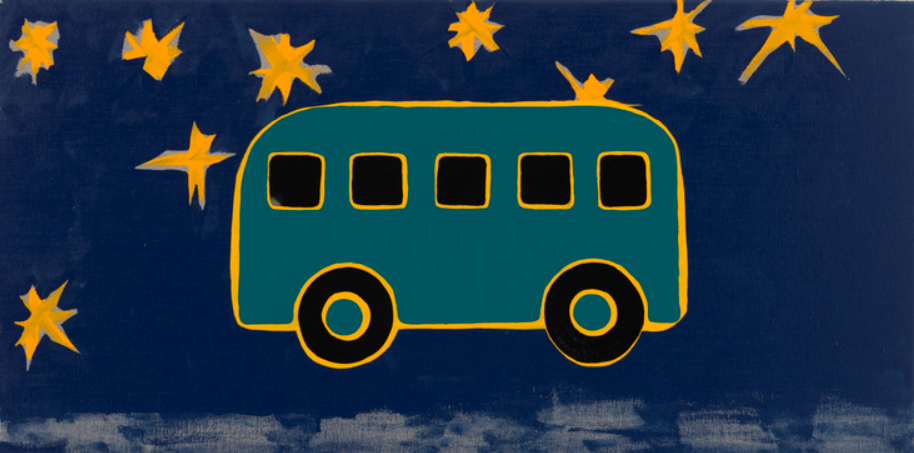
Paintings for Children is composed of one hundred small paintings of trucks, buses, vans, and automobiles. Each painting is different, but the figures are not. Nine vehicles repeat in a seemingly endless variety of color combinations fit for a nursery school. These vehicles, though hand-painted, appear stamp-like with thick, firm edges. They seem to hover before their backgrounds—framed but not really grounded, separated from the world behind them like vivid cartoon characters layered over a hazy desert landscape. The backgrounds, in contrast, are painted with loose, expressive brushstrokes. And unlike the figures they are each unique, locating the vehicles in a variety of different scenes and settings: roads, grass, sky, stars, stripes, and polka dots, among others.
The works are composed of sign painter’s enamel on linen. The muted gray of the textile peeks through the high-gloss paint to a greater or lesser extent in each work. In some cases, this adds a sense of spatial depth. In others, it recalls the presence of paper behind a child’s crayon drawing. Indeed, the industrial enamel appears surprisingly crayon-like as applied to the backgrounds in a single, thin layer. The vehicles themselves, in comparison, look more like the glossy commercial signs for which the paint is intended.
Thick and slick, one wonders if it might be possible to peel a truck off one painting and stick it on to another. To make these one hundred paintings, Kitnick engaged in mass production on a micro- or, shall we say, kids’ size-scale. He performed a division of labor that separated the painting of backgrounds from the painting of figures. And the latter process was further sub-divided: the vehicles were traced from templates, then painted by hand in multiple separate layers. To accomplish all this, Kitnick set up a sort-of production line in reverse. Each ‘product’ (read: painting) remained stationary on one of a dozen tables lined up in a row, while the artist and his assistant moved from one to the next executing the same task on repeat. The series’ nine different vehicles and twenty-some colors functioned as a set of interchangeable parts that, like modular furniture or choose-your-own upholstery, provide the illusion of personalization within mass production. That is to say, each painting is unique, though its components are not. In enacting this process, Kitnick was, as he puts it, “playing factory” like a child plays doctor or princess. And no wonder, because he’s accustomed to play these days. He has been surprised to find out how much of parenting involves time spent on the floor stacking blocks.