
MARIN MAJI: DISCODISCO
NINO MIER Gallery is pleased to present discodisco, the gallery’s third solo exhibition with Frankfurt born and Brooklyn based artist Marin Majić.
May 15 – June 13, 2026
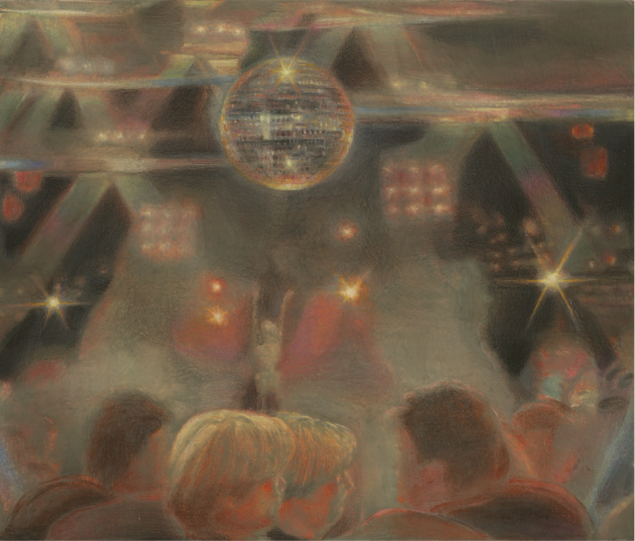
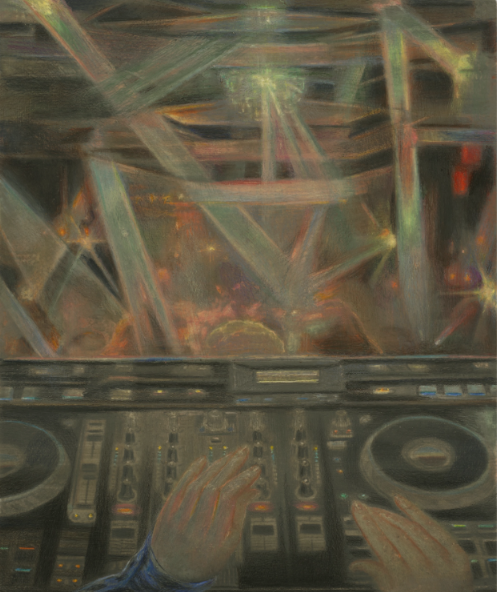
Expanding upon the visual and conceptual language as shown in his 2023 solo exhibition Nocturnes, discodisco premieres intimately scaled paintings depicting discotheques and primitive landscapes.
The disco era roughly began in 1967 and was most popular from the decade of 1970 through 1980. At nightclubs throughout the world, the youth came together to dance and engage in subculture, in effort to try and escape the time of political upheaval from the Vietnam war. This sentiment of heedlessness and anxiety towards news headlines and daily turmoil, and cataclysmic gravitation toward living in the moment becomes a throughline in the real and sublime narratives within Marin Majić’s work. While the nightclubs and dancefloors in discodisco are more contemporized with CDJs and visual lighting effects, the feeling of enjoyment and pleasure amidst imminent catastrophe as witnessed in the abruptly ended disco era becomes paralleled in Majic’s painted worlds. The dancers, prehistoric individuals, animals, and lobbies shown throughout the exhibition seem to dance on the volcano, ambivalent to the life-changing events yet to transpire, but enthusiastic in each person, being, or setting’s delightful free will in the moment.
To achieve the scratchy yet soft chiaroscuro nature of the works in discodisco, Majić mixes oil color with marble dust, wax, and turpentine, further feeding into the alchemical and surreal scenes he produces. With the marble dust, Majić sculpts away at the surface to create pockets of light, color, and texture. Works like Gravity use this technique both formally and conceptually through the cloisonne-like detailing of each individual pane of the central disco ball, capturing the reality of the object while imposing otherworldly light sources emanating within and beyond its confines.
In Musings, Allen returns to a single female shadow, revisiting it through slight variations that trace the movement of creative thought. Here, musing names a mode of thinking that is associative rather than directed, unfolding through the open drift of the imagination. To Distraction 1–3, by contrast, turns to the psychological tension that emerges when this creative impulse is contained. Saturated in vivid yellow, the compositions depict shadowed female figures caught within enclosing interiors, their forms stretched and ambiguous shapes that suggest fluctuating states of female experience. Body language becomes a primary expressive vehicle, as subtle shifts in posture communicate psychological nuance that may elude conscious awareness. While rooted in the artist’s own figure, the ambiguity of the shadow resists singular identification. It functions as a porous signifier, capable of expanding outward into broader projections of experience.
The twelve paintings of Thinking Man take as their starting point Rodin’s famous sculpture The Thinker. Where Rodin described thought as something that extends through every muscle, limb, and joint, Allen transposes this idea onto the shadow of a solitary male figure, whose shifting postures map a range of interior states. Displayed as a grid, the paintings recall the illuminated windows of an apartment building at night, discrete yet contiguous sites of private experience. Echoing the urban solitude described by Olivia Laing in The Lonely City, each work appears as a self-contained interior, glimpsed from a distance yet ultimately inaccessible. Allen’s thinking men are similarly enclosed, trapped not only within rooms but within their own heads. Male suppression of emotion finds form here not through confession but through silhouette.
Elsewhere, Allen turns from shadow to the fully realized female body, depicting figures in states of rest or withdrawal, bathed in bands of sunlight and shade. In Daydreaming 1–3, Let me be lonely, and The Memoir, a woman reclines across a sofa, reading, sleeping, or lying still. Light cuts across upholstery and skin, emphasizing the weight and placement of the figure: an arm draped, a torso angled, a head turned slightly away. These figures appear caught in recursive cycles of thought, their inward focus rendering the external world secondary. In Let me be lonely and The Memoir, a male shadow passes across the scene, registering ambiguously as either a trace of remembered companionship or a present figure rendered peripheral by the subject’s psychological absorption. The repetition of closely related compositions across the series underscores Allen’s iterative approach, in which small variations in body language and environment recalibrate the emotional tenor of the scene. What might initially register as quiet contemplation gradually reveals itself as a more ambivalent condition, where time seems to stretch and fold inward.