GROUP EXHIBITION: PINK
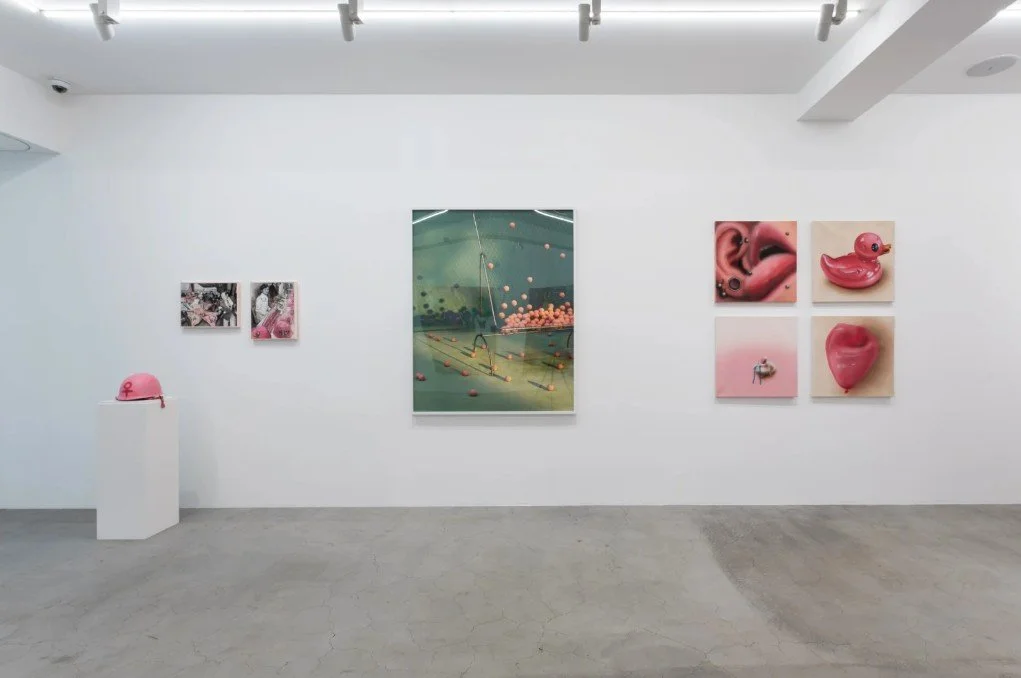
OTA FINE ARTS Tokyo is pleased to present Pink, a group exhibition showcasing works by our gallery artists that explore the varied uses and meanings of the colour pink.
December 28, 2025 – January 5, 2026
While pink has long been associated with femininity and sweetness, its significance has expanded across cultural and social contexts to encompass ideas such as agency, solidarity, irony, and resistance. In this exhibition, perspectives ranging from femininity and queerness to pleasure and tension, charm and defiance, desire and fantasy unfold through the works on view.
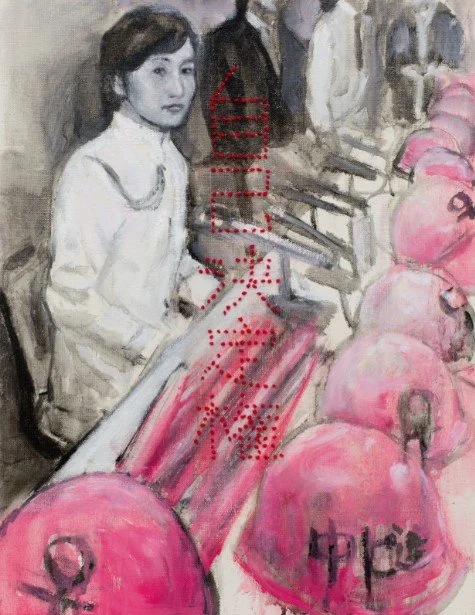
Yoshiko Shimada In her solo exhibition ‘It's Not Yours to Decide!’ (2023) held at Ota Fine Arts Tokyo, Shimada focused on the 1970s women’s activist group ‘Chu-pi-ren’ (Women's Union for Liberalization of Abortion and Legalization of the Pill) , known for their pink helmets marked with the ♀ symbol. By reevaluating their direct action to win rights from the authorities and reexamining women's ‘right to self-determination’ regarding sexuality and reproduction, Shimada revived pink as a colour of resistance. At a time when abortion rights remain contested globally, for Shimada, pink represents a colour expressing a fighting attitude and spirit–just as Chu-pi-ren embodied half a century ago.
Chen Wei Chen Wei has for many years explored the aspiration for a better life in rapidly changing Chinese society. As lifestyles diversify, new options for leisure and hobbies serve as an indicator of how individuals construct their own lives. The motif of tennis is one such symbol. In Pink Bobble (2021), the hardness of the steel frame and the soft presence of the pink ball seems to quietly allow two extremes—the urban reality and personal desire, tension and lightness—to coexist. The pink used here reflects the "dream of life" that wavers with social change, seemingly embodying deep-seated emotion.
¥ouada Drawing on internet culture and memes, ¥ouada has employed spray-paint techniques to caricature contemporary consumer culture. His earlier works feature high-saturation, toxic pinks that visualize the acceleration of desire and the excesses of visual consumption. In this exhibition, he departs from that vocabulary and turns to a subdued, quiet pink—an ‘gentle pink’ that reveals more delicate emotional strata. Soft motifs such as rubber ducks and balloons are pierced by metallic textures, producing a sense of Steadfast tenderness. A hamster in a party hat sheds a tear, bringing forward a coexistent humor and emotional fragility. In Two pleasures plus one (2) (2025), soft body parts are shown in close-ups, rendered sensually in shades of pink. The depiction quietly evokes the colour’s historical association with sexuality. Metal piercing accentuate the flesh’s softness, while strong blurring transforms the body into an almost abstract form.
BuBu de la Madeleine ‘Why do we call it “pink”?’ -Despite the presence of native colour names like cherry blossom colour (sakura-iro・桜色) and peach colour (momo-iro・桃色), the foreign word ‘pink’ dominates everyday usage in Japan. This question led BuBu to focus on the Japanese crested ibis (toki) in her new work, whose feathers display a striking hue. BuBu has observed treasures that traveled the Silk Road since childhood through the Shōsō-in repository in Nara, where she is based. The history of pigments and dyes is also the history of cultural exchange between East and West. Among these, BuBu is deeply interested in the cultural history embedded in colour names. The crested ibis, once nearly extinct but now recovering through conservation efforts in China and Japan, also invites reflection on the evolving relationship between humans and animals.
Yayoi Kusama For Kusama, an exceptional colourist, pink is a vital part of her palette. She has appeared in pink garments and wigs, imprinting the colour onto both her work and her public image. A Chat in the Universe (2010), an early piece from the My Eternal Soul series (2009–2021), features luminous red dots floating in a vivid pink void bordered by black organic fringes. Abstraction and figuration, the inner world and cosmic scale are gently interwoven. Untitled (1980), a cosmetic box filled with combs and mirrors and covered entirely with pink protrusions belongs to her Accumulation series, which visualizes and attempts to confront obsessive fears around death and sexuality. The pink here radiates a bright, almost mischievous energy, transforming dread into exuberance. This method of envelopment extends even to a small Marshall amplifier, where iconic branding meets Kusama’s polka dots to heighten its pop allure.
Maria Farrar Maria Farrar translates emotions drawn from her multicultural background and everyday life into vivid colors and expressive brushwork. For her, painting is a way to give form to thoughts and feelings that cannot be contained within her body or mind, moving seamlessly between figuration and abstraction to explore both the darkness and sweetness inherent in human existence. While her work has sometimes been labeled as ‘too feminine,’ Farrar embraces femininity as an essential part of her artistic language rather than suppressing it. At the same time, she approaches motifs traditionally associated with femininity—ribbons, sweets, and the like—with a measured, observational gaze, incorporating the dynamics of looking—including echoes of the male gaze—into her compositions. Rich color palettes, recurring motifs, memories of Asia, and the subtle tensions of daily life in London converge in her paintings, which consistently emerge as natural, unforced expressions of the self.
Ming Wong Video and performance artist Min Wong explores themes of authenticity, otherness, and gender through the reenactment and reinterpretation of world cinema and popular culture. In this work, first presented in his 2019 solo exhibition 'Fake Daughter's Secret Room of Shame' at project space ASAKUSA, Wong appears as a fictional porn actress. Wong draws on the visual language of Japan’s 1960s pink films—independently produced erotic cinema—and the later Nikkatsu Roman Porno series, combining these references with the production methods of contemporary digital video. The result is a cross-temporal reenactment that links different eras and media. Designed for viewing on a smartphone, the work reflects how images of desire, pleasure, and secrecy have migrated over time—from the cinema, to home video, and now to online platforms. Wong, a male artist, performing the role of a female objectified by male desire, queers the hegemonic gaze embedded in pink film. At the same time, the work gestures toward the rise of cross-dressing expression circulating in Asian subcultures since the 2010s, including Japan’s otokonoko (男の娘) and the Chinese term wei niang (偽娘).
Masanori Handa The overpass pillars were far taller than I had imagined. | The tide had already risen. | When I returned to myself, I realized that although I thought I had been walking on the road, | I was looking up from beneath the sea.
Masanori Handa’s diptych Whales (2021) was inspired by the artist’s firsthand experience of a whale washed ashore near his home. The composition places a coastline on the left, an empty road at the center, and a solitary figure standing in the sea on the right, with a cone depicted like a moon in the upper left. Encountering the fourteen-meter whale, Handa sensed its immense scale and a “time of its own,” unlike human perception. Many people gathered around the whale, a scene that felt almost timeless to him. Observing the crowd from a distance, he experienced a sense of solitude, which he embodied in the lone figure—also echoing the whale itself. The vivid pink mark the dramatic yet quiet moment when consciousness flips from the everyday (the road) to the otherworldly (the sea).