BERNAND FRIZE
PERROTIN Paris is pleased to present Bernard Frize’s tenth exhibition in Paris at its Matignon space, marking the artist’s twenty-first collaboration with the gallery internationally.
April 9 - May 30, 2026
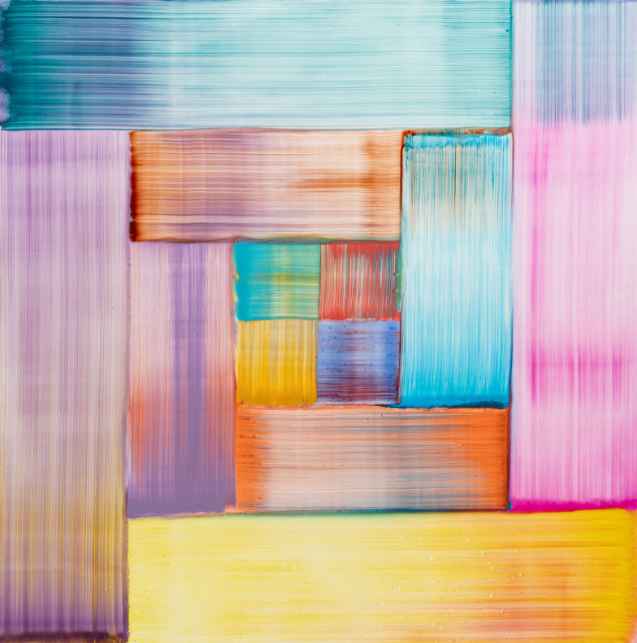
For several decades, Bernard Frize’s work has developed in distinct families, each setting its own conditions of emergence through protocols and rules that define its operational framework. The square-format paintings in his new series at Perrotin gallery were created using brushstrokes of three different widths, interwoven into grids through juxtaposition and layering that follow a principle of permutation between brush widths and their associated colors. The paintings consist of three squares nested within one another, formed by twelve brushstrokes that establish a rhythm, superimposing a four-beat tempo—the square form— over a three-beat tempo—the nesting of the three squares. Each gesture applies a layer of color that merges with the still-wet color beneath, partially covering it and creating moiré effects and transparencies to produce a captivating chromatic blur. For the attentive viewer attempting to reconstruct the exact chronology of this architectonics, the compositions ultimately reveal the impossibility of faithfully adhering to the initial protocol. The sequence of four brushstrokes forming the contours of a square shows that the final stroke cannot simultaneously lie over the previous stroke and beneath the next one, which was the first to be applied. Thus, to achieve the interlocking of this vertiginous architecture, an element of "cheating" is involved–– precisely because it is impossible. The truth supposedly grounded in the rules of the game is transgressed by illusionistic corrections that conceal the technical dead ends inherent in the initial protocol. Cézanne said we are owed "the truth in painting"; Bernard Frize manufactures a simulacrum of it, sealed beneath a layer of resin. Paradoxically, it is by bending the rule at the moment it proves unworkable that he shifts the authority of the protocol toward something essential: painting as material, as the reality of layerings, revisions, and adjustments.
The constraints he chooses introduce a certain distance, yet far from being coercive, they also open up a freedom, a willingness to embrace chance, the unexpected, and the sudden bleeding of one color into another in an unpredictable harmony. This freedom emerges at the exact moment where the rule encounters the irreducible unpredictability of paint itself: the viscosity of acrylic, the pull of gravity on matter flowing vertically or spreading across a horizontal plane, the resistance of the brush, the deviations caused by the variable density of pigments, the dominance of one color over another, the subordination of a value inflected by its neighbor, rhythms unexpectedly born of strident tones working against the harmonics... Painting becomes a negotiation in which an ethics plays out, one attuned to cooperation, relationship, and the interplay between constraints and accidents, intention and material consequence. Each series redefines the terms of this relationship, from the rigorous discipline imposed upon the paint to its emancipation, where it asserts its own logic, spreading, thickening, blurring, stratifying, and contaminating itself through runs, clumps, and deposits. In these discreet excesses, the paint reveals its autonomy, retaining a memory of its liquid state and a capacity to insist and resist. Let us not forget that the first viewers of a painting are the artists themselves 1 , fascinated by what eludes control, by the emergence of color, light, and astonishing chromatic arrangements. They are keenly aware of the irreversible tipping points of a mixture that, against all expectation, can become epiphanic.
The viewer is invited to mentally retrace the journey, to imagine the stages, to sense the moments when the paint slows, thickens, loosens, refuses, yields. If the rules of the game led only to the game itself, the painting would be reducible to a labyrinthine image whose execution one could simply reconstruct. Yet Bernard Frize's paintings are also sensory, sensual, organic bodies, conveying the pleasure of painting, of watching paint open its chromatic corollas at the intersection of brushstrokes and the unruly flow of matter. This sensuality arises from a field of experience where viscosity, pressure, speed, adhesion, brilliance, saturation, and transparency become the tonalities of time, repetition, divergence, and variation. As Jean Frémon observes of Robert Ryman, "We discuss the ins and outs, the ends and the means, yet in reality we know nothing; nothing of what it truly means to take, with the tip of a brush, some color from a palette and place it on a panel." 2 One is led to appreciate both the rigor of the system and the beauty of color. And to accept that these two dimensions do not cancel each other out, that the rule does not suppress the pleasure of making and seeing but instead holds it near, embracing it with a persistent question: What becomes of painting when it is allowed to act, when it is listened to, when one organizes the conditions for its emergence rather than dictating its outcome?
-Jean-Charles Vergne. Curator, author and director of the upcoming Gandur Museum