GELITIN: ALL FOR ALL
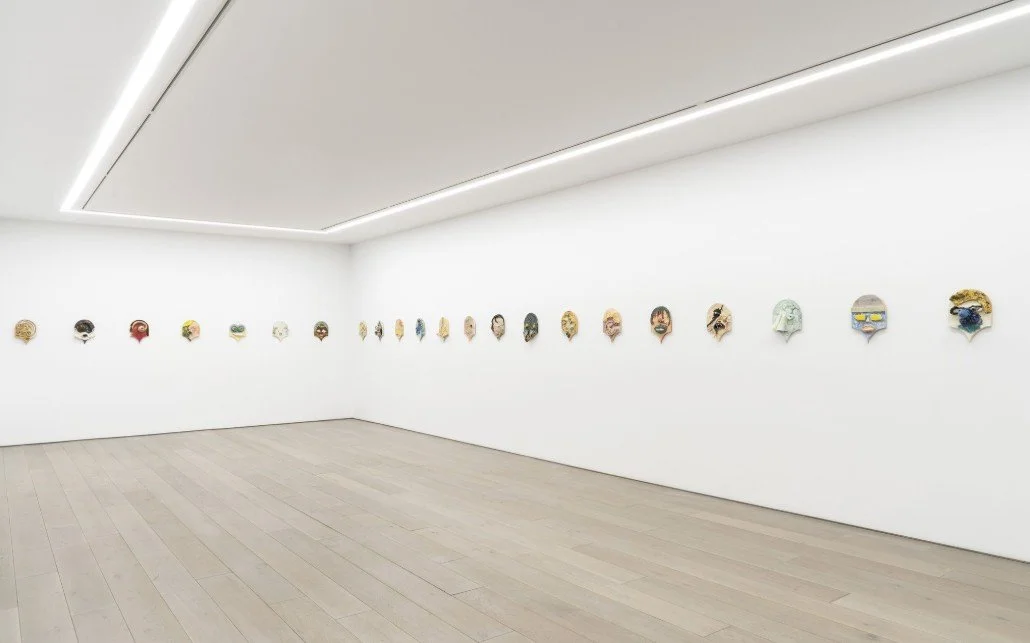
PERROTIN New York is pleased to present All for All by Gelitin. The exhibition brings together two series—All for All and WirWasser—that highlight community engagement as a key tenet of Gelitin's practice. The titular series consists of distorted ceramic portraits that are displayed as a group, exploring the tension between collective and individual.
March 5 - April 11, 2026
With All for All, the Austrian self-defined non-collective Gelitin continues its long-running investigation of how artworks can behave like social forms. Building chosen families and temporary publics. Gelitin (Ali Janka, Florian Reither, Tobias Urban, and Wolfgang Gantner) describe their authorship as “four bodies that are actually one artist.” For decades, that shared organism has produced performances, installations, and objects that treat participation as the core operating system.
Gelitin’s art is situational. Again and again, it returns to questions of proximity and cooperation: how people come together, how they negotiate shared space, and how agreement takes shape. What emerges are not fixed artworks but social conditions, structured around the ongoing problem of being together.
This question runs insistently through their practice. Across performances, sculptures, and public commissions, Gelitin ask how people support one another. How do groups form and fail? What does it take to hold something collectively, even if only for a moment?
“When we do exhibitions, we open the field of Gelitin and invite more people in. Then they all become Gelitin.” Authorship, for them, is deliberately porous. Their works resist closure, inviting others to enter and activate them. The artwork functions less as a finished object than as a temporary commons, something that only fully exists through use, presence, and shared responsibility.
This openness is mirrored in Gelitin’s embrace of materials and gestures that resist preciousness. “We made sculptures out of shit. It’s something everybody can do.” Humor operates as a leveling force, collapsing distinctions between artist and audience, skill and instinct. Shit becomes not provocation but common ground: bodily, universal, unavoidable. Art does not begin with mastery or scarcity, but with shared experience. Everyone can do it. Everyone should.
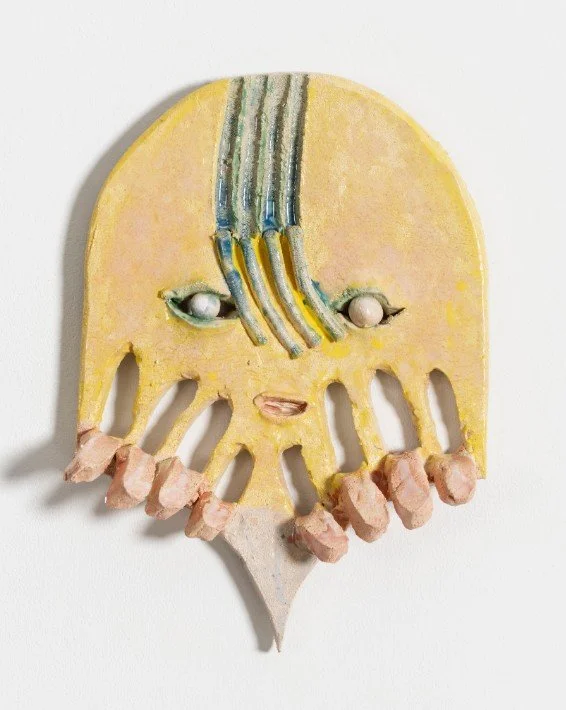
At the center of All for All is an ongoing series of hand-formed ceramic face tiles, each one shaped, glazed, and fired by hand. There are no casts, no editions, no attempts at consistency. The tiles range widely in expression and affect. Some seem tender, some awkward, some funny, some opaque. Traditionally, they appear clustered in cloud-like formations, accumulating into something that reads as a small society.
The project began as a proposal for a public school in Munich, where students would pass the same staircase day after day as they went through their school years. Rather than offering a single image or didactic statement, Gelitin chose to create a crowd of companions, something that could age alongside its viewers. The aim was presence instead of instruction, plurality instead of singularity.
For the New York presentation, the tiles are shown in two distinct configurations. In one space, they gather in clusters, emphasizing collective form. In another, they appear as a linear sequence of single faces stretching across the wall. The arrangement mirrors how they perceive this metropolis: extreme proximity of bodies paired with frequent isolation, lives running parallel without necessarily intersecting. Together, yet alone.
But by individualizing the tiles, Gelitin also introduce a form of accessibility that resists art-market exclusivity. The works are intentionally approachable in scale and price, allowing people without significant disposable income to take part and to own a fragment of the group rather than observe it from a distance.
The artists describe the installation as something like a bazaar. Viewers are not positioned as passive spectators but as participants in a social situation.
This logic extends into the drawings included in the exhibition, which depict WirWasser (UsWater), Gelitin’s permanent public fountain in Vienna, which sparked some aesthetic controversy. WirWasser is made of a ring of humanoid figures whose bodies collectively form the vessel that holds the water. The figures are deliberately ungainly: exaggerated, awkward, almost swollen, somewhere between cartoon and monument.