
HUGO TORO: OJO DE AGUA
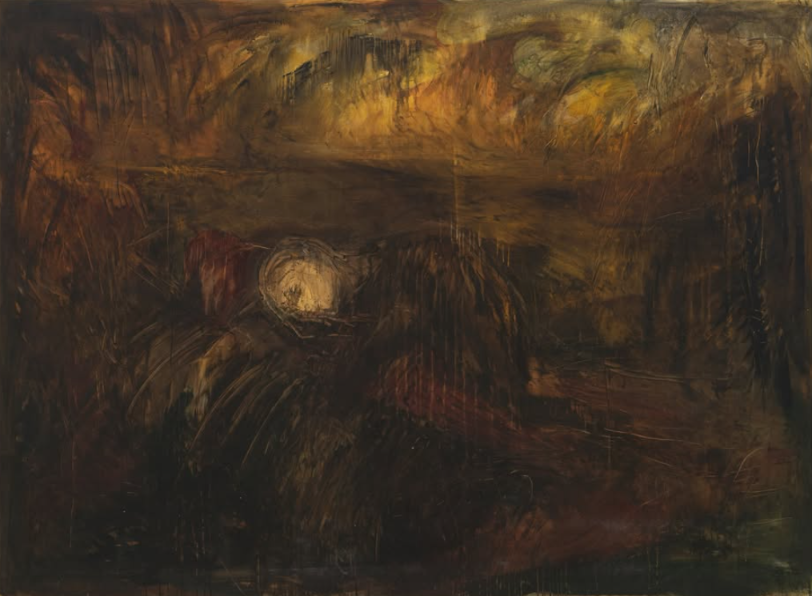
PERROTIN New York is pleased to present Ojo de Agua, the gallery’s first exhibition with Franco-Mexican artist Hugo Toro and the artist’s first presentation in the United States.
June 10 – July 31, 2026
Toro navigates the space between reality and imagination, painting landscapes that reveal stories that have shaped his identity, whether from his own life or his ancestral lineage. Across this new body of work, water appears as the main source of inspiration, painted in melancholic shades that reflect the element itself and its ability to reflect light, memory, and emotion.
Born in Eastern France to a Mexican mother and a French father, Hugo Toro carries within him the duality of his identity like an intimate enigma that he seeks to resolve on the canvas. This internal friction, born of two distinct worlds, serves as the primary engine for his creative process. His work is not merely an aesthetic exercise but a profound ontological investigation into what it means to belong to two places at once, and perhaps, in the end, to belong fully to neither except through the act of creation.
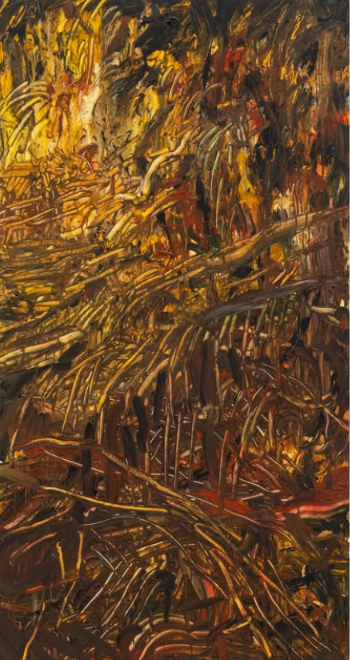
His telluric palette purposefully blurs the traditional boundaries between abstraction and figuration. Much like the dense jungles he constructs through layers of paint, his compositions borrow from the register of a Mexico that is simultaneously fantasized and real. It is a visual poetry written in prose, delivered in the first person. Toro’s “landscapes” are psychological mappings. He invites the viewer into a space where the earth and waters merge and seem to breathe, slowly.
The mangroves that interweave their complex roots in his paintings speak, above all, of his own origins. They represent a Mexico where he never lived, a place that exists for him as a powerful phantom—at once distant and incredibly present through his mother’s vivid storytelling, memories of family vacations, and the domestic mythologies centered around his ancestral village in Oaxaca. These roots are not fixed in the ground; they are semi-aquatic, shifting, and tangled, mirroring the fluid nature of his heritage.
Instinctive, even animalistic in his approach, Toro gives form to this sensory, interior, and mysterious universe so that he might better explore it. He navigates the river of his origins, moving upstream without a fixed destination, yet certain that every stroke brings him closer to the core of who he is. There is a palpable tension in his work between the existential anxiety of the unknown and the enveloping, benevolent warmth of a familiar world that one recognizes without ever truly knowing. This duality creates a unique emotional resonance; it is the feeling of coming home to a place you are visiting for the first time.
He progresses through the heavy waters of fragmented narratives, half-remembered readings, and lingering dreams. His work oscillates between melancholy and joy, fear and excitement. This is perfectly captured in the concept of his "murmuring waters," a theme explored in his recent exhibition at the Mexican Cultural Institute in Paris. These waters are not silent; they carry the echoes of a heritage that demands to be heard, even if the language it speaks is one of impressions rather than definitions.
As an artist, Toro is wary of the urge to be merely illustrative or literal. To combat this, he often turns to large-scale formats. The vastness of the canvas helps to abolish traditional architectural space, allowing the work to become its own autonomous environment. In these moments of creation, the canvas is the only space that truly matters to him. It is a sanctuary where the physical world recedes, leaving only the artist and his internal vision.
He refers to these spaces as his "limbos"—a state existing between two worlds and two realities. Within these limbos, he seeks to reconcile the image with the impression, imagination with memory, and the real with the dreamt. This liminal space is where he truly resides. He is a Mexican whose body grew in France, but whose spirit has always been nurtured by the essence of Mexico. The canvas becomes the bridge between these two states of being, a site of resolution.
His fabrication and specific use of pigments—what he terms his "pigmentogenesis"—play a vital role in this quest. These pigments are the ingredients of his search, the tactile equivalents of his psychological journey. They are composite, thick, and intense, yet they possess a fragility that mirrors the nature of memory and the subconscious. They are heavy with the weight of history but as fleeting as a reminiscence.
In many ways, these pigments are the words of a mother tongue that he does not speak well enough to fully inhabit his identity. Where words fail, the physical medium of paint succeeds. Painting provides him with the abstract vocabulary needed to articulate his complex emotions. It offers him—or perhaps restores to him—the language of his roots. There, again are the mangroves, the floating roots of a fluid identity, a constant process of growth and movement that never ceases to draw and redraw the contours of his profound, complex interior landscape. Through this, Toro does not just paint a world; he births a self.
-Guillaume Kientz, Director of the Hispanic Society Museum & Library in New York.