
SUSUMU KAMIJO
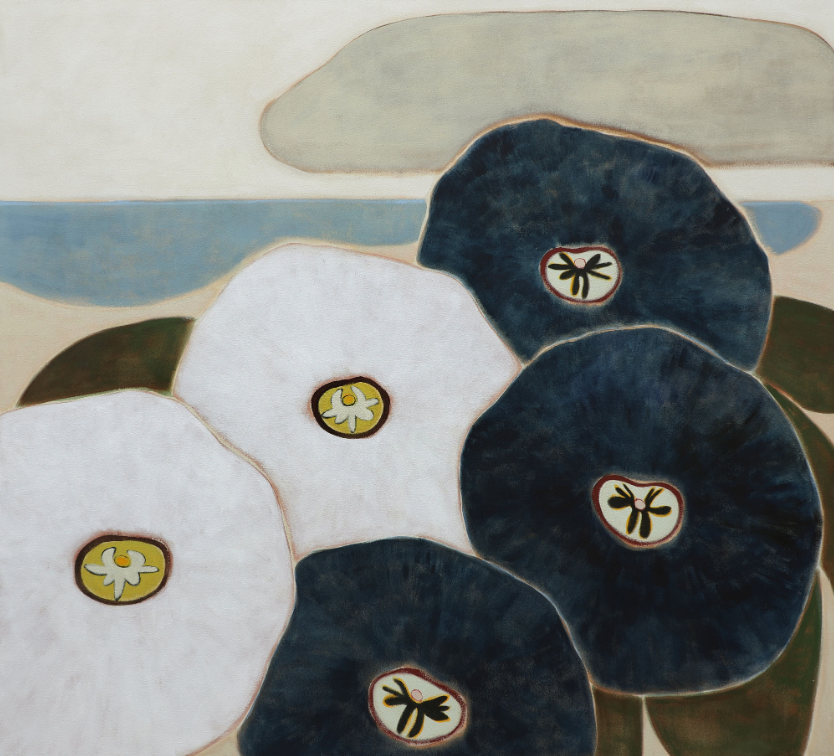
PERROTIN is pleased to present the exhibition of Susumu Kamijo, which immerses us in a tranquil and poetic world, populated by monumental flowers, animals and landscapes defined by intuitive lines.
April 25 – May 30, 2026
Susumu Kamijo’s painted world is filled with large flowers, fruit, and sometimes animals: butterflies, parakeets, sailfish. Occasionally, one encounters a few everyday objects. It is a calm world. In the background, certain elements hint at the scene’s scale: a cloud floating in the sky, a horizon line over the sea, a colorful hill. Yet it is a form of painting that never tries to create the illusion of depth or tell a story.
Applying art historian Leo Steinberg’s 1968 distinction between the vertical “window” model of painting and the horizontal flatbed picture plane (originally developed in relation to Robert Rauschenberg’s work), it becomes evident that Susumu Kamijo’s practice aligns with the latter. His inclusion of landscape elements follows an intuitive logic, focused entirely on exploring the flatness of the pictorial surface. The artist explains, “If I sense that something is needed in that spot, I might add a cloud, and that helps maintain the composition’s equilibrium.” His chromatic choices follow a similar pattern: certain colors and color combinations draw him in, not for their representational value, but for their ability to organize the painted surface and create visual and emotional effects. The large, recurring flowers function primarily as formal devices. The artist describes their inherent dynamism as a principle of outward expansion radiating from a central point. In short, the flower is an intriguing motif because it carves out its own space. “Like a big bang, a nebula,” he adds.
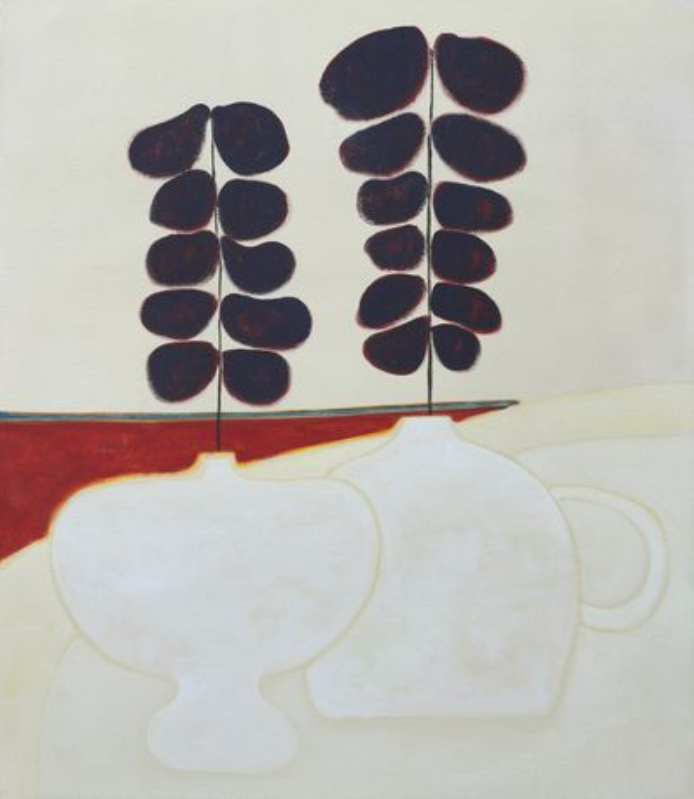
Symbolism, too, invariably seeps into his work. The cut flower, beyond its formal role within a composition, is an ambivalent symbol deeply embedded in Western art history, combining a celebration of life’s beauty with a poignant awareness of its transience. “I like the idea of these two things, the tragic and the joyful, intersecting within the painting,” he explains. This recalls Andy Warhol’s playful approach to his 1964 Flowers series, which remains one of his most popular works. He intended the series as something cheerful and accessible, appealing to both the public and his gallerist, Leo Castelli (who first exhibited his hibiscus paintings). At the same time, the motif allowed Warhol to discreetly continue his obsession with mortality, in the vein of his Death and Disaster allegories, images of accidents and fatal catastrophes he had been working on since 1962.
“I like the idea of these two things, the tragic and the joyful, intersecting within the painting.”
— Susumu Kamijo