SABINE MORITZ: ROT GELB BLAU STAUB
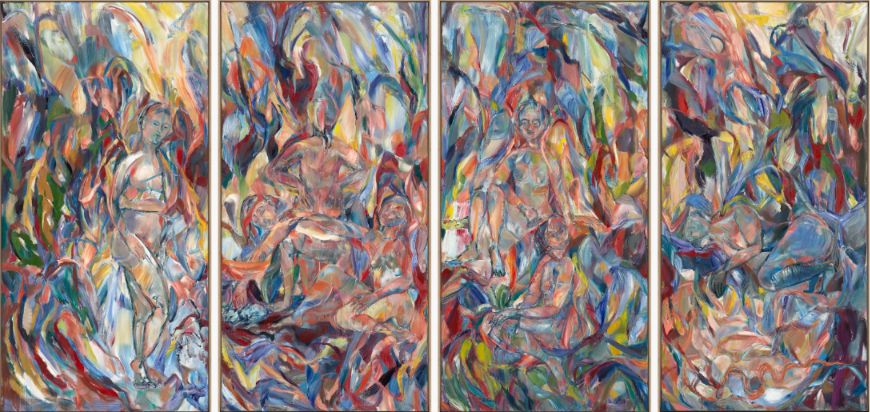
Fragment einer ldylle, 2026.
Galerie Max Hetzler is pleased to present ROT GELB BLAU STAUB, a solo exhibition by Sabine Moritz, in Berlin.
September 11 - October 31, 2026
For the exhibition, Moritz brings together twelve large-format canvases arranged in groups of three, her first quadriptych oil painting, and a still life. In addition, a selection of works on paper are presented on the upper floor gallery, offering an insight into the artist’s diverse oeuvre from the last thirty years. Working in abstraction and figuration, Moritz paints or draws on canvas and paper, across large and small scales, in pared-down tones in her early works, and later in vivid hues.
Since 2023, Moritz has been introducing corporeal forms into some of her compositions, testing notions of the abstract-figurative divide. In her new monumental quadriptych, female bodies emerge in a kind of alchemy from gestural swathes and strokes of paint. Slipping in and out of focus, their contours gently dissolve, ebbing and flowing between pigment and form. Driven by instinct, Moritz paints freely and spontaneously. Her figures evoke associations with the canon of art history – from Titian to Picasso – as much as with raw emotion, sentiment and mood.
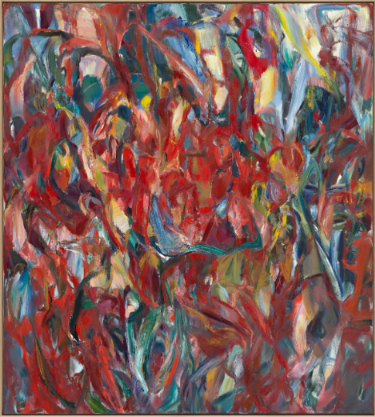
Feuer II, 2026
Translating to ‘RED YELLOW BLUE DUST’, the title of the exhibition encapsulates Moritz’s aesthetic and conceptual dialogue between colour and matter. In her paintings, dense areas built largely from primary colours seem to diffuse upwards, as if shifting between elemental forms. Light-filled daubs in sky-blue and rose-petal pink are offset by verdant greens and yellows in the artist’s three Luft (Air) paintings. In the Feuer (Fire) works, a deep red smoulders at the centre of each canvas. From the jewel-like, dappled ground of Teach us to number our days II, three skulls materialise, forming an enduring memento mori.
On the upper floor, Moritz’s works on paper present figurative images and associations that have come to define her early practice: helicopters, ships and apartment blocks; singular flowers wilting or blooming on a stem; the lone figure of a child. Such references stem from her childhood memories of growing up in the GDR, as well as art-historical, social and political iconography, and recurring symbols of ephemerality. They permeate her drawings with the elusiveness of a dream. Drawn into the artist’s world, the viewer is invited to linger and weave narratives from these momentary fragments of form.