GROUP EXHIBITION: PAINTER/MODEL
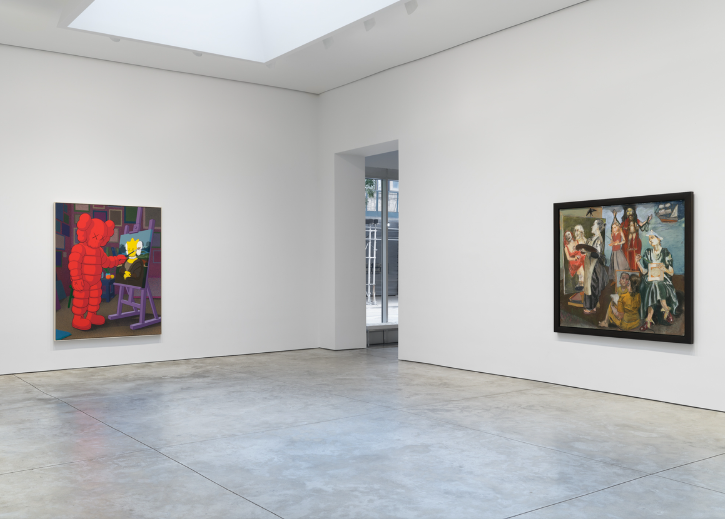
SKARSTEDT Chelsea is pleased to announce Painter/Model, an exhibition devoted to one of art history’s most enduring subjects: the charged encounter between the artist and their sitter.
October 30 - December 20, 2025
With a genealogy that stretches back to Vermeer’s The Art of Painting (circa 1666-1668) and Velázquez’s Las Meninas (1656), the subject of the painter and model has over time developed into a distinct genre within the history of art. As a pairing that dramatizes intimacy and distance, invention and observation, power and vulnerability, the theme of the painter and model has become a site for artists not only to rethink the act of painting but also to probe the structures of power embedded in the act of representation itself.
The exhibition revolves around Picasso’s extensive engagement with the subject in 1963. For Picasso, who was over 80 years old at the time, his obsession with the scene of creation suggests a certain anxiety about both his virtuosity and his virility at this late stage of his life. As Marie-Laure Bernadac writes, “Through all these manifold scenes, Picasso is asking himself the question, ‘What is a painter? A man who works with brushes, a dauber, an unrecognized genius, or a demiurge, a creator who mistakes himself for God?’” Through these frantic, urgent compositions, Picasso strips painting down to its barest elements, interrogating the very essence of painting as manifested in the primal confrontation between man and woman.
While the eroticism of the female nude is worshipped and somewhat taken for granted in Picasso’s work, later artists have exposed the fundamental asymmetry of the painter/model relationship. For instance, in Eric Fischl’s (What is there) Between the Artist and His Model (1994), it is as if the painter’s gaze itself had aggressively thrown the model to the ground. While Fischl reveals the latent violence of the painter’s desirous gaze, in her painting, Arrangement (2010), Dana Schutz subverts the sexualization of the female form through a grotesque reimagining of the painter and model scene. While she borrows Picasso’s basic compositional structure, Schutz replaces Picasso’s voluptuous woman with a monstrous hybrid that thwarts the male gaze and threatens to lunge toward the powerless painter with its twisted limbs. If Schutz contests the passivity of the female nude within the history of art, Paula Rego and Cristina BanBan instead radically reclaim the artist’s studio as a domain of female agency. Inspired by Balzac’s seminal allegory of artistic creation, The Unknown Masterpiece, Rego’s The Balzac Story (2011) inverts the traditional hierarchy between male painter and female muse by replacing Balzac’s male protagonists with female artists, engrossed in the act of creation. In a new, monumental diptych, Cristina BanBan similarly reconceptualizes the artist’s studio as a distinctly female space, where her heroic women are represented by and for each other.
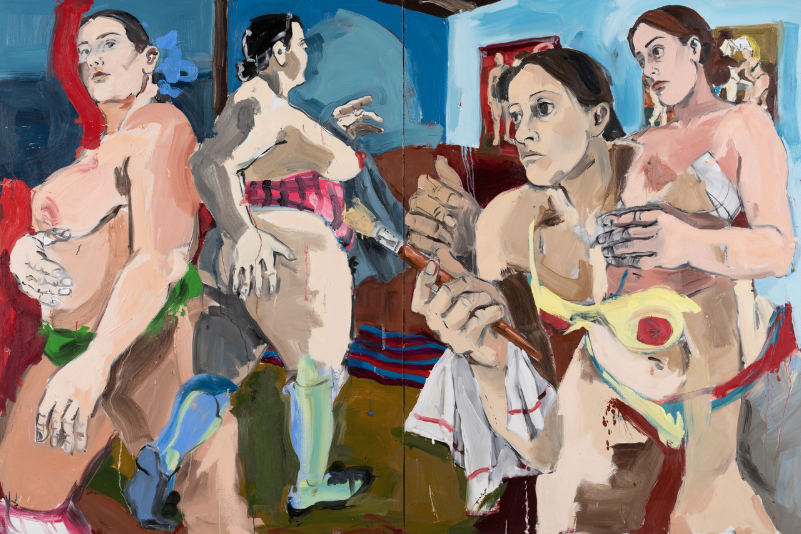
Although she stages a similar role-reversal between male painter and female model in The Painter and Her Model (2025), Chantal Joffe reimagines the painter/model relationship as one of intimacy and reciprocity rather than hierarchy. Despite the echoes of Picasso’s simplified figuration and Matisse’s flattened space, Danielle Orchard likewise envisions the possibility of a non-hierarchical relationship between painter and model, thereby underscoring how the contemporary painter can cite, challenge, and expand upon the legacy of her modernist forebears.