GROUP EXHIBITION: 1985-2025 MODERN CHINESE INK PAINTING EXHIBITION
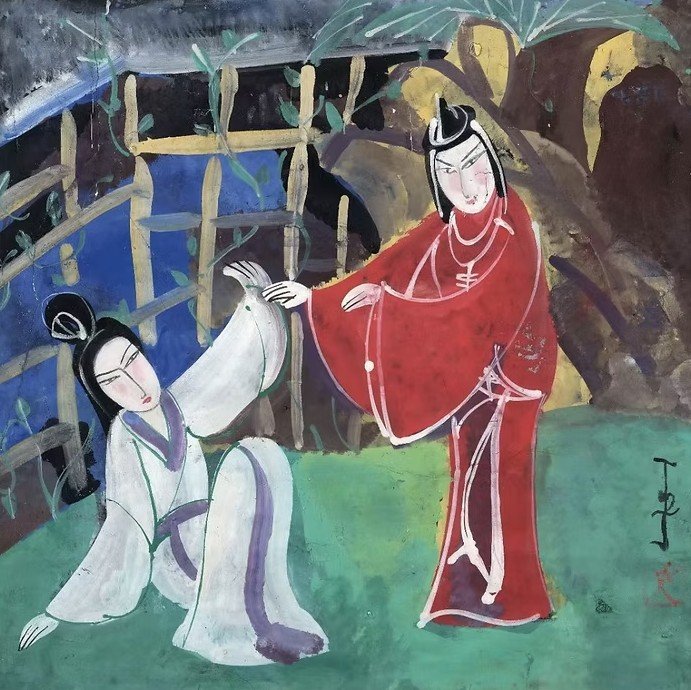
TANG CONTEMPORARY ART is pleased to announce a grandly present the major group exhibition “1985–2025: Chinese Modern Ink Art” at its dual spaces in Beijing’s 798 Art District. Curated by Zou Jianping, the exhibition brings together more than 120 works by 68 artists, offering a comprehensive survey of four decades of landmark achievements and innovative explorations in ink art.
March 14 – May 6, 2026
Looking back at the awakening and breakthroughs of ink within the currents of contemporary Chinese art, the exhibition traces how ink has evolved from tradition to the modern and contemporary, and from the East onto the global stage.
Participating artists include: Wu Guanzhong, Walasse Ting (Ding Xiongquan), Ding Liren, Yuan Yunsheng, Jia Youfu, Shi Hu, Liang Quan, Wang Chuan, Zhu Xinjian, Gu Wenda, Tian Liming, Xu Lele, Yang Jinsong, Zou Jianping, Liu Zijian, Wang Yanping, Wang Huangsheng, Yang Jiechang, Hu Wei, Liu Jin’an, Liu Yun, Li Jin, Lin Rongsheng, Shen Qin, Zhang Jin, Shan Fan, Li Xiaoxuan, Zhang Yu, Zhou Jingxin, Wang Tiande, Zuo Zhengyao, Liu Qinghe, Qin Feng, Shi Lei, Su Liqun, Feng Fang, Cai Guangbin, Fang Lijun, Wu Rongguang, Xu Lei, Wu Yi, Fang Xiang, Jiang Hongwei, Lei Zirren, He Weina, Wang Shaoqiang, Liu Haiyi, Tan Jun, Tao Aimin, Hang Chunhui, Wu Jian’an, Li Na, Kang Chunhui, Ma Bing, Tao Qingyou, Zhou Mingde, Liu Tianlian, Sun Ziyao, Wang Hongzhou, Yao Hao, Li Sen, Xiong Hui, Yu Yu, Qiu Rongfeng, Ye Zi, Xie Tianzhuo, Wang Qingyuan, and Liu Yujun.
The creation and reinvention of Chinese ink painting have traversed four decades since 1985.
Forty years ago, the claim that 'Chinese painting has reached a dead end' pushed the medium to a crisis point. Since then, Chinese ink painting has faced both significant challenges and occasional setbacks. Overcoming repeated disappointments and obstacles, it has navigated major changes in culture and society and, despite many difficulties, continues to assert its value in contemporary art.
From "Chinese painting" to "ink painting," then to "ink art," the evolution of nomenclature traces the arduous trajectory of generations of artists struggling, breaking through, and reconstructing within the interstices of tradition and contemporaneity, East and West. Today, as we assemble these works spanning four decades, we offer not merely a review of achievements but a re-examination of ink's destiny—whether it has succumbed to adversity or achieved rebirth through rupture.
Four decades ago, that generation of young artists attempted to "make the old new" through Neo-Literati Painting, seeking to reclaim traditional cultural lineage, yet fell into new formalist constraints through imitation of ancient brushwork. Experimental ink, taking Western modern art as a reference, deconstructed brush-and-ink conventions and expanded media, yet often devolved into hollow formalism. The introduction of new media liberated ink from the confines of paper; cross-disciplinary fusion with installation, video, and performance appeared vibrant, yet frequently lost cultural substance amid technical spectacle.
Ink art has long drifted between "brush-and-ink centrism" and "medium theory," exhausting itself through anxiety over Western centrism and obsession with Eastern discourse, becoming a "lonely night wanderer" after the artistic feast, caught between tradition and the "Other" (the contemporary).
Four decades of Chinese ink art development have failed to sever ties with tradition completely, yet struggled to integrate genuinely into contemporary art's mainstream vocabulary; aspiring to shed the heavy burden of "national essence," yet reluctant to relinquish the symbolic dividends of traditional culture...
Nevertheless, we must pay tribute to all explorers! From Yuan Yunsheng's prying open of public vision with life's celebration to Liu Qinghe's portrayal of urban men and women; from Gu Wenda's deconstruction of text to Wang Tiande's fire-burning experiments; from Zhang Yu's fingerprint narratives to Cai Guangbin's digital constructions... generation after generation of artists have shattered ink's inherent boundaries through "self-reflexive" courage. Whether breaking free from academic constraints of brushwork, escaping traditional symbolic traps, reconstructing ink language through mixed media, or excavating cultural roots in Western regions, they have attempted to build bridges across the fault lines between tradition and contemporaneity. Their efforts prove that ink is not destined to become a museum specimen; it retains the artistic agency to respond to its era and bear philosophical weight.
The works assembled in this exhibition encompass both creative transformations of traditional brushwork and bold experiments with new media, as well as profound reflections on cultural identity and interventions into real-world issues. We intend neither to gloss over the present nor to presume arrogance, hoping only to present ink's true ecology over these forty years—its confusion and bewilderment, exploration and breakthrough, but also its refusal to surrender and its persistence.
Generation after generation interrogates itself through the brush: when ink no longer clings to brushwork's purity nor frets over categorical boundaries, can it become a freer vehicle for artistic expression? When tradition is no longer an insurmountable barrier and the West no longer a mandatory benchmark, can ink, rooted in native cultural soil, grow genuine indigenous qualities that transcend the contemporary?
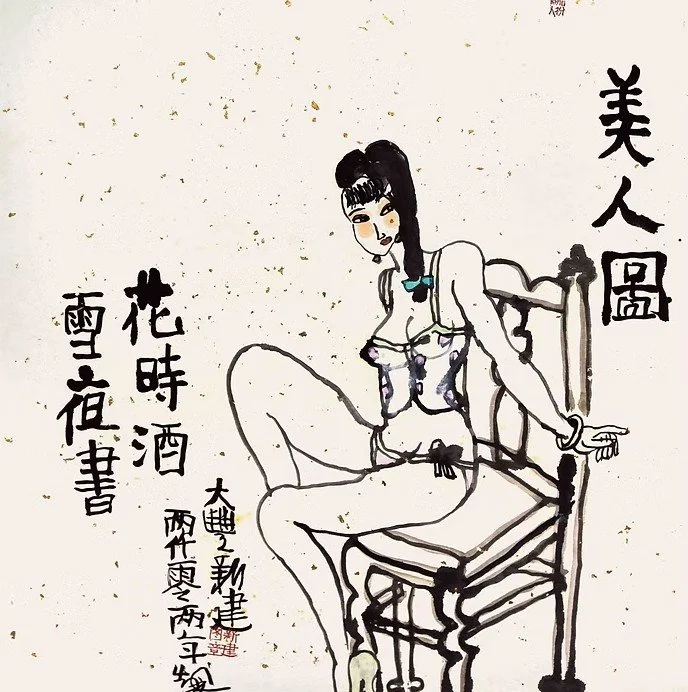
Tradition and contemporaneity are not oppositional; their rhetoric and reconstruction within artworks are unified. Visual reference does not aim to reinforce object representation but directs vision toward the conversion of the artist's concept—that is, conceptualism—where the work becomes confirmation of the artist's subjectivity.
Ink's future lies neither in blind worship of tradition nor deliberate imitation of the West, but in lucid recognition of cultural identity and profound engagement with lived reality. It must break free from the narcissism of "literati taste" and the emptiness of "abstract expression," escape formalist entanglements and the abuse of cultural symbols, and recover cultural genes through "spiritual archaeology" and gain vitality through real-world intervention. As I have comprehended through my "Journey to the West" practice, tradition is not a fixed specimen but a cultural resource that can be torn, stretched, and reconstructed; ink is not a rigid medium but a vehicle capable of bearing complex humanity and reflecting social reality—the images flowing from ink are becoming visual expressions of power, faith, emotion, and collective memory.
Today, standing at this new historical juncture, we hope this exhibition becomes a new starting point—allowing ink art to emerge from the ivory tower of Oriental mirrors, to escape shallow accommodation to cultural consumption, suffused with the smoke and fire of human life, bearing the bloodlines of existence, grinding against the hardness of reality. Only thus can the millennia-old patterns of brushwork gain rebirth in contemporary contexts rather than sinking into nostalgic cultural symbols or pages of musty historical records.
Even now, the generation of young ink practitioners emerging from academies approaches traditional painting rhetoric through deconstruction and subsequent reconstruction. They not only provide new spaces for the social knowledge embedded in images but may also bring greater thematic imagination and creative construction to visual communication.
The narrative of Chinese ink remains unfinished. Its future must not live in the shadow of the past; it compels every creator to confront reality and advance boldly. Life's present scene may still be bewildering, but art's history, like a mirror placed within the soul, illuminates each creator's spirit thoroughly. It awaits our reshaping of history, our writing of today, our journey toward the future.