GROUP EXHIBITION: CHRONOLECT
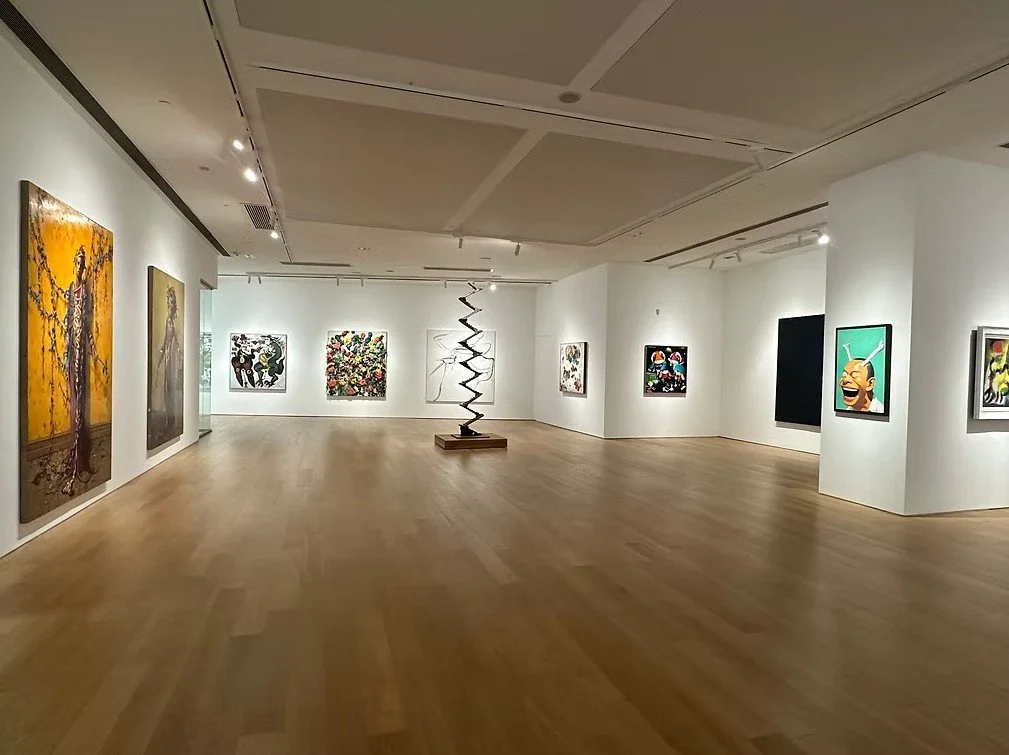
TANG CONTEMPORARY ART is proud to announce to celebrate the tenth anniversary of our Hong Kong space, we are presenting a large-scale group exhibition "Decade One: Chronolect".
December 18, 2025 - January 31, 2026
The exhibition's title, "Chronolect" – a lexicon of time – captures the distinct artistic language developed over this inaugural decade. The exhibition aims to focus on the most precious gains in artistic practice—namely, "accumulation and growth"—connecting the iterative evolution of the artists' works, the gallery's and collectors' explorations within the industry, and the unwavering adherence to their original aspirations.
Since taking root in Central in 2015, the space has borne the academic accumulation of nearly 100 exhibitions, becoming a vital bridge connecting Chinese contemporary art with global dialogue. The second Hong Kong space was established in Wong Chuk Hang in 2023, focusing primarily on pan-international projects with young artists, interspersed with group and solo exhibitions featuring artists from Europe, America, Southeast Asia, and Japan.
This "Decade One: Chronolect" exhibition stands as a milestone connecting past and future. The Central space will bring together fifteen artists of international influence, using diverse media to outline the ecosystem of contemporary art. The participating lineup spans creative lineages across multiple generations: from internationally renowned pioneers such as Yue Minjun, Huang Yongping, Yang Jiechang, and Zhu Jinshi, to mid-career representatives including Qin Qi, Cai Lei, Wu Yi, Wang Du, and Zhao Zhao, and further to the highly anticipated emerging forces Xiyao Wang and Leng Guangmin. The selection also encompasses international artists who transcend cultural boundaries—from Jonas Burgert, a profound thinker of German contemporary painting, and Spanish conceptual realist Edgar Plans, to Filipino cross-cultural practitioner Jigger Cruz and one of Indonesia’s most internationally acclaimed contemporary artists, Heri Dono. The juxtaposition of these fifteen artists gives form to the "Chronolect" – a unique vocabulary of time shaped by a decade of practice. We are not only gathering the artistic brilliance of the past decade but also converging a stellar spectrum that crosses geography and generations. The exhibition is not merely a retrospective of past achievements but hopes, through these powerful works, to reflect a facet of the development of contemporary art from both Hong Kong and a global perspective, heralding a prospective view of the next artistic decade.
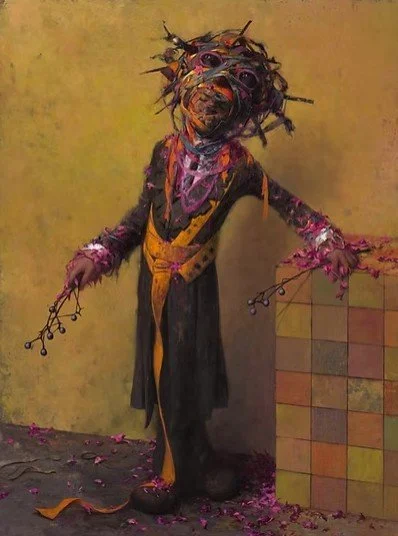
Jonas Burgert, with his epic, grand scenes, is dedicated to constructing a profound theater of the human psyche. Over the past decade, his paintings have continually gathered fragments of existence—pain, longing, and life itself—solidifying them into moments filled with drama. His works contribute a profound syntax to the "Chronolect," acting like searchlights, guiding the viewer to the sublime spiritual dimensions that art can reach in the digital age.
Cai Lei has deeply cultivated the boundary between two and three dimensions for a decade with his minimalist geometric language. He gathers space and light themselves as materials, transforming cold plaster and pigment into tactile poetry. Each seemingly minor advancement redefines the dimensions of perception, embodying a profound academic trajectory accumulated through focused exploration and adding a unique grammatical structure to the exhibition's temporal lexicon.
Jigger Cruz deconstructs and reshapes art historical classics with a ferocious yet precise painterliness. He "gathers" the dialectic of destruction and creation through the layering of pigment, showcasing a unique growth trajectory that transcends cultural barriers and introduces a bold, textured vocabulary into the "Chronolect."
Heri Dono is known for his uniquely contemporary, Javanese style inspired by traditional Wayang Kulit (puppet theatre). Through his construction of thoughtful layers in his work, he is able to emphasize the more serious, underlying reflections on and criticisms of social and political issues such as military intervention, political corruption, and environmental destruction, allowing easier engagement with often difficult concepts.
Huang Yongping is one of the indispensable figures in the Chinese avant-garde art movement of the early 1980s. In 1986, he co-founded "Xiamen Dada." In 1989, he traveled to France to participate in the landmark exhibition Les Magiciens de la Terre at the Centre Pompidou, after which he lived and worked in France. The collision of multiple identities and cultural differences led him to develop an approach in his work that "uses the East to challenge the West and the West to challenge the East."
Leng Guangmin calmly gathers the readymades and artificial textures of the consumer era, translating them with exquisite skill into ambiguous painted objects. Beneath their smooth, jade-like surfaces, his works conceal profound questioning of material culture and nihilistic aesthetics. Over this decade, he has continuously refined his unique, cool aesthetic, contributing a tone of critical reflection to the decade's evolving language.
Edgar Plans's "little heroes," with their innocence and imagination, confront the complexity and norms of the adult world. His creation consistently gathers and guards that initial childlike wonder and courage; this unchanging original heart has become the warmest beacon on his artistic growth path. His works contribute a universal dialect of pure emotion to the "Chronolect," proving to be the best bridge connecting different cultures.
Qin Qi's canvases resemble an ever-expanding museum of styles. Over ten years, he has freely gathered fragments of art history, everyday objects, and personal memory, reassembling them into spectacular scenes filled with dramatic tension. His creative journey itself is an unceasing experiment and iteration, his eclectic style forming a crucial and expansive chapter in the exhibition's narrative of time.
Wang Du works in a range of media, including installation, sculpture, photography, and multi-media. His statement, “I am media, I am reality, I am image,” could be seen as an interpretation of the concepts behind his work. He believes that “the completely digital third reality is constructing a contemporary society and culture that needs to be constantly redefined.”
Xiyao Wang's canvases are direct manifestations of flowing emotions and inner landscapes. Her vibrant brushstrokes gather every moment of intuition, struggle, and ecstasy from the creative process. As a highly-touted emerging artist, her practice iterates rapidly, growing naturally like an organism. She speaks the "Chronolect" with a raw and vital accent, recording the most precious original aspirations and burgeoning creativity of a young artist.
Wu Yi's works have been exhibited in National Art museum of China (“Experiment of tension--Exhibition of Expressive Ink-wash Painting”, 1994), Pace Gallery (Beijing), Museum of Contemporary Art in Zagreb, Crotia (“Golden Harvest:China Modern Art Exhibition”, 2002), Malaysia National Art Gallery (“Spot, Radiation and Penetration: Visual Transmission from Brush and Ink”, 2004) and other important art institutions in China and abroad.
Yang Jiechang's artistic practice as a calligrapher-painter turned global social actor inverts the contemporary Chinese art world norm of using Western avant-garde forms to critique contemporary Chinese society. He accomplishes this by adopting the performative expressivity of the traditional brush and the paradoxical dialectics of pre-modern Daoist skeptics to expose the underlying social and cultural forces that shape our contemporary global reality.
Yue Minjun, a pioneer of Chinese contemporary art, has seen his iconic laughing images become cultural symbols of an era. In the flowing light of the past decade, his works, like never-eroding mirrors, continuously reflect individual anxiety and social reality beneath collective revelry. This presentation secures his legacy within the "Chronolect", not only gathering a segment of glorious historical light but also bearing witness to the precipitation and reverberation of his critical spirit through the long river of time.
Zhao Zhao engages with real subjects in multiple mediums and plays with art forms, emphasizing an exploration of the relationship between the individual and the rest of society. His work is developed around the subtle emotional changes that take place as we are confronted with diverse cultural influences. He brings together the expressive methods of contemporary art and traditional culture to create metaphors for people's living circumstances and modern society's real conditions in a globalized world.
Zhu Jinshi produces abstract paintings whose surfaces are built up with thick, near-sculptural layers of oil paint. Resembling colorful landscapes, Zhu’s images range in palette and scale, but the artist is known to always apply his oil paint with spatulas and shovels. Producing dense lashings of color, the artist’s method recalls the style and techniques espoused by the German Expressionists, whom Zhu was profoundly influenced by during his years living in Berlin.