ISAAC JULIEN: ALL THAT CHANGES YOU. METAMORPHOSIS
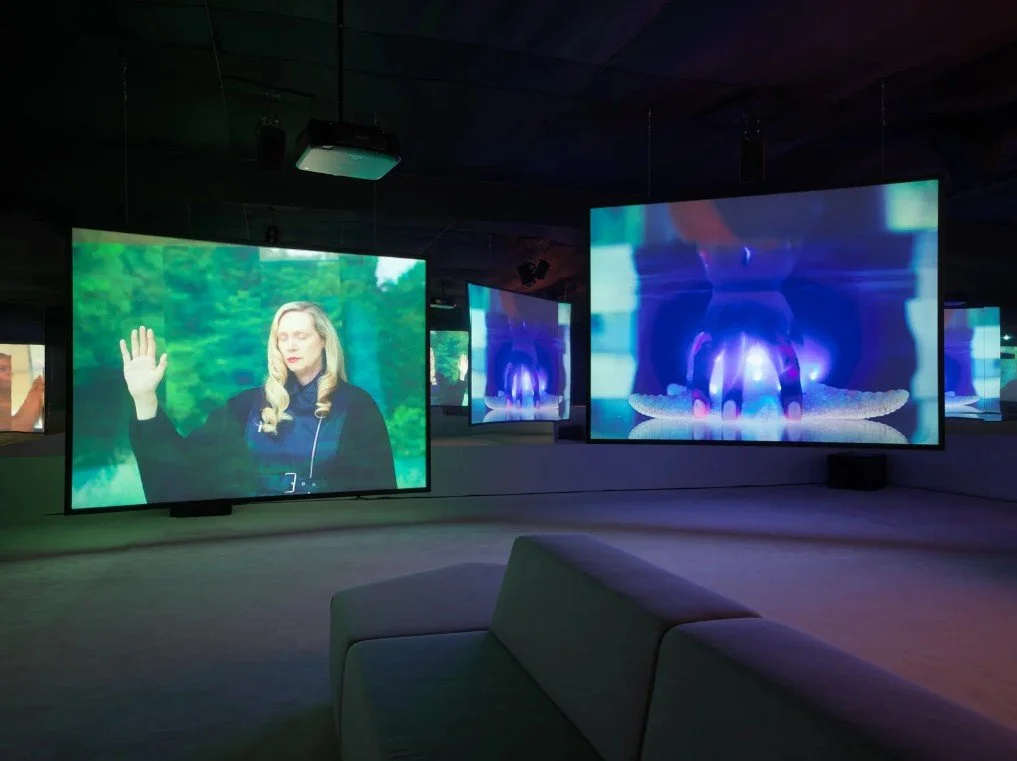
VICTORIA MIRO is delighted to present the world premiere of the five-screen installation of Isaac Julien's acclaimed film installation All That Changes You. Metamorphosis, accompanied by new photographic works.
February 13 – March 21, 2026
All That Changes You. Metamorphosis, 2025, is a vivid, sweeping, visual poem about change, what it means to transform, to adapt and to survive. Commissioned to celebrate 500 years of Palazzo Te, Mantua, Italy (where it is currently on view) and exhibited here for the first time as a five-screen installation, Julien's latest work moves between science fiction, philosophy, ecology and art, imagining new forms of life and identity beyond the human.
The work draws inspiration from thinkers who explore how transformation shapes who we are and how we live, including writers Octavia Butler, Naomi Mitchison, Ursula K. Le Guin and philosopher Donna Haraway. Their ideas weave through the film's layered images and lyrical dialogue, beginning with Donna Haraway reading from her provocative thesis, Staying with the Trouble, 2016. Haraway's voice, outlining her theory of 'becoming-with-living with other species rather than seeking to dominate them grounds and sets the tone for the film. Haraway reminds us that 'trouble' once meant 'disturbance' suggesting that to live we must embrace uncertainty rather than fleeing from it. For Julien, metamorphosis is both survival and an act of imagination, a way of learning to live in a world in flux.
Two protagonists are at the heart of the film, played by internationally acclaimed actors Sheila Atim and Gwendoline Christie. Atim's character, Lilith, is inspired by two of Octavia Butler's heroines, combined into one mythic figure who embodies transformation. Opposite her is Naomi, portrayed by Christie and loosely based on Naomi Mitchison's science fiction novel Memoirs of a Spacezcoman which Mark Nash first adapted into a screenplay at the beginning of 1990s, and which served as an inspiration for All That Changes You. Metamorphosis. While Lilith speaks from a posthuman future, Naomi remains grounded in the human present, searching for new ways to connect. We are not in control," she says. "Not even of ourselves. Everything is in flux. Naomi's strength lies in empathy, in listening, adapting, and forming bonds across difference.
All That Changes You. Metamorphosis also draws on contemporary ecological and philosophical thinking from scholars such as Anna Tsing and Carlo Rovelli. Rovelli's conception of time as something that does not flow independently but instead emerges from a web of relationships resonates with Haraway's sense of interconnectedness, her insistence that all beings are entangled in shared. processes of becoming. Together, these ideas are felt rather than stated, embodied in the rhythms of the film and in the ways Lilith and Naomi move, speak, and encounter their changing environments.
Celebrating Palazzo Te's 500th anniversary, Julien's work centres on ornate rooms of the palace. Giulio Romano's Renaissance masterpiece becomes the stage for transformation. In Romano's Room of the Giants, frescoes of collapsing Titans set the scene for cosmic rebirth. Both protagonists are time travellers who move across a series of architectural spaces that function not merely as settings but as living environments. These spaces shape and respond to the character's journeys while delineating different times: from Palazzo Te to the postmodern, twentieth-century Charles Jencks's Cosmic House in London, to a futuristic glass 'spaceship' and video art pavilion by Herzog & de Meuron for the Kramlich Collection in Napa Valley, California, and finally Richard Found's glass home in Cotswolds. Each site bears its own signature, a living presence that Lilith and Naomi transform with every encounter. An Apollo space capsule, placed among the California redwood trees transforms over the course of the film from a quiet place for reflection into a symbol of conquest.
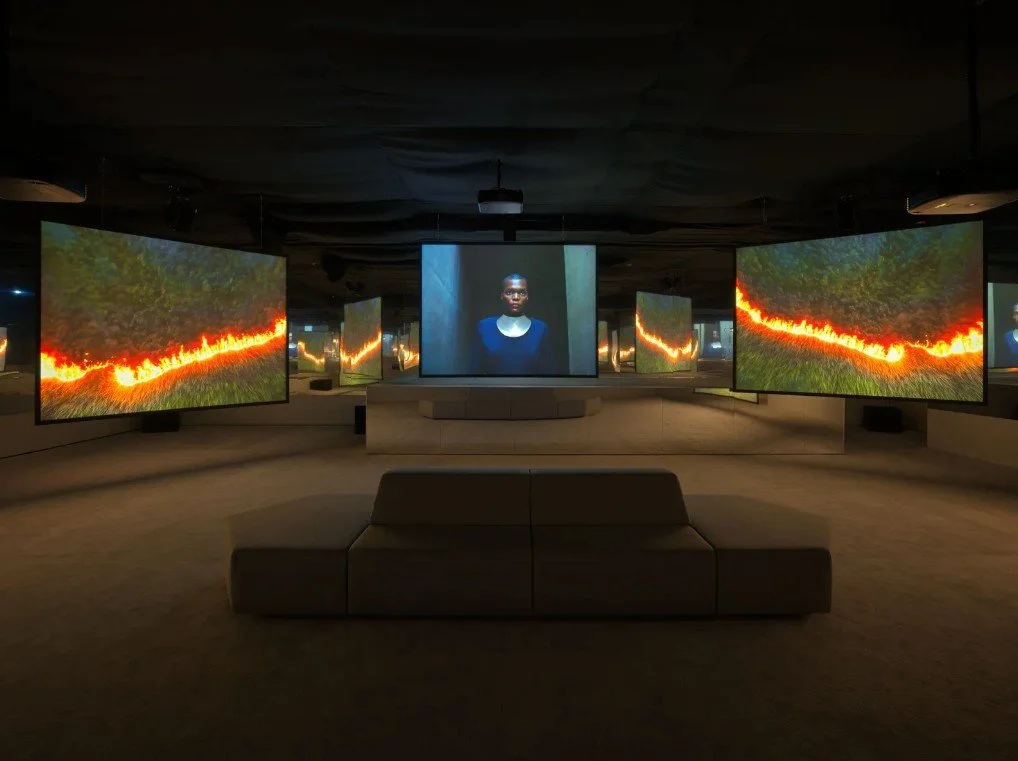
Those human-made sites are contrasted with the lush and meditative and the devastating and chaotic, hetween verdant landscapes and scenes of environmental collapse. Ancient woodland, luminous jellyfish, raging forest fires and solar flares evoke the fragile web that binds all life.
Presented across five screens within a mirrored environment, the installation encourages multiple viewpoints. Scenes overlap, dissolve, are reflected and reappear. Dialogue becomes poetry and time folds in on itself. Every moment carries with it a metamorphosis, Naomi softly speaks, capturing the film's rhythm of renewal. All That Changes You. Metamorphosis explores the non-linear and invites the viewer to move and drift between layers of image and its immersive sound, becoming part of the transformation the film depicts.
At its core, All That Changes You. Metamorphosis questions the idea that humanity stands at a zenith. Lilith and Naomi embody a new kind of intimacy, one that grows from difference rather than sameness. "It was from the difference between us [...] that love came, Lilith says. This is posthumanism not as the end of humanity, but as its rebalancing within a shared ecology.
The work does not provide solutions or complete answers, instead asking us to inhabit change, to see transformation as part of what it means to be alive. Time is now measured by the rhythms of earth, air, and fire. Isaac Julien invites us to look at the world in motion, and to imagine how we might change with it.