
WANGARI MATHENGE: Re-membering
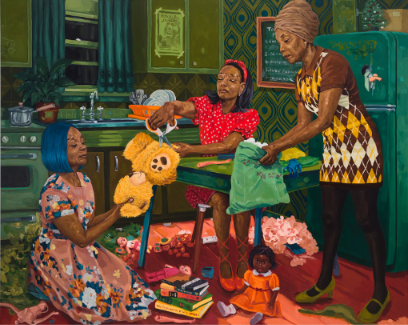
Re-membering XII (The Wednesday Women's Club)
Lévy Gorvy Dayan is delighted to announce Wangari Mathenge: Re-membering, the artist’s first solo exhibition with the gallery in New York.
September 17 - October 24, 2026
The exhibition’s title Re-membering derives from the artist’s series of the same name, which she began in the fall of 2024. It was inspired by Ngugi wa Thiong’o’s 2009 book Something Torn and New: An African Renaissance—which focuses on the critical impacts of colonialism and slavery on the experience of diasporic and continental Africans, as well as strategies of resistance and recovery.
The new paintings on view at Lévy Gorvy Dayan constitute another path in Mathenge’s journey, representing her project as one of action. As she explains, “‘Re-membering’ signifies not merely the act of recall, but the active gathering and reassembly of what has been fragmented: cultural memory, inherited forms, histories, and ways of seeing.” In these new works, Mathenge portrays women—each an avatar for the artist—in vibrant domestic interiors interacting with, altering, and reconstructing the objects and spaces around them.
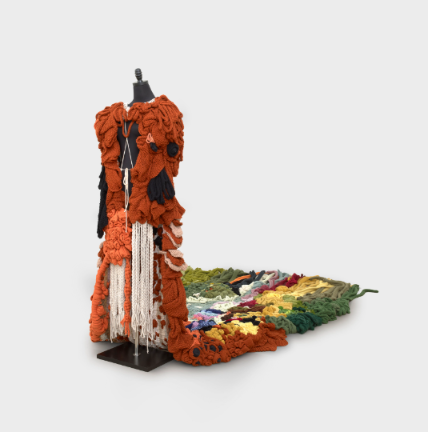
Re-membering IX (The Shape of Inheritance), 2025–26
Displayed on a dress form, the ornate and voluminous knit sculpture Re-membering IX (The Shape of Inheritance) (2025–26) stems from the memory of a historical Gikuyu garment. The largest ethnic group in Kenya, to which Mathenge also belongs, the Gikuyu’s traditional modes of dress were deeply rooted in craft, in particular their practice of treating leather, including sheep- and goatskins, resulting in warm ochre- and cinnamon-toned clothes.
Again bringing her practice into her community, the knitting was done with contributions from Mathenge’s circle, in her words, “extending ‘Re-membering’ into a collective act of making, in which cultural form is not simply preserved but remade through shared labor, memory, and care.” As the dress moves down towards the train, allusions to the human figure transform into those of landscape and terrain, bridging the distinctions between body and land. In Re-membering, Mathenge deconstructs how history is produced and experienced, and composes how it can be inhabited and reenvisioned.