DAVID HAMMONS AND JANNIS KOUNELLIS
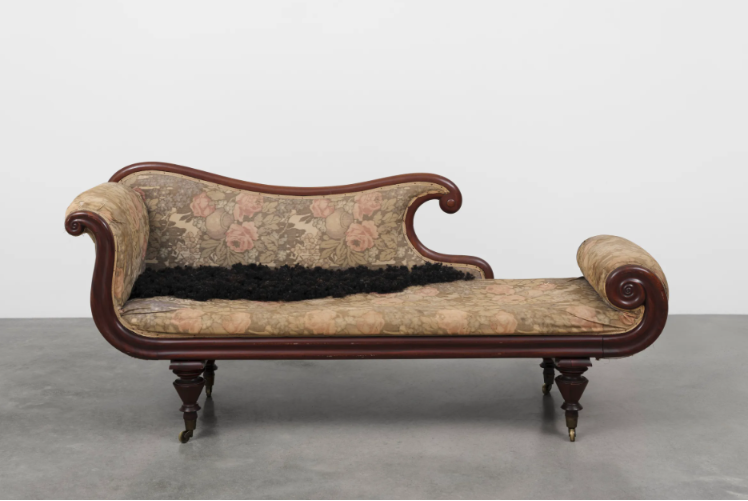
WHITE CUBE presents an exhibition of works by American artist David Hammons (b.1943) and the late Greek-Italian artist Jannis Kounellis (1936–2017), marking the first two-person exhibition of their work in over 30 years.
May 30 - June 13, 2026
They make the near-impossible look easy, these two, and if you have doubts then try it yourself. Select, from all the teeming materiality of the world around you, one or two elements: things that are right in front of everyone’s eyes, but near-invisible in their familiarity. Now recode your selection as art, but lightly, in a way that keeps the realness intact and – the trickier bit – makes it bloom ideationally. What you’ve focused on must remain what it is but also point, synecdoche-like, towards the systems and inequalities that surround it, at the arrant adjudicating-from-above of what matters, what has value or doesn’t. Relatedly, it should place itself in smart conversation with the fluctuant state of art. It should sing in a minor key while feeling extremely major.
Done right, that’s wizardry. So yes, it makes sense that David Hammons and Jannis Kounellis were friends: born seven years and 8,000 kilometres apart, they first met properly in 1993 at the American Academy in Rome, exhibited there together, stayed close afterwards.1 Even leaving aside the mutated Arte Povera DNA within Hammons’s art, game will recognise game; and the oeuvres of both artists testify to their understanding that art is the most serious of games, one with only a tiny number of meaningful moves at any time.
Case in point. In 1958, when the Greek-born Kounellis was in his mid-twenties and had recently relocated to Rome, he began the ‘Alfabeto’ (Alphabet) series of paintings he’d develop until the mid-1960s. What he saw on the city streets – at a hinge moment when there was a growing exhaustion with the hermetic navel-gazing of Abstract Expressionism and Art Informel but hardly anyone seemed to know where to go next – was signage, official language, the visual traces of a cultural order. At the time, Italy was in the throes of its postwar economic miracle, which depended on something like an ordered and functional society, of which signs – go this way, go that way, do this, you can’t do that, serve the polis – are the spoor. But ‘postwar’, as the existentialists had already diagnosed, also brought with it a sense of the loss of meaning, and orders were the language of fascism. Commingled feelings about all of this feel to come complexly together, rubbing and making sparks, in the language- and order-breaking, signal-jamming ‘Alfabeto’ paintings and drawings.
In Untitled (1959), Kounellis’s stencilled letters have the authority of language-as-system and the impersonality of stencilling – suggestive of the armed forces – but vital letters appear to be missing and sense is in freefall, headed towards rhythm-driven concrete poetry, towards stranded vowel and consonant sounds, or rewinding to Dada’s epistemic revolts. By Untitled (1961), Kounellis had incorporated the wordless but meaningful glyphs of traffic signs: as well as reversing a couple of J’s so that they look like L’s, he sends a railroad line of black and an arrow sliding out of the right-hand edge. Where next, the painting murmurs – of society, of art – while refusing to accept the imposed state of things as they are, overlaying them with the anomie and suspension du jour. This is a lot to achieve by messing with letters and arrows.
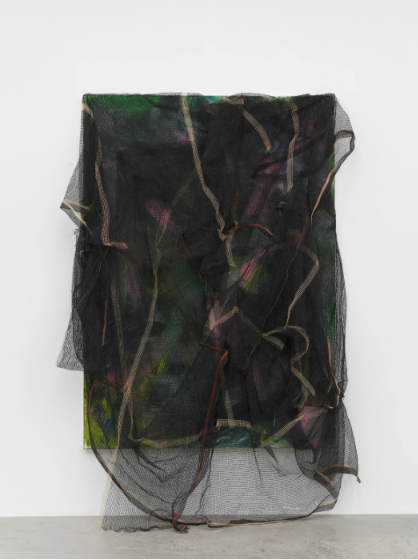
Cut to later that decade, when David Hammons was in Los Angeles asking himself similar questions concerning how life’s brutalities could show up in art, could commingle with the articulately artful. The body-print works he began in the late 1960s, which counterpoint the undeniable indexical evidence of Black bodies with other elements (human hair, wallpaper, coloured paper, supports such as doors, windows, Plexiglas), were in partial dialogue with the European avant-garde – most obviously Yves Klein’s 1960s ‘Anthropometries’, using women’s bodies and blue paint. But they were also influenced by, or in a lineage with, the assemblage/collage practices of Los Angeles artists such as Noah Purifoy and Betye Saar. These works, like Kounellis’s mangled alphabets, are the thing-in-itself – the insistent trace of the real – plus what that thing might expansively signify when powered by extremely economical yet culturally loaded visual language.
[…] - Text by Martin Herbert