EL ANATSUI: MIVEVI
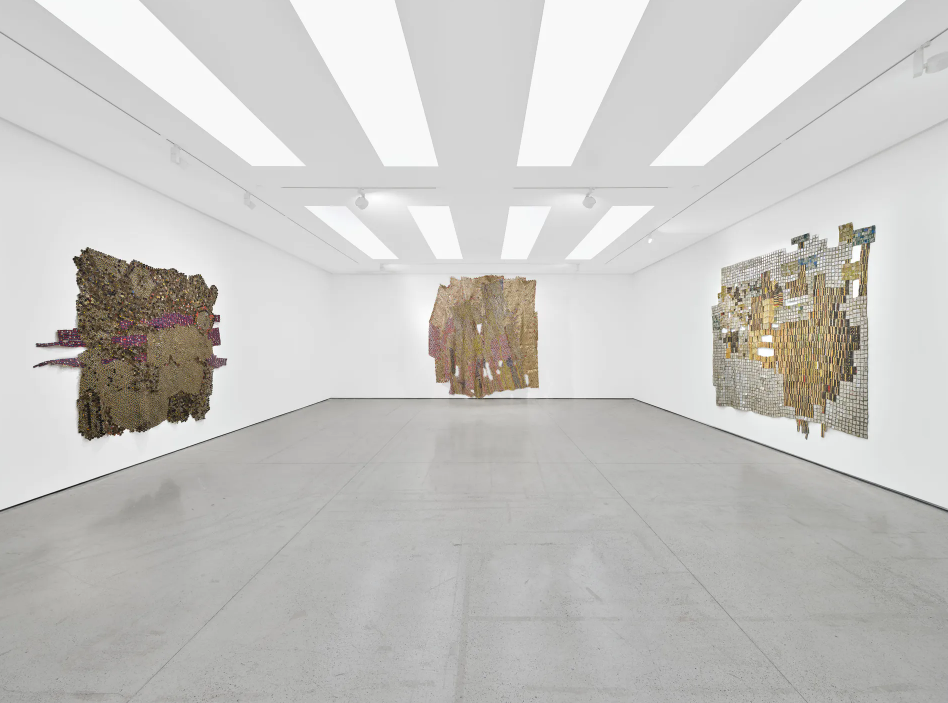
WHITE CUBE Hong Kong and Seoul presents MivEvi, an exhibition by El Anatsui.
March 25- May 9, 2026
Since the late 1990s, El Anatsui has rewritten the possibilities of sculpture with his large-scale metal works, transforming used bottlecaps into expansive fields of eloquent form and colour by cutting, flattening, crushing, folding and suturing the individual elements into infinite permutations. The internationally acclaimed sculptor’s practice rests on a conception of sculptural objecthood as provisional: form is not fixed at the point of making but remains contingent, responsive to site, orientation and time itself. The recent metal works, presented concurrently across White Cube’s Hong Kong and Seoul spaces, offer a renewed articulation of these concerns, rendering legible the processes of construction that underpin the works while newly foregrounding questions of orientation as well as duality.
For the first time in Anatsui’s metal practice, the constructive logic of the bottle-cap works is fully reciprocal: conceived and displayed as double-sided, the sculptures offer no privileged face. The caps’ reverse resolves into shimmering, monochromatic planes of modulated silver, set in counterpoint to the earthy chromatic register of browns, blacks, ochres and oxidised reds that distinguish the opposite branded surfaces. Suspended freely in space or attached loosely to the wall, this bilateral condition unsettles any fixed orientation, drawing attention to the mode of construction itself: innumerable bottle caps cut, flattened, folded and sutured into accretive sections with copper wire, their exposed joinery bringing thickness, porosity and seam into view.
The formal propositions advanced by the metal works emerge from a longer trajectory in which Anatsui’s engagement with sculpture has, from the outset, been shaped by a sustained and exacting attention to material conditions and the possibilities they afford. Born in 1944 in the former Gold Coast, Anatsui was educated at the Kwame Nkrumah University of Science and Technology in Kumasi, where his training was structured within a predominantly British colonial academic framework orientated towards Western modernist models. In 1975, he moved to Nigeria to take up a teaching position at the University of Nigeria, Nsukka – an institution that had by then emerged as a vital site for post-independence debates around artistic form, material practice and cultural identity. There, Anatsui entered an intellectually charged and interdisciplinary milieu of artists, writers and thinkers engaged in a collective reassessment of inherited conventions, animated by the search for alternative models of artmaking adequate to post-independence realities.