
HOWARDENA PINDELL: OFF THE GRID
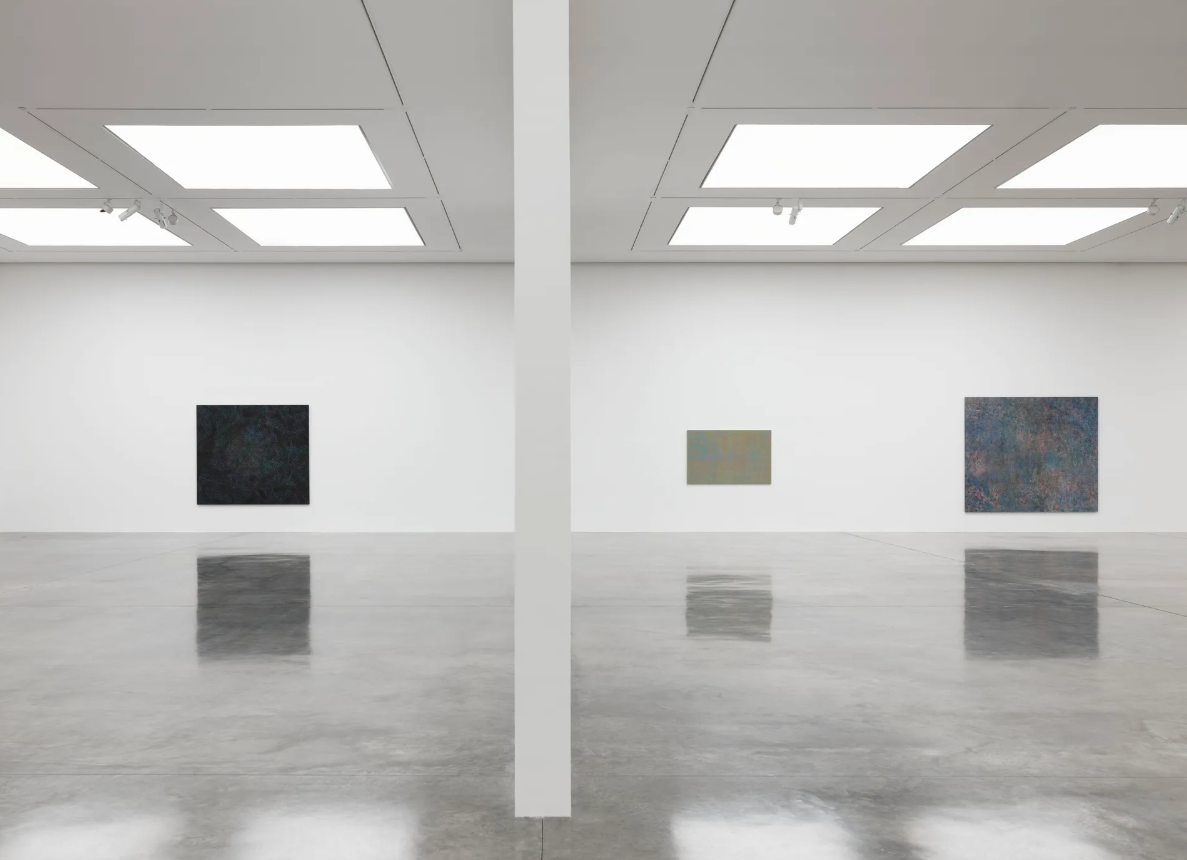
Presenting work that spans her six-decade career, ‘Off the Grid’ affirms Howardena Pindell’s status as one of the leading abstract artists of the last half-century.
November 21, 2025 – January 18, 2026
Scintillating detail, material depth and texture come together in her layered compositions that, while beautiful and joyous, never cede their political subtext rooted in African American experience. Alongside peers such as Jack Whitten, Sam Gilliam, Lorraine O’Grady, Adrian Piper and Ana Mendieta – artists who, in distinct ways, challenged the period’s critical orthodoxies and expanded the formal and conceptual capacities of abstraction – Pindell’s work reflects a deeply political undertaking. Ranging from early, geometric works on paper to video and large-scale canvases, ‘Off the Grid’ explores Pindell’s subversion of the grid as a formal device alongside the wider personal and sociopolitical concerns of her practice.
A departure point for the exhibition, the motif of the grid played a significant role in the development of 20th-century Modernism and served as a ruling principle of the postwar Minimalist movement. If the grid has been appraised for its ability to structure and organise, critic Rosalind Krauss has further noted that ‘no form within the whole of modern aesthetic production has sustained itself so relentlessly while at the same time being so impervious to change.’1 The grid is also crucial to understanding division and segregation in the United States: Thomas Jefferson’s 1785 Land Ordinance survey divided the country into uniformly apportioned zones, while in urban development, the grid would come to delineate neighbourhoods reserved for people of different classes and races.
Through Pindell’s engagement with personal history, the racialised body and West African textiles, the grid is propelled into a realm of activism and change. Born in Philadelphia in 1943, Pindell recalls a visit to the Philadelphia Museum of Art as a child, where she encountered Marcel Duchamp’s Why Not Sneeze, Rose Sélavy? (1921), which provided her with an early visual concept of the grid. In 1965, she became one of the first Black women to study art at Yale, where she was introduced to the colour theories of Bauhaus educator Josef Albers via his protégé Si Sillman. Graduating with an MFA in 1967, she moved to New York and began work at the Museum of Modern Art (MoMA), later becoming the first Black woman to hold a curatorial position there. Though she was not involved in its undertaking, she spent time at MoMA’s 1972–73 ‘African Textiles and Decorative Arts’ exhibition, where she learned of loose stitching, layered amulets and other sophisticated features of African textile arts. Artworks bearing similar features and qualities can be found throughout the exhibition, from the kaleidoscopic ‘Hole Punch’ works with their dense topographies of paper circles, to the ‘Woven Tapestry’ series with their ley lines of open seams.
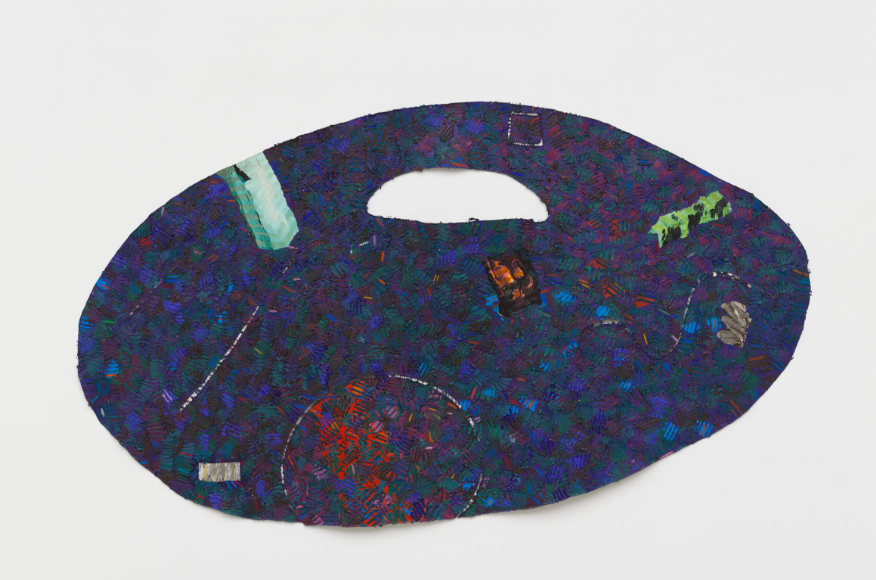
It was during her time at MoMA that Pindell developed the ‘spray dot’ and ‘hole punch’ techniques that continue to inform her work to this day. There, she began to experiment with office supplies, punching holes in manila folders, cardstock, envelopes and other stationery to create stencils that she would then spray paint through. Paintings like Untitled (1971–72) achieve a diffuse, apparently gaseous effect, the interplay of colours creating subtle modulations as well as voids of uncertain depth. Employing the ‘spray dot’ process in turn produced innumerable ‘chads’, tiny discs of paper refuse that would later comprise her ‘Hole Punch’ works. Making use of the everyday materials in her office environment, Pindell conjures associations with the monotonous secretarial labour so often enacted by lower-socio-economic echelons of women in the late ’60s and ’70s. Equally, Pindell connects her impulse to create compositions with small circles to a formative memory in her childhood during the Jim Crow era. Stopping by a root beer stand with her father, Pindell describes noticing a small red circle at the base of the mug, which she learned was used to identify and separate the restaurant utensils intended for Black customers.