SHAO FRAN: REFRAIN
WHITE CUBE presents a Shao Fan's exhibition called Refrain.
May 22 – June 27, 2026
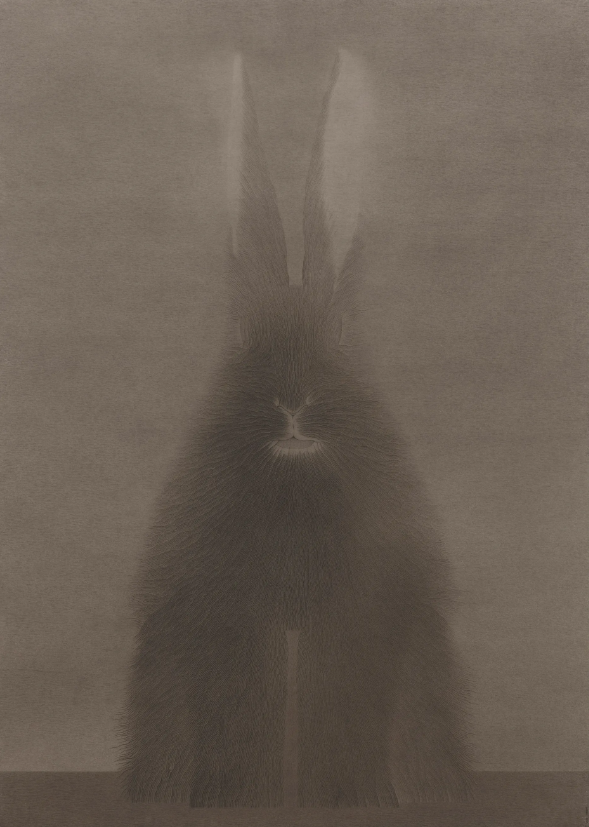
Fan's work is rife with rabbits. They first appeared in his paintings around 2009 and have reappeared ever since: solemn, watchful, and strange. Enlarged to almost human proportions, they gaze directly at the viewer, sitting upright with the ceremonial frontality of ancestral Chinese portraits. Soft ears perked up, dark eyes almost level with our own. In the early paintings, the rabbits were more figurative and detailed, rendered in muted tones of acrylic and oil. As Shao's technique and palette have become more subdued over time, the rabbits have become more spectral and elusive, molded into subtle forms with strokes of black ink that mimic fur. Even when their eyes are no longer visible, as in his most recent series of paintings, we somehow still feel as if they are staring back at us across the void.
Shao often recounts the anecdote of looking into the eyes of one of the rabbits in his care and feeling, for a brief moment, that the animal was looking back at him. In that instant of mutual gaze, the positions of observer and observed, human and animal, became fluid and indefinable. This encounter evokes one of the most suggestive parables in Taoist philosophy, in which the sage Zhuangzi (c. 369-286 BCE) describes a vivid dream in which he floats in the air like a butterfly and, upon waking, wonders if he is nothing more than a butterfly still dreaming that he is a person. The parable suggests a consciousness attuned to another frequency of perception, where identity, species, and time no longer retain their usual forms.
This transformative experience opened the door to what could be considered a “turn toward the animal” in Shao’s philosophy and aesthetic practice. The rabbit portraits were soon followed by an eclectic bestiary—animal, vegetable, and chimeric: old monkeys and cabbages, giant lingzhi mushrooms and sea creatures, bearded arhats and apples. The rabbit offers the clearest entry point into the artist's curious repertoire of everyday and quixotic things. It is a creature of the threshold, moving above and below the earth, associated with seasonal recurrence: the arrival of spring, the bounty of autumn, the waxing and waning of the moon. In East Asian mythologies, the cratered surface of the moon is said to resemble a jade rabbit, diligently grinding lunar dust into an elixir of immortality for the exiled moon goddess.
Shao’s iconography is cohered by the symbolic field longevity, wisdom and transformation share, each intimately connected to the passage of time. Yet Shao’s fixation with these temporal symbols could also be seen to reflect a deeper chronic anxiety which seems to be unique to our species. What does it mean to exist as a creature so painfully aware that time is fleeting? As the Romanian-French writer Emil Cioran once remarked, ‘There is something sacred in every being unaware [time] exists, in every form of life exempt from consciousness. He who has never envied the vegetable has missed the human drama.’
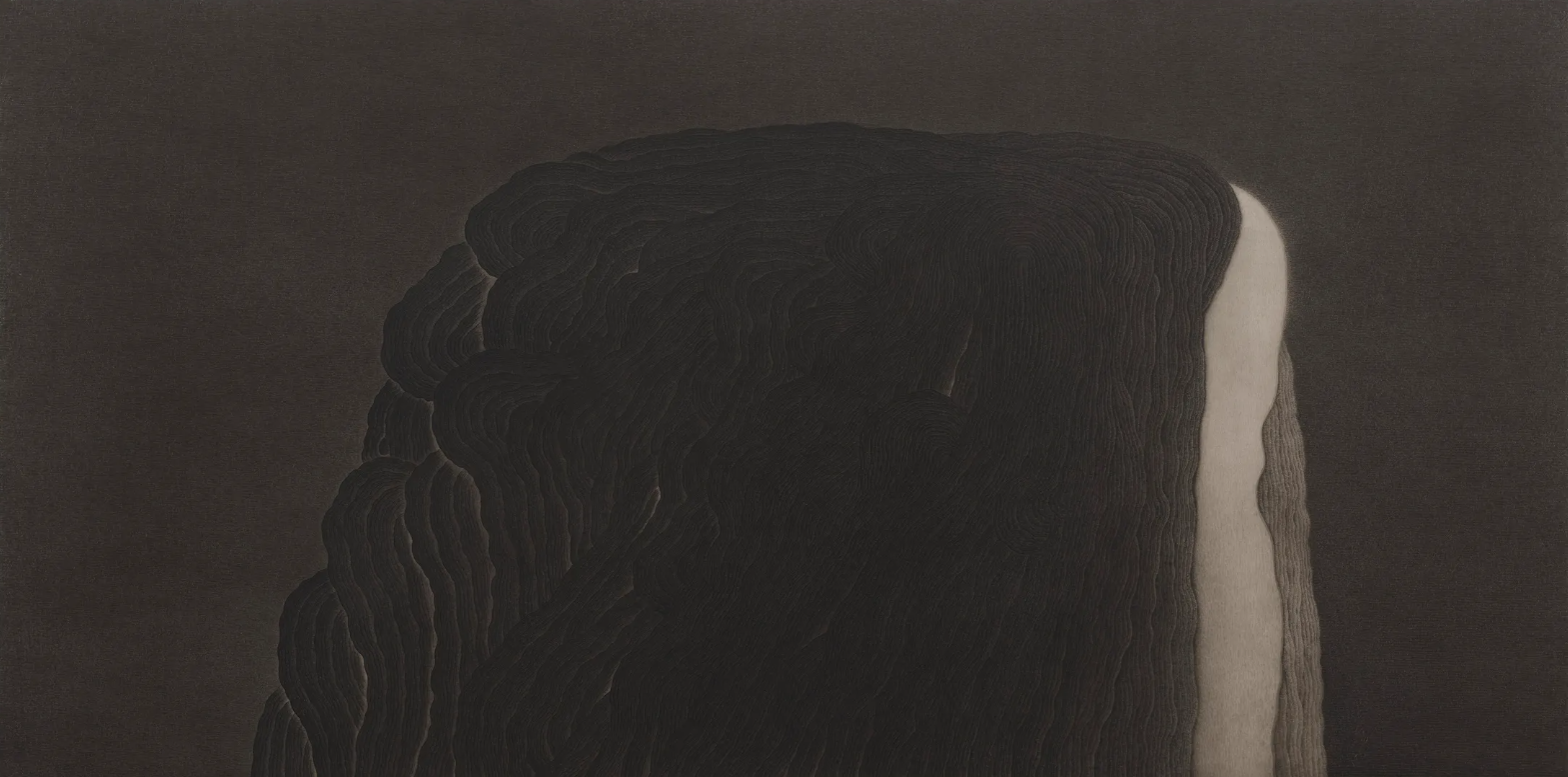
In the small-scale painting Chinese Cabbage (2024), the most ordinary of household vegetables is imbued with the solemn gravity of a devotional object. Its crisp white stem cuts a luminous horizon across the pictorial field, while at its head, the crumpled folds of its leaves dissolve into the soft, grainy darkness around it. It is a work that does not lend itself to cursory viewing. At a glance, the image appears almost glitchy, as if obscured by a haze of televisual snow. Up close however, this apparent pixelation resolves into a tactile field of hand-painted brushstrokes, each an index of subtle variations in pressure, rhythm and touch. The longer we look, the more conscious we become of the sheer accumulation of labour sedimented in the surface, the more we marvel at the time it must have taken to complete. The humble cabbage becomes an image of temporal multiplicity: durational, gestural, material and imaginary, the artist’s time and ours enfolded into a single pictorial surface.
That surface is also a landscape, or at least it begins to look like one. The cabbage’s folds become mountain peaks, ridges, vapours and weather systems, ink marks gathering like storm clouds into areas of atmospheric density before dispersing into thin veils of pigment. The resemblance to Chinese landscape painting or shan shui 山水 is deliberate, not least because Shao executes his work on the traditional rice paper xuan 宣. For Shao, landscape is not simply a genre but a way of thinking through transformation: the ‘rhythmic vitality’ or qi 气 that flows through all things, animating apparently inert forms far older than any human life. As Shao notes, ‘In the case of ink painting, the picture is written with the brush […] We in China don’t paint a picture, we write it. Writing with the brush represents a form of turning oneself into air. Insofar as one expresses one’s inner feelings, one feels relieved; one frees oneself from the enormous burden of one’s own feelings.