JULIA DE RUVO: SOFT TEETH
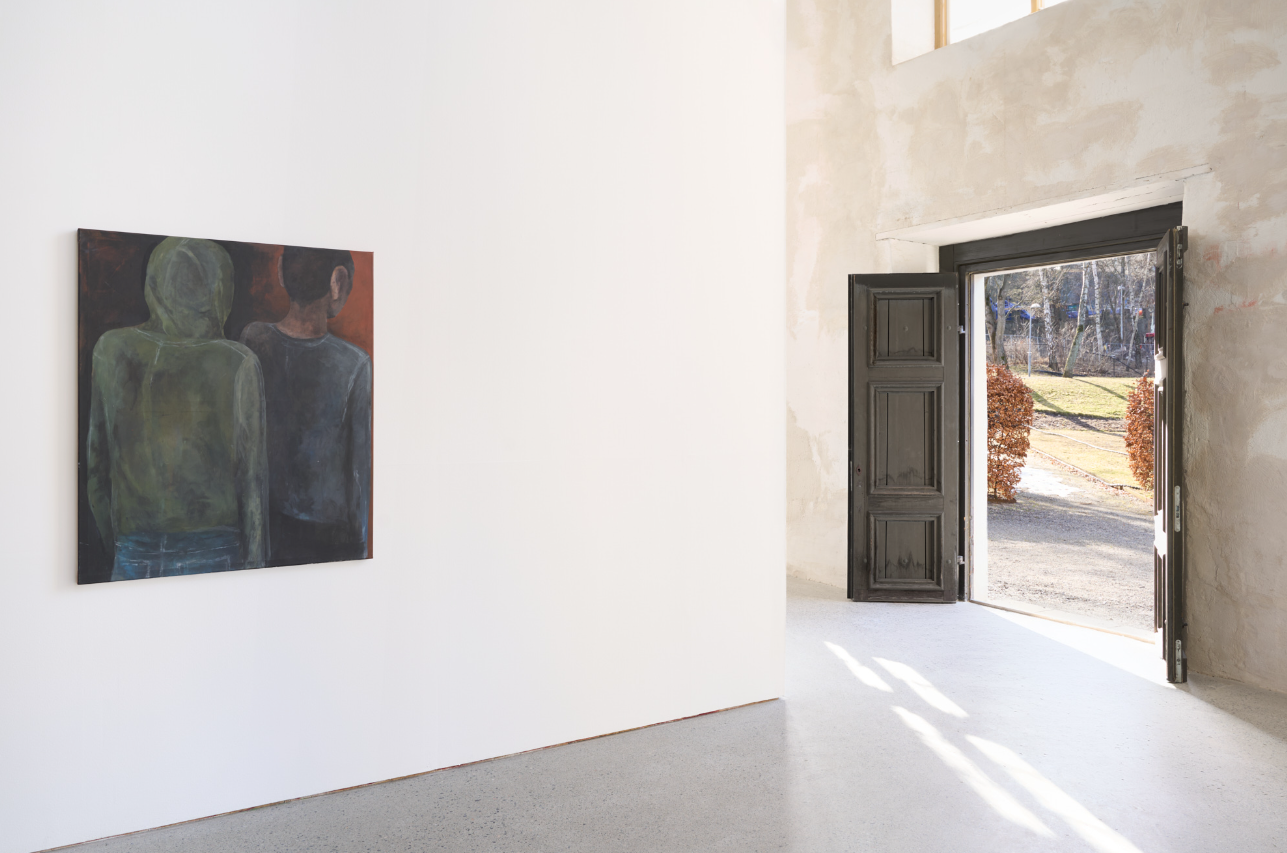
CARL KOSTYÁL is delighted to present Julia de Ruvo’s (b. 1993, Stockholm) debut exhibition ‘Soft Teeth’ with the gallery at Hospitalet, Stockholm. De Ruvo first showed with the gallery in 2025 at MARKET ART Fair in the group presentation ‘For Pete’s Sake 2.0’.
March 3 – April 13, 2026
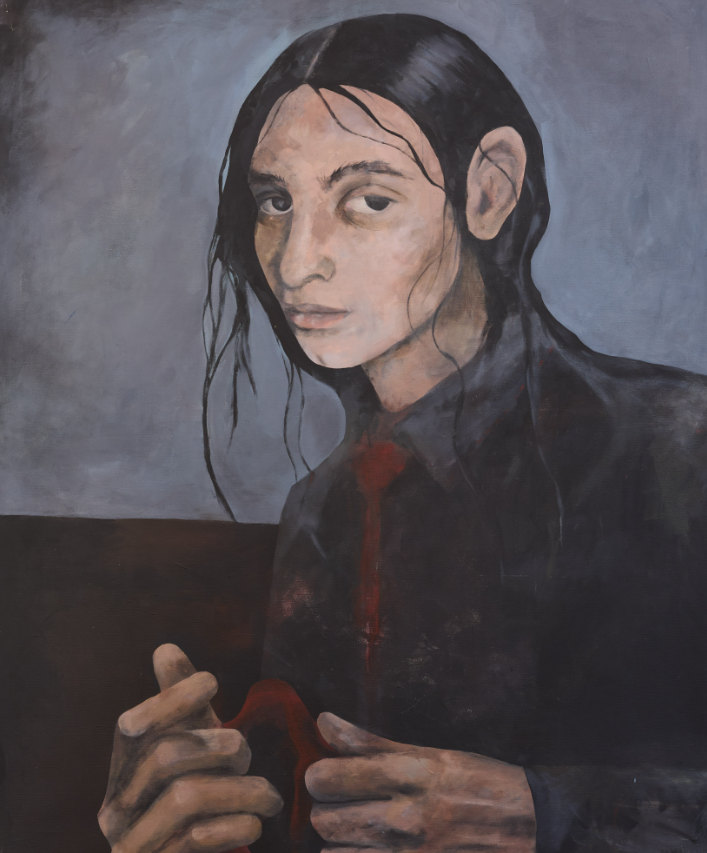
“A nymph-like woman, with wet hair and Bauer–esque ears, appears in post-coital repose. She is so close to the pictorial edge we feel as though we’re lying in bed beside her. Yet unlike the many reclining females that populate the history of painting, Julia de Ruvo’s figure in ‘Awake’, 2026, does not entertain our gaze. She recoils into herself, sullen and vacant. Beyond her expression, a sense of anxiety is palpable in her naked shoulder, which juts awkwardly from the bedsheet. She is resting but not rested.
While the environment of ‘Awake’ feels imagined–with its stark blocks of colour and absence of architectural detail–it carries an atmosphere of memory, as though the scene is being recalled rather than directly observed. The rendering of the body, the unusual expression, and the immediacy of the figure hint at a moment drawn from the artist’s private life. Is the painting of de Ruvo, of a lover, or an amalgamation of the two?
Painted over the last seven months, ‘Soft Teeth’ draws us into the world of Julia de Ruvo. The figures across these nine paintings appear to emerge from her inner circle of family, friends and lovers, offering an intimate view of relationships. Yet she resists revealing too much. The cast of ‘Soft Teeth’–both human and animal–therefore are multivalent in meaning. At once they show scenes we assume appear from her life, while on the other, they move beyond portraiture to images that explore universal themes of love, loss, intimacy and vulnerability.
De Ruvo is a largely self-taught painter who works exclusively in acrylic on unprimed canvas. She approaches each work individually, sometimes beginning with a loose sketch or by reworking older canvases, allowing the image to develop through the act of painting itself. While the works may at first glance appear dark, a range of colours gradually emerges across the canvas: reds, blues and browns push through the surface, giving the paintings a visceral, at times violent quality.
Queer life in contemporary Sweden is depicted across the works in ‘Soft Teeth’. In ‘Adam & You’, most likely named after the artist’s cousin, actor Adam Eatens, two effeminate boys strike a pose on a muddied red ground. One lasciviously lifts his arm, revealing a chiselled abdomen, as he clutches the hair of the other. In its companion piece, ‘Saltarö’, the place where de Ruvo and Eatens have spent summers since childhood, the figures turn their backs to the viewer. It is unclear whether it signifies their separation or a private exchange not meant for our eyes. Together, the two paintings are bold, unapologetic displays of same-sex affection. Like in the great American artist Nan Goldin’s ‘The Ballad of Sexual Dependency’, which de Ruvo cites as an inspiration, the artist reveals these figures to us from an intimate vantage point. She is not a voyeur; she is a participant. In this sense the images are not only homoerotic, but they give us access to understanding what being gay feels like–and means–in Sweden today.
Perhaps more than humans, it is dogs de Ruvo has become so famed for. Asked about ‘Baby & I’, 2025, she describes it as being about “the dog’s sadness of being owned.” In the painting, a pit bull stands between the legs of its owner, held tight by a leash. Its eyes are heavy and half-closed, as though enduring something it cannot escape. In ‘Among the Birch Trees’, 2026, a scene reminiscent of the winter walks de Ruvo takes in Saltarö with her dog Boris, the animal takes on a different presence—alert, almost predatory—turning the forest into a place of tension. The dogs in ‘Soft Teeth’ operate on two levels. On one hand, they reflect de Ruvo’s close observation of animals and her interest in how they experience the world. On the other hand, they function as allegories of human feeling. As Susan Rothenberg once said of her iconic Mary paintings of the 1970s, “the horse was a way of not doing people, yet it was a symbol of people, a self-portrait really.” Something similar is at work in de Ruvo’s paintings: the dog allows the artist to approach human emotion indirectly, giving form to feelings of dependence, control, ownership and vulnerability.”
– Gabriel Max Shelsky
Julia de Ruvo (born 1993, Stockholm) studied at the Konstskolan, Stockholm, before developing her largely self-taught painting practice. She has had solo exhibitions at Guts Gallery, London (2025 & 2022), Steve Turner Gallery, Los Angeles (2023), Riche, Stockholm (2021); and Coulisse Gallery, Stockholm (2022). Her work has also been included in ’For Pete’s Sake 2.0’ with Carl Kostyál at MARKET ART Fair (2025) and two group exhibitions at Guts Gallery, London (2021 & 2022).