NIKLAUS STOECKLIN: UNTITLED
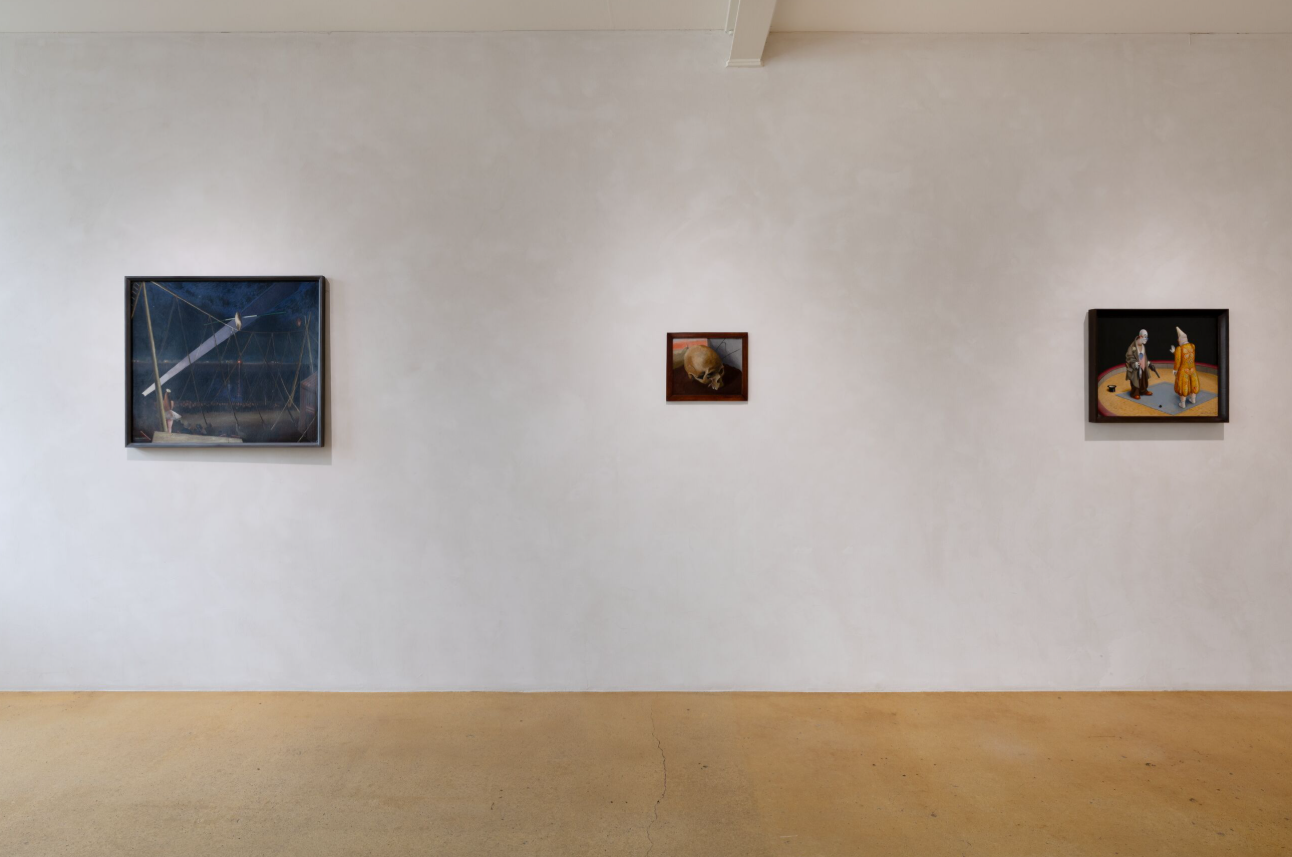
Focusing on the 20th-century Swiss artist Niklaus Stoecklin (1896–1982), HAUSER & WIRTH is pleased to presents a group of paintings and drawings from the 1920s to the 1970s, including several works that have rarely been shown in public before.
March 19 – May 23, 2026
Curated by Martin Schwander, traces Stoecklin’s artistic development from the coolly detached figuration of the interwar period to the diaphanous luminosity of his late work. It follows on from group exhibitions on New Objectivity painting in Mannheim and Chemnitz last year, which highlighted Stoecklin’s contribution to this important modernist artistic movement.
Niklaus Stoecklin, born into a Basel merchant family, showed exceptional talent for drawing from an early age. At the beginning of 1914, he enrolled at the School of Applied Arts in Munich. When World War I broke out, he returned to Basel, where he continued his education for a short time at the Arts and Crafts School. Stoecklin did most of his military service in Ticino and the lake landscape there inspired him to create his first masterpiece, the painting ‘Casa rossa’ (1917). After his active service, Stoecklin established himself in Basel as a painter, graphic artist and book illustrator. In 1918, together with Alice Bailly, Fritz Baumann, his siblings Francisca and Fritz Stoecklin, Sophie Taeuber and others, he was one of the founding members of the short-lived artists’ association ‘Das Neue Leben (The New Life)’. The painting shown here, ‘Landscape near San Gimignano’ (1921), was created during a trip to Italy in the spring of 1921. The following year, Stoecklin married the bookseller Elisabeth Schnetzler.
The enigmatic, undated portrait ‘Begegnung (Encounter)’ (undated, c. 1922) was created in the year of their marriage: it depicts the young couple approaching a figure resembling the goddess of fate against a stylized classical architectural and landscape backdrop. 1922 was also the year of Stoecklin’s first trip to Paris. The painting shown here, ‘Pariser Hinterhaus, auch: Pariser Vorstadthäuser (Parisian Rear House, also Parisian Suburban Houses)’ (1937), is a visual testament to the explorations Stoecklin undertook in the French capital over many decades. In 1923, his only daughter Noëmi was born, whom Stoecklin portrayed at the age of five in the iconic painting ‘Fensterausblick (View from a Window)’ (1928), reminiscent of early Romantic German painting. In 1928, Stoecklin moved with his family to Riehen near Basel into his newly built home-studio, where he lived and worked until his death in 1982.
During the interwar period, Stoecklin also received several important public and private commissions for murals. For example, in the late 1920s, he created a series of paintings for the restaurant ‘Zum grünen Heinrich’ in downtown Basel. The painting shown here, ‘Ruchenstein’ (1929-30), painted with old-master dedication, depicts the torture and execution site of the town of Ruechenstein, one of the settings in Gottfried Keller’s story ‘Dietegen.’
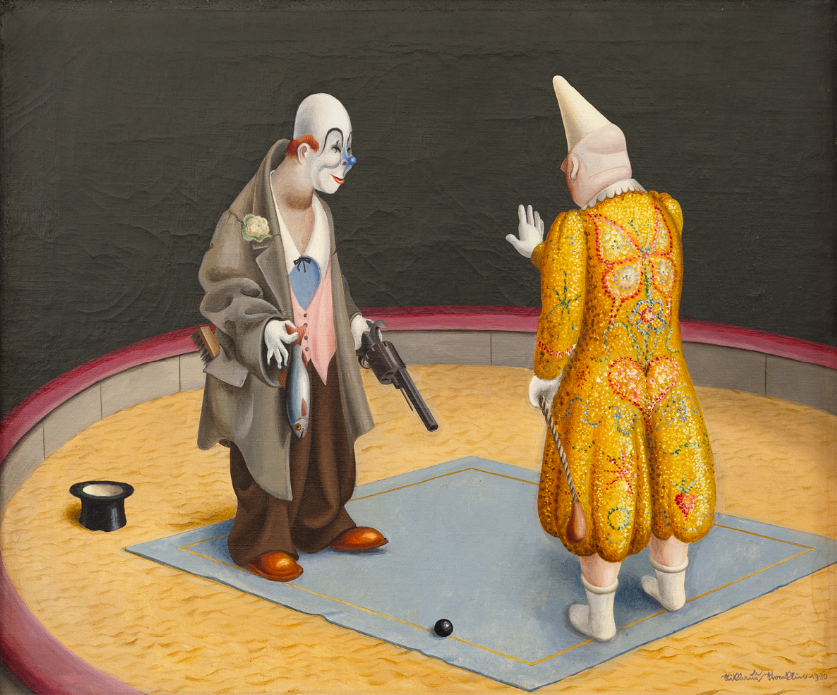
In the early 1920s, Niklaus Stoecklin was one of the pioneers of New Objectivity painting. In 1925, he was the only Swiss artist to take part in the groundbreaking exhibition ‘The New Objectivity. German Painting since Expressionism’ at the Städtische Kunsthalle Mannheim, which celebrated the centenary of the movement with an exhibition from 2024–2025. The artists presented there were part of a generation for whom the First World War had been a turning point. The war, fought with unimaginable brutality, had pulled the rug out from under their feet. Politically engaged artists such as Otto Dix and Georges Grosz processed the existential shock in paintings that held up a mirror to what they saw as the unjust and hypocritical German post-war society with unsparing harshness. Stoecklin took a different path in Switzerland, which had been spared the war but also had to cope with political, social and societal crises in the 1920s. During this period, he consolidated his artistic self-image as a loner who viewed the world with detachment, perceiving it as beautiful and wondrous, but also as alien, grotesque or incomprehensible at times.
For more than six decades, Stoecklin painted landscapes and cityscapes, still lifes and genre paintings, portraits and decorative cycles. Many of his images, which sometimes have a ‘magical’ life of their own, oscillate between an affirmation of modern progress and a subliminal fear of the manifold changes in a society threatened by a loss of connection to social and cultural traditions. Some of these paintings also convey a sense of fragility that refers to the transience of life.
In his later years, Stoecklin’s detached attitude toward his own present turned into a kind of inner emigration. His late work is dominated by enchanting still lifes painted with old-master precision and, from today’s perspective, wistful views of cities such as Basel, Paris, and Venice. Stoecklin gained wide recognition for these works, which he developed through quiet, concentrated study. This was reflected, among other things, in Stoecklin being awarded the Art Prize of the City of Basel in 1958.