
JOHN ARMLEDER: RIPPLE: FURNITURE SCULPTURE AND PAINTING AFTER 1982
DAVID KORDANSKY is pleased to present Ripple: Furniture Sculpture and Painting after 1982, an exhibition of historic works by John Armleder from this period.
May 7 – June 13, 2026
Throughout John Armleder’s career, which has thoughtfully and effortlessly traced a myriad of personal and art historical references, a throughline exists in his perpetual interest in collectivity. Armleder attributes this to two major events in his life: a seven-month stint in prison for refusing Switzerland’s mandatory conscription, and his time as part of a rowing team, practicing several hours a day. Each of these experiences reaffirmed his belief in the collective, an idea that shapes how he lives his life, but also how he approaches art making. Many of the works on view, predominantly from the 1980s, are part of his historic Furniture Sculpture series and exemplify this thinking. It was in an old prison laundry room that he created one of his earliest explorations of this concept, consisting of a table, a window, and some wires.
Like that early example, each of the Furniture Sculptures on view incorporates a seemingly functional or decorative object, so that the viewer is given a generous access point through which they can draw their own associations, and so the artworks themselves act as a bridge between artist and onlooker. His interest in furniture and design objects can easily be traced as far back as his childhood, where he spent his earliest years living in his parents’ hotel where furniture was constantly moved and rooms redecorated. In FS 156 (1987), the artist presents a vintage wooden vanity with a large canvas placed where a mirror would traditionally appear. This piece distills the idea that the painting or wall-based work recedes to the background and may be interchangeable with objects that have more decorative or functional associations, like mirrors. Furniture used throughout the exhibition, and in the series at large, is often found or sourced by Armleder and accompanies a painting the artist has made.
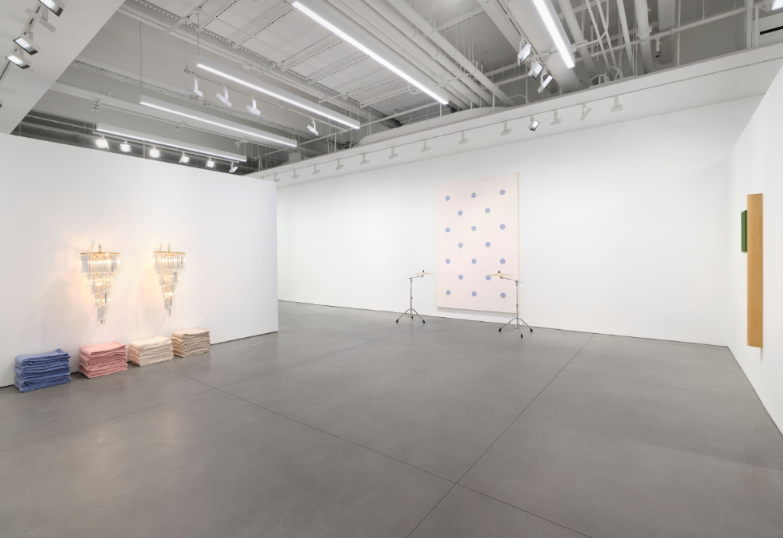
The impetus to create the sculptures on view came from an early engagement in experimental compositions like Erik Satie’s furniture music, from which Armleder’s series takes its name, and a formative interaction with John Cage around the release of his essays, Silence: Lectures and Writing, which speak to the importance of chance in creative practices. Paintings like Untitled, U17 (1986), typify Armleder’s Pour Paintings, a series that dates back to the 1970s in which the artist pours, drips, and manipulates paint and other media onto an upright canvas so that the material pools and layers to create textured striations, ridges, and grooves along the surface. Paintings in this series can be read as distinctly modernist, foregrounding color, line, material, and process over a planned compositional outcome. Like Cage, Armleder relies on chance in the creation of these paintings.
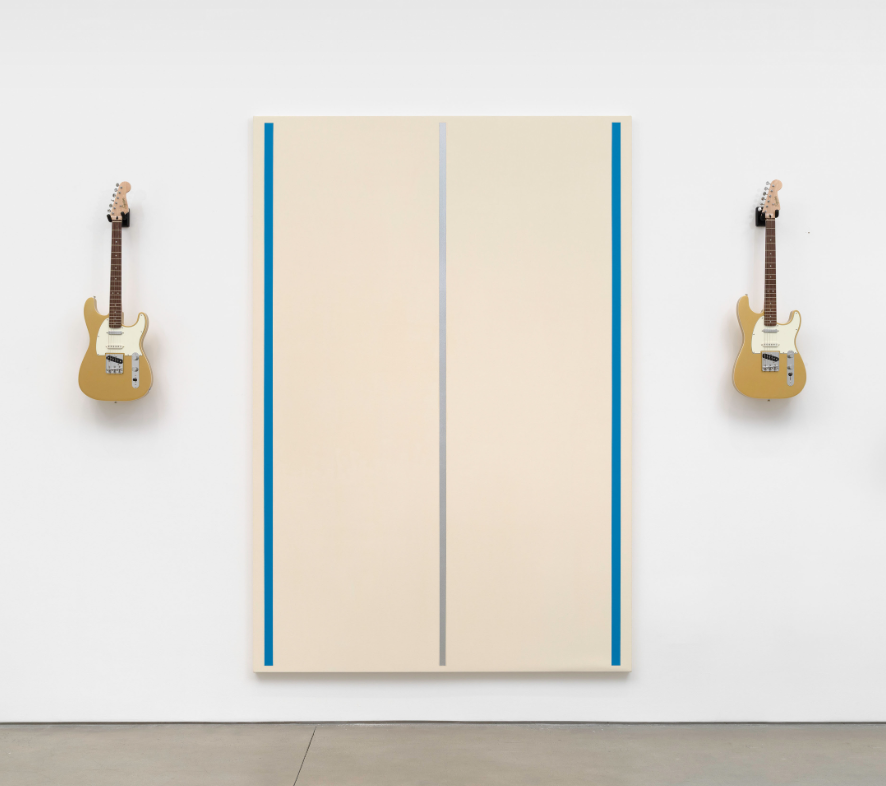
Satie created his furniture compositions so the sound existed in the background and could be experienced as secondary to a conversation, a drink, or any other exchange. In Untitled (FS) (1987) and Untitled (1986–2020), Armleder flanks a wall-based painting with two musical instruments which, while the instruments take center stage, recall the impermanence of compositions like Satie’s as there’s a sense that the instrument could easily be plucked from the wall, a cymbal could be readjusted, or furniture could otherwise be swapped out.