GERHARD RICHTER: UNTITLED
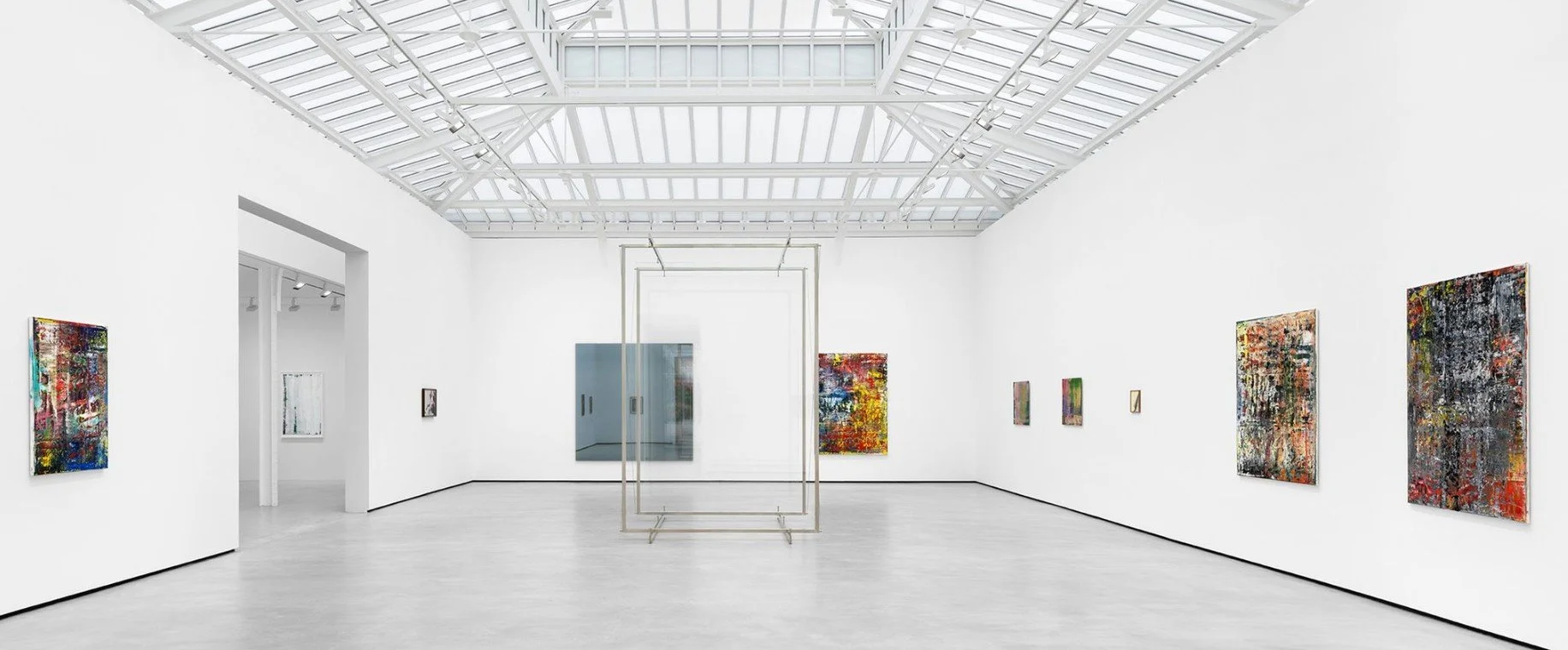
DAVID ZWIRNER is pleased to announce an exhibition of paintings, drawings, and glass installations by renowned German artist Gerhard Richter at the gallery’s Paris location. This is the artist’s third show with the gallery.
October 20—December 20, 2025
The exhibition coincides with a major retrospective of Richter’s work curated by Nicholas Serota and Dieter Schwarz at the Fondation Louis Vuitton in Paris, now on view.
Characterized by an impressive variation in scope, scale, and technique, the works on view in Paris collectively highlight Richter’s expansive understanding of the painted medium and his endlessly investigative approach to the process of artmaking itself. The exhibition opens with the artist’s 3 Scheiben (3 Panes of Glass), from 2023. Richter first began working with the medium of glass over half a century ago, with his landmark 1967 installation 4 Glasscheiben (4 Panes of Glass), which he conceived of as a response to The Large Glass (1915–1923) by Marcel Duchamp.
The present installation belongs to a later body of work comprising groups of freestanding transparent glass panes. When viewed head-on, the image visible through the glass becomes increasingly distorted, dimmed, and opaque as it passes through each successive panel, forming a potent corollary to the blurred effect of Richter’s photo paintings, which the artist began experimenting with in the 1960s.
“Richter gradually dissolved the ‘image’ as a framed detail of reality by increasing the distance to reality through various forms of manipulation, such that the work then took on a reality all its own.”
—Dietmar Elger, curator, in “Images in the Plural,” Gerhard Richter: 14 Panes of Glass for Toyoshima, dedicated to futility, Wako Works of Art, 2016
Also on view are additional wall-mounted glass installations. As with all of Richter’s glass works, these pieces acknowledge and defy the expected artistic role of glass as a protective shield devoid of its own material presence, while also freeing it from its traditional modernist constraints as a setting within walls, vitrines, or cubes. The experience of beholding these works—along with the images seen on their surfaces—enacts a radical paradox in which reality is both rendered impassable through its physical mirroring and distortion, while also being perfectly emulated with an indelible proximity to the real world.
“The mirror set a new zero point. Unlike a painting, there is no artistic, painterly reflection to convey delay. Instead, the mirror is a pure ‘reaction machine.’ It sees everything and remembers nothing; every image is created and destroyed in the same instant. The mirror reveals pure transience and hence is the purest manifestation of Richter’s intention yet: to eliminate himself as the author while retaining maximum presence by engendering images in the viewer without having to paint them.”
—Martin Germann, curator, in “The Perfect Artist: Gerhard Richter in the Mirror of Sculpture,” Gerhard Richter, Fondation Louis Vuitton, 2025
The exhibition includes a selection of Richter’s Fotobilder (Photo Paintings), such as Blumen (Flowers, 1992), Torso (1997), and Kl. Badende (Small Bather, 1994). Beginning as early as 1962, at the outset of his career, Richter made use of photographic imagery as the source material for his paintings. His first canvases depicted images taken from advertisements, the news media, and other mass-reproduced sources, in addition to personal family photographs and ordinary snapshots.
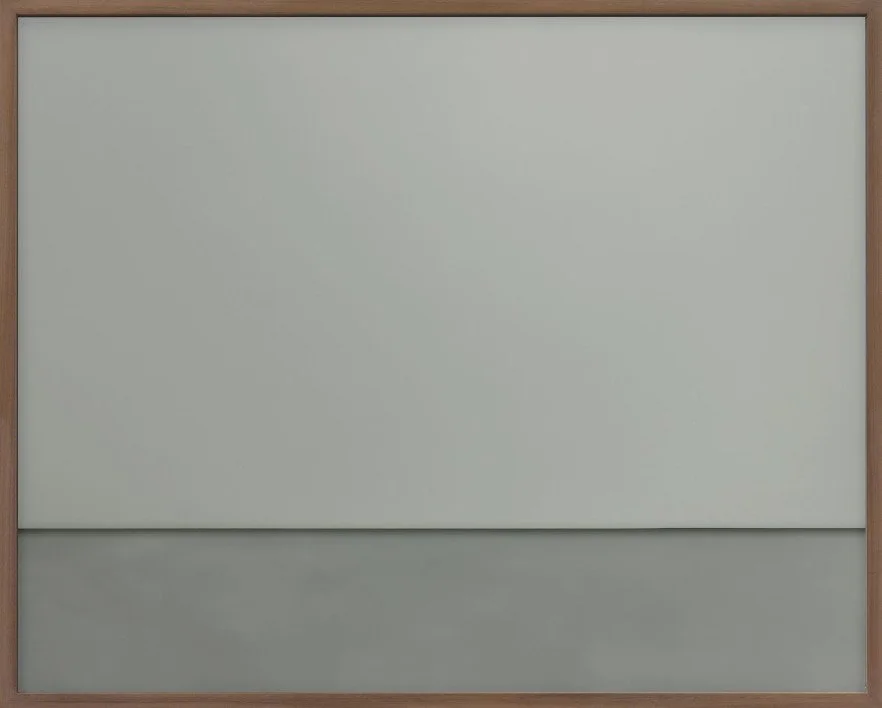
Deviating from traditional figurative painting, Richter typically blurs the depicted subjects or objects, in order to complicate the relationship between painting and photography. As art historian John T. Paoletti has observed, “Just as a photograph does not replicate the world which exists before the camera, neither do Richter's paintings replicate the photograph. Tellingly, Richter uses techniques stemming from photographic 'mistakes'—the out-of-focus image, the blur, the accidental or awkward snapshot detail—to comment on the artistic choices being made about what reality to present.”