LUC TUYMANS: THE FRUIT BASKET
DAVID ZWIRNER is pleased to announce an exhibition of new paintings by Belgian artist Luc Tuymans on view at the gallery.
November 6—December 19, 2025
This presentation considers the pervasive atmosphere of fracture that is specific to the United States at this moment. Foregrounding the highly mediated state of contemporary experience, Tuymans reinforces a growing sense of dissolution through varied subject matter and formal approaches, which appear in an unexpected cadence across this exhibition. Throughout, he modulates the tonality of his colors to match the heightened artificiality of the imagery he has carefully chosen, creating thought-provoking juxtapositions of scale and technique.
Measuring sixteen feet tall and more than twenty-three feet wide, The Fruit Basket (2025)—from which the exhibition takes its title—presents a picture that is literally fragmented, composed of nine distinct parts arranged into a grid. Based on an iPhone photo that Tuymans took of an actual basket of fermenting fruit projected onto a blue-cast multipart screen, the eerie tones and diffuse focus of this painting betray the presence of digital light.
An object of fascination for the artist, the fruit basket—sometimes seen as a symbol of plenty—and its contents are distorted almost beyond recognition, becoming something else entirely, a kind of memento mori. Due to the sheer size of the composition, the viewer must step back to take in the work in full, only to notice the intrusion of the artist’s fingers at the bottom corner that indexes his engagement with the image on his phone.
“The idea with my imagery is that it has to work from afar, but once you get close to it, it disintegrates.… That’s what it’s all about.”
—Luc Tuymans in conversation with Helen Molesworth
The strong diagonal that cuts across the picture plane mimics the construction of the similarly scaled epic history painting The Raft of the Medusa (1818–1819) by Théodore Géricault. In likening a fruit basket—an object that is also commonly gifted to the sick—to Géricault’s raft of the dying, adrift from a shipwreck, Tuymans emphasizes decay rather than abundance.
“It might be argued that one of the most consequential impacts on the way we see the world and deploy ourselves in it over the past century and a quarter has been that recording devices serve more and more as our main portals to the experience of reality.... It is not for nothing that Tuymans himself has observed that he doesn’t paint subjects, but rather memories.”
—Laura Hoptman, in her essay for the forthcoming catalogue, Luc Tuymans: The Past, UCCA Center for Contemporary Art, Beijing, 2024–2025
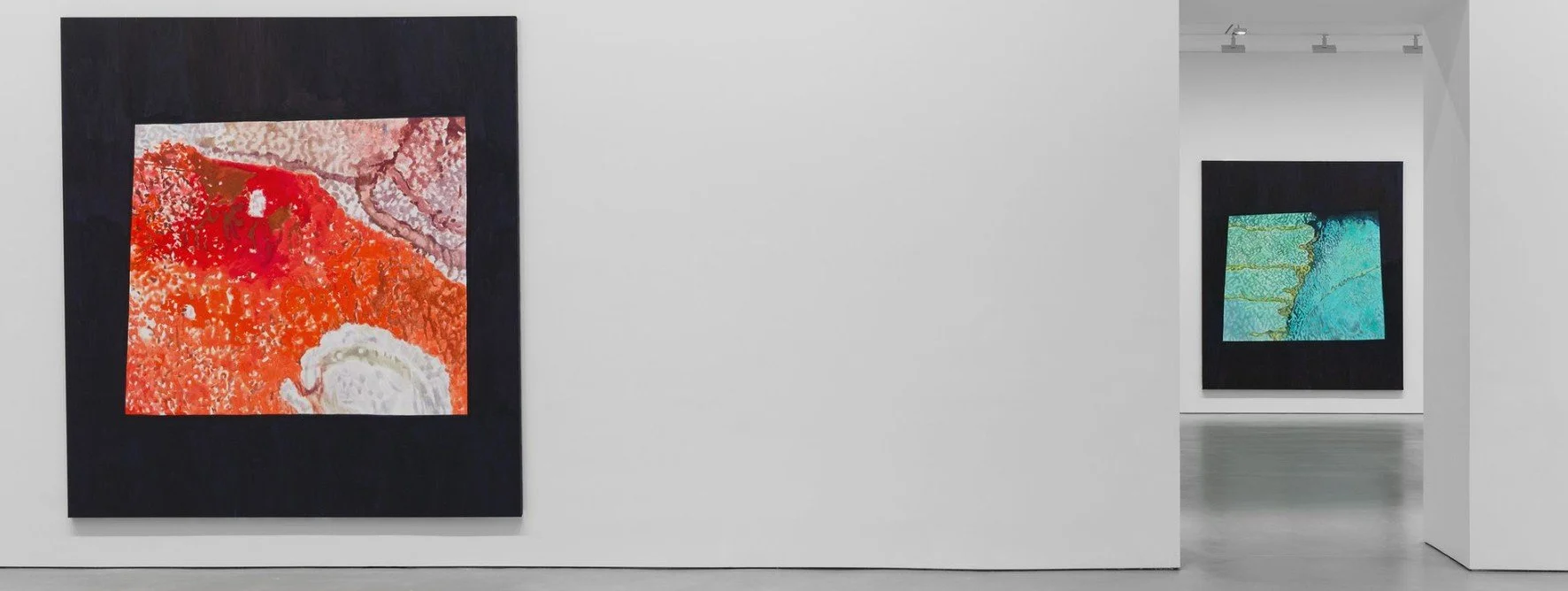
A related group of four large-scale works, collectively titled Illumination (2024–2025), is installed throughout the show, appearing at first as fields of color that are lit from within in a manner akin to the rectilinear abstractions of Mark Rothko—a prodigious artist whose life ended in tragedy, and an ongoing interest for Tuymans.
Tuymans’s paintings harken back to 1960s and 1970s abstract expressionism and color field painting, non-referential styles that had their heyday during a period of intense sociopolitical turmoil in the US and are now the subject of renewed interest.
In contrast to the spontaneity of abstract painting, Tuymans’s works are deliberately constructed, based on zoomed-in stills captured on his phone from a documentary about the restoration of fifteenth-century illuminated manuscripts. Tuymans decided to encase these compositions in nearly black hues, though using no actual black pigment, applied by hand in thick bands around their borders.
“Art’s purpose is to make things visible, especially those that are most commonly ignored, those we miss precisely because they are there in plain sight. To the extent that the penumbra which settles over Tuymans’s images further obscures them, its effect, indeed its function, is to make us look harder.”
—Robert Storr, in his essay for the exhibition catalogue Portraits. Luc Tuymans, Menil Collection, Houston, 2013–2014
One group of canvases, painted in Tuymans’s distinctive and recognizable style, literalizes a feeling of intrusion at the heart of the exhibition. Hollow (2025) features the empty interior of a prosthetic latex mask, which floats against a dark, monochromatic ground. The inverse of a face, this image foregrounds the question of what is real and what is fake. The smallest work in the show, The Maggot (2025) presents a close-up of the titular insect, alternately considered a harbinger of decay and rot and a medical cure capable of cleansing an open wound.
From the same group of works, Migrants (2025) glows urgently with hot reds and oranges and a looser treatment of paint. Rendered in an impressionistic style that is legible only from a distance, the image of dozens of faceless figures cloaked in shadow derives from a news photograph of migrants waiting at a border—the only work in the show to be based on an unmanipulated, “real” image.
“Tuymans has painted horrors.... But his subject is not horror. It is the way in which such atrocities, as components of what we call ‘history,’ become inseparably woven into the new ‘universe of technical images.’”
—Jarrett Earnest, in his essay for the exhibition catalogue La Pelle: Luc Tuymans, Palazzo Grassi, Venice, 2019–2020
Finally, a group of four canvases based on 3D-printed figurines of actual people feature individuals that in different ways read as quintessentially American. Appearing at once uncannily lifelike and frozen in time, the people are rendered with an increased feeling of dimensionality, hinting at their status as objects.

Likewise, the last painting in the show, The Family (2025) features a group portrait of three generations clustered together, smiling brightly while receding before our very eyes, underscoring the impossibility of a certain kind of reality.
Paintings from this group both open and close the exhibition. Executed on a more intimate scale that brings the viewer face-to-face with the subjects depicted, these paintings are meant to project optimism. However, Tuymans has bestowed the canvases with an ashen underlayer, coupled with a thin treatment of paint, causing the figures to appear as if they were never alive to begin with.