
TETSUYA ISHIDA
GAGOSIAN is pleased to announce an exhibition of paintings by Tetsuya Ishida (1973-2005), the first dedicated to the artist's work in France.
June 10–July 31, 2026
Ishida came of age during Japan’s “lost decade” of the 1990s, an era that saw a severe, long-lasting recession accompanied by social challenges and economic displacement that significantly affected his generation. The scenarios in Ishida’s vivid, hyper-detailed paintings address those travails, their absurdities resonating on both psychological and sociological levels.
Many of Ishida’s protagonists are young people or working-age men with blank expressions, their generic anonymity recalling René Magritte’s bowler-hatted figures. Isolated and desperate, they face bizarre, dreamlike situations and are often subject to mechanical or animalistic metamorphoses. Drawing on Social Realism, Surrealism, and Japanese popular culture, Ishida’s wildly imaginative works are powerful symbols of the loss of individual agency in a society organized around work, consumption, and technological dependency.

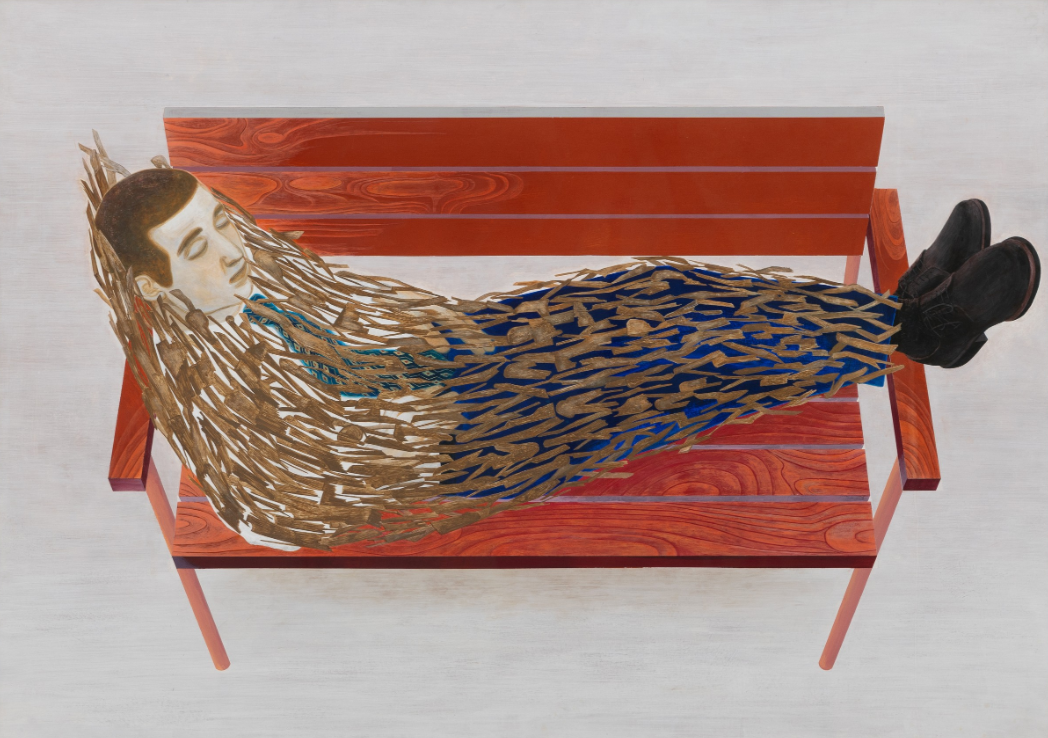
Sleeping Bagworm (1995) represents a man in suit and tie who is sleeping on a bench, his body encased in a cocoon that appears simultaneously protective and discomforting. Convenience Store Mother and Child (1996) pictures a figure slumped inside a shopping basket that doubles as a crib, while a woman stands over him, both cradling his head and scanning him with a barcode reader. The dozing man is coded as infant, worker, and product, while the duo also evokes the mother-and-child pairing of Michelangelo’s Pietà. In Getting Up (1999), a bed is replaced by a dump truck, its back tipped up as the figure braces himself to avoid falling out.
Supermarket (1996) depicts a man wearing a suit, his arms replaced by conveyor belts. Standing between a cash register and shelves stocked with branded packages of food, this merger of human and machine symbolizes the dehumanizing tendencies of late capitalism. In Recalled (1998), a family dressed in mourning attire who are kneeling on tatami mats watch a technician inspect a man’s body. The corpse’s head and hands are detached and compartmentalized in a box that combines the form of a coffin with electronics packaging, offering an incisive critique of the commodification of all aspects of life—including death.