
GEORG BASELITZ: BACK AGAIN
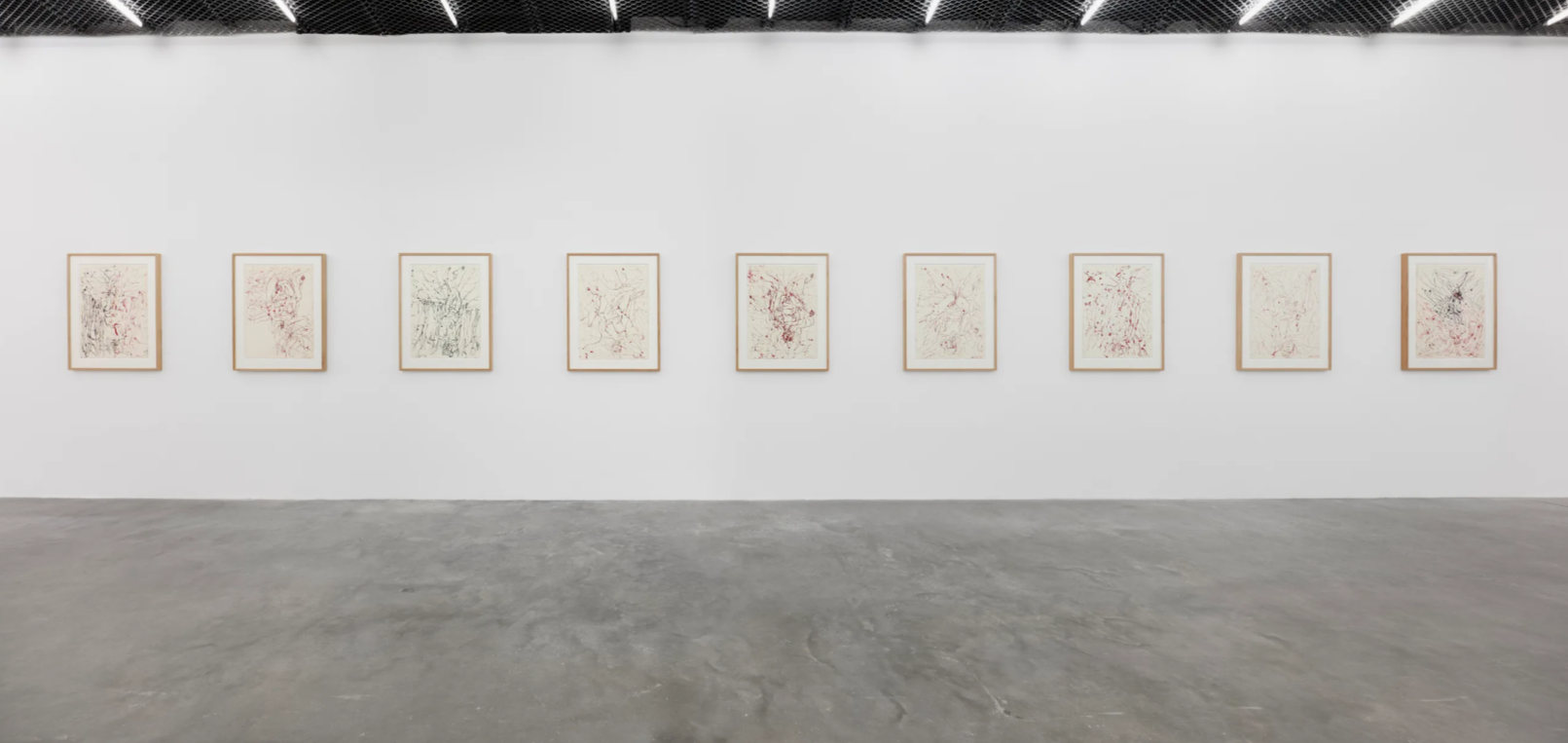
WHITE CUBE presents a Georg Baselitz’s solo exhibition that takes its title from one of the artist’s final paintings, Back Again.
June 10 - August 30, 2026
It is a now poignant testament to the artist’s drive to return, distil and resolve those motifs that consumed him during a career that spanned more than 60 years. One of the very last exhibitions Baselitz conceived before his passing in April 2026, the artist elected to bring together those subjects that defined his practice, including the eagle, the figure of the Hero and his longtime muse, wife and partner, Elke Kretzschmar.
In late July 2025, in the gilded confines of the Salzburg Marionette Theatre, Georg Baselitz wept. The figures he had designed for a production of Igor Stravinsky’s avant-garde theatrical work L’Histoire du Soldat (The Soldier’s Tale) moved with a life he had not anticipated. Marking his first foray into puppet theatre, Baselitz had created 15 raw, minimalist forms – bodies of cardboard, limbs jointed and pulled by strings, heads of uniquely coloured crinkled metal foil – whose distorted physiognomies brought a new expressivity to the medium.
Stravinsky wrote The Soldier’s Tale in 1918 while living in exile on Lake Geneva in the wake of the Russian Revolution. He turned to Alexander Afanasyev’s Faustian folk tale for his two-part theatrical fable that follows a soldier who trades his beloved violin to the Devil for vast economic gain. The soldier’s bargain delivers everything he asked for and nothing he needed. Wealth arrives but his sense of belonging dissolves. Unrecognisable to those who once knew him and now without an army, our lost soldier is unable to retrace the steps that brought him here and soon discovers that what was lost cannot be recovered. On stage, these jointed bodies enacted Stravinsky’s fable of bargain and sacrifice with a strange, lurching grace. The backdrop featured Baselitz’s scrawled playing cards, the Dame and the seven of hearts in black on blue among them, as the soldier plays his hand with the Devil. What did it mean for an artist who was himself expelled – who traded the certainties of East Germany for the freedoms and estrangements of the West – to contribute to the production of this fable at the end of a long career? And what is the violin – the instrument surrendered, the irreplaceable thing – in Baselitz’s own story?
For an artist who spent six decades driving the figure to its limits in paint, what undid him in Salzburg was not the spontaneous overflow of sentimental feeling (no one could accuse him of that) but a more penetrating recognition: the forms he had made could still exceed his intentions, achieving through motion what paint achieves through mark. The marionette is an instrument of delegation as the artist’s hand, now removed, is replaced by string and gravity and the exposed logic of the stage. That his painted and his puppet figures share this quality – of bodies who have slipped the direct control of their maker and who still have the capacity to surprise and move even him – resonates with force across his latest suite of paintings. ‘Back Again’, 30 paintings made between 2024 and 2025, are among Baselitz’s final works. He knew that would be the case, working at floor level on canvases that exceeded the wheelchair-bound painter’s reach. ‘I have a long biography to look back on’, the artist said earlier this year, as he prepared for a major exhibition of large-scale gold-ground works at Fondazione Giorgio Cini in Venice. ‘Now that I’m more or less at the end of my painting activity, I thought I should draw some kind of conclusion: a summation of the paintings I’ve done over the years.’ Running concurrent to these late returns is a larger argument about the figure as something held between earthly weight and another kind of power, at the mercy of forces it cannot see. The soldier’s violin cannot be reclaimed.
Elkes Geburtstag am Teichdamm (2025) names the person present in Baselitz’s work longer than almost any other motif: his wife, Elke Kretzschmar, whom he met in 1958 at the Hochschule für Bildende Künste in West Berlin. Both Eastern exiles – she studying graphic design, he already deep into the important ‘Rayski-Kopf’ series – they were part of the same Dresden circle as their mutual friend A. R. Penck. They married in 1962, the year after the Berlin Wall went up, sealing off the world they had come from and making the life they were building together the only direction left. ‘You can lose the model, but you don’t lose the subject,’ Baselitz said, ‘Elke comes in and out of the picture... I don’t illustrate her. If anything, I try to remove her, but I usually can’t. She comes into the process whether I want it or not, through the back of my mind. The point of portraiture is to leave the portrait behind so that you can go forward.’
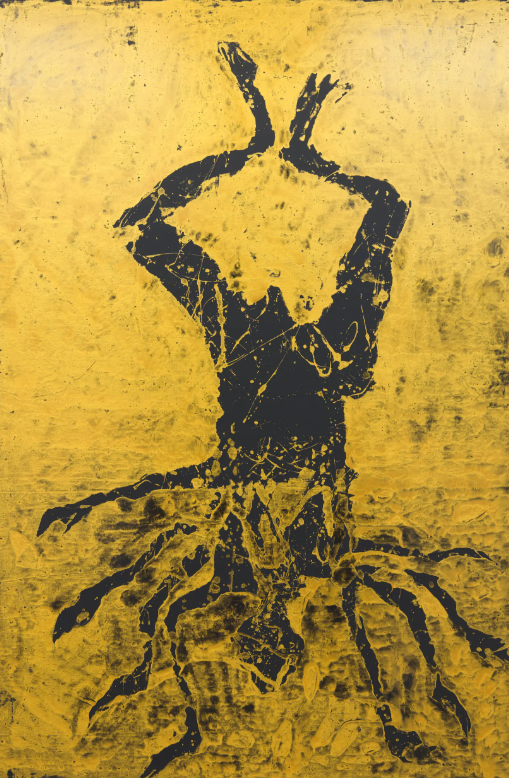
To go forward, as ever in Baselitz’s work, is also to go back. Teichdamm, a compound proper noun for ‘pond’ and ‘embankment’ or ‘causeway’, is not a waterhole in any minor sense of the word: it is one of the great Upper Lusatian lakes, rimmed by oaks and birches, overflown by sea eagles, ospreys and falcons. It was in this Saxon enclave that the young Baselitz would climb trees and scale the vertiginous ledges of the local quarry where, as Richard Calvocoressi writes, in the ‘immediate aftermath of war, the landscape was a ruin: littered with decomposing corpses, burnt-out tanks, crashed planes, and other debris’. It was here Baselitz and a local friend would collect up ‘live ammunition, rusting machine guns, and other military paraphernalia.’ To return to Teichdamm, then, is to return to the place where Hans-Georg Kern first learned to see – before he moved to the West in 1957, before he shed his given name and took instead the name of his birthplace, Deutschbaselitz, as if to carry the landscape with him into the life he was making. To mark, in the very syllables by which the world would come to know him, both the village he left and the fact of leaving.
Catherine Lampert, watching Baselitz work across the floor canvases in which Elke’s body took a splayed form, caught the same doubleness that runs through everything here: the figures, she wrote, might have their feet tied to ‘the earth wire’ and yet at other times ‘the zero gravity of dark, outer space prevails.’5 The inverted figure that became Baselitz’s signature pictorial invention he first deployed in 1969, as a way of liberating the image from narrative and forcing the viewer to attend to paint itself rather than subject. In Elkes Geburtstag am Teichdamm, the arboreal tubers of the forest double up as arteries or veins, as the upended body appears both suspended above, and subsumed into, the gaping earth. Once more freed from the conventions of portraiture, the inversion makes the figure simultaneously earthbound and celestial, rooted and adrift, with the same doubleness that has driven the work for 60 years.