ANDRÉ BUTZER: UNTITLED
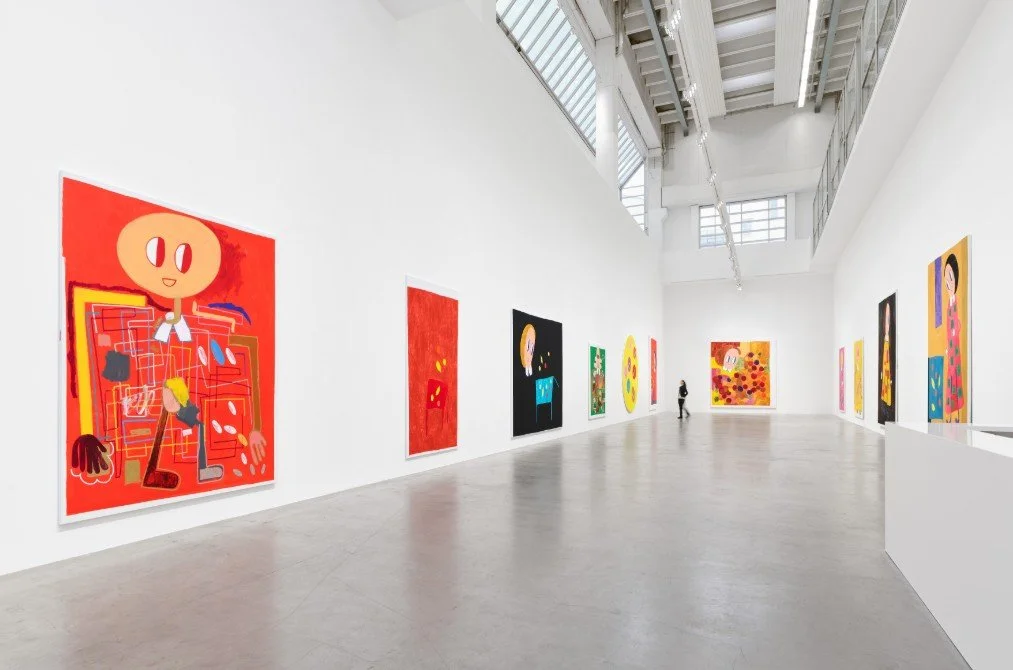
GALERIE MAX HETZLER is pleased to present a solo exhibition of new works by André Butzer in Berlin.
February 13 – April 18, 2026
The following excerpt is from a conversation between André Butzer and Christian Malycha, in the forthcoming publication André Butzer: Farben, Früchte, Bilder, Geneva: JRP | Editions, 2026, pp. 237–245.
CM
Is it Pop, what you’re doing? Expressionism? Matisse and Warhol?
AB
I find myself after the long end of Pop Art. The readymade is destroyed. Two-thousand years of painting history continues. The image of the woman endures.
CM
What about cartoons and comics, the ready-made and seriality? The actual absence of the image.
AB
Images are, or rather, bear witness to presence. They are the genuine proximity towards truth. The principle that counteracts reproducibility.
CM
Tradition and history are being erased, we no longer encounter ourselves anywhere and are becoming increasingly alienated from ourselves.
AB
Nothing is erased. The image first introduces us to ourselves, reminding us of our origins and thus of our future. So, there’s nothing contemporary about it.
[…]
CM
Still, your paintings are always relational, filled with the world. There are sentiments, places, people that appear, are evoked and make up the image. There’s a palpable bond to being-as-presence. This bond is constantly there. Like the sum of your experiences …
AB
Being-as-image
CM
Image-as-being … Every time I stand in front of a new painting, I marvel at the uniqueness of the genuine presence. How distinctive and sincere each individual image is, expressing gentleness, joy, affection, severity or shyness.
AB
I’m happy to hear that. Uniqueness exists only in relation to repetition. Only through repetition do we recognize uniqueness, the system being interrupted each time, which has been imposed on people’s real need for this uniqueness. This principle is repeatedly destroyed in precisely the same place and is thus sacrificed in all the mildness of beauty.
[…]
CM
Matisse wondered how “life” could “remain possible” in the midst of torment and pain, in the midst of the strife of the times and the temptations of one’s own fate. You said that paintings are “localizations of the greatest despair and the greatest hope” and this is exactly why “they come closest to the very joy and aid we are in dire need of”. How is human dwelling on earth possible?
AB
Eventually, there will be no more dwelling, or rather, there probably isn’t any left already.
[…]
CM
There’s one thing I find pretty astonishing about the Fruit Paintings. The fruits have … no, that’s not the right word. At times, the fruits are accompanied by fine blue lines. These are neither contours nor colorful shadows, though. The blue takes up the outer boundaries of the color form and retraces it. It is as if the fruits were held or carried by the blue, as if they were carried in the chalice of a hand’s open palm. Cézanne uses a similar blue, but as a shadow. Matisse contours his fruits. For me, however, it’s reminiscent of Warhol. In the mid-1970s, he began to trace the contours of his screen prints, but gesturally. The lines stand for themselves and yet relate to the motif. Which brings us back to Matisse and Warhol …
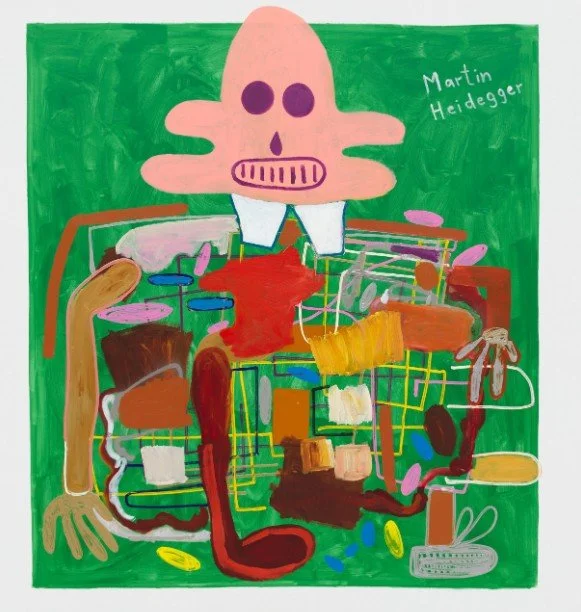
‘It’s important to understand how, in the exhibition, the themes are intertwined, that is the philosophers Hesiod / Heidegger, the depiction of (small) peasant life in "ancient" Greece (= Works and Days), the women with the fruits in their eternal return, the Matisse-like ornamental / decorative, the equation of the synthetic essence of the thinkers with the holistic, comprehensive essence of the women and the fundamental homeliness … all the way to Agrippa von Nettes-Heim, NASAHEIM.’
A. Butzer