BARRY FLANAGAN: ON THE OTHER HAND
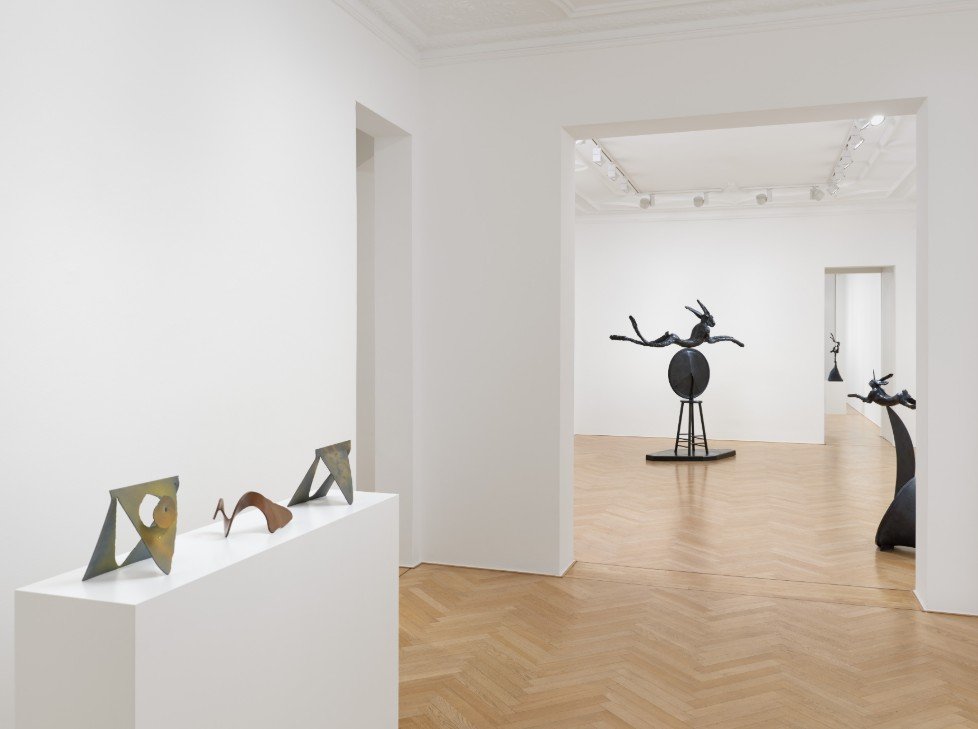
GALERIE MAX HETZLER, Berlin, is pleased to present On the other hand, a solo exhibition of works by Barry Flanagan. This is the third presentation of the artist’s work at the gallery.
January 23 - February 28, 2026
Working across a range of media and styles for more than fifty years, British sculptor Barry Flanagan took great interest in the materiality of his works. Anything from industrial sand to cloth, stone, sheet metal, and bronze could become sculptural form. This exhibition highlights his intensive engagement with different materials, which he considered to be of equal importance, free from hierarchy. The focus lies on his use of four different materials in particular, and on the range of scale in his works, from stone carvings to sheet metal, and tiny ceramic ‘pinch pots’ to monumental bronzes. The title of the exhibition refers to a turn of speech often used by Flanagan, inherited from his father. He described it as having an effect like boxing, which suited his elliptical, mysterious, unpredictable, and often funny use of language: ‘On the other hand / Art still / thinks it’s / special’.1
The stone carvings, dating from 1973 until the mid 1980s, are the earliest works in the exhibition. Already, these works mark a departure from the pieces of the late sixties and early seventies which were often made of ‘soft materials’ such as rope, hessian, or projected light frames across space. If the earlier works referred to the context of pristine gallery environments and were understood through perambulation, the stone carvings are to be considered for their three-dimensionality and mass. Flanagan’s treatment of stone attends closely to its special material properties; his use of different coloured stones varies as much as his choice to use found or carefully selected stones. Weighty and earthbound, the carvings embody the material they are made of: their ratio of weight to mass is altogether higher than that of the average object. Most of the sculptures are dominated by the horizontal line which reaffirms their heavy materiality. Formally the works range from crude mark-making, such as the engraved line on found limestone in stone carving, 1973, to the smooth and polished curves of Carved stone, 1985, sculpted from Pietra verde serpentino marble.
Around the same time, Flanagan created his small sheet metal ‘snoot’ series, with the works in the exhibition dating from 1978 to the mid 1980s. These small objects, cut and sometimes painted, show Flanagan’s love of shapes and mythology. Spirals, triangles and circles echo ancient organic or animalic symbolisms. The spiral could be ammonite, or cochlea, or scroll, or helix. Iconography is rather subsidiary. The metal disc at the centre of several of the metal projections, which unrolls in an unfussy way like an ‘apostrophe’, is one example of this. In the yellow painted steel of VII 78 the corn’s up, 1978, a spiral grows skyward forming a curious object which is almost cultic to look at. In the use of these symbols, we observe Flanagan’s interest in Pataphysics, a ‘science of imaginary solutions’, which he discovered in 1960. The concept was coined by Alfred Jarry, the French author of the play Ubu Roi (1896), and provided a framework for Flanagan's art, informing his playful, absurd, and experimental approach to sculpture.
A large number of ceramic pinch pots, from around 1992, are also presented. These tiny, curious objects were made by Flangan in his everyday studio practice. Produced from ancient times to the present day, a pinch pot is a simple and basic method of pottery-making, in which a ball of clay is pinched, pressed and shaped into a round vessel or bowl using the thumb and fingers. This process does not require any special tools or a potter's wheel. Declaring all materials art, the artist’s hand leaves its residual mark, in a humble yet personal gesture. The use of repetition and seriality, which defines so much of Flangan’s work, is exemplified in the pinch pots.
After his Minimalist practice of the 1960s and 1970s, Flanagan’s investigations expanded into figuration in 1979, and in later life he became best known for his bronze statues of biomorphic forms alluding to animals, human figures and mythological creatures, especially after 1982, when he represented Britain at the Venice Biennale. The hare, with its mythological nature and symbolism of unpredictability, resurrection and renewal, fitted particularly well into his oeuvre. There is contradiction in the depiction of a creature defined by speed and transience, by casting it in a material which is known for its solidity and permanence. This is emphasised by the monumental size of many of the bronzes, which represent the largest works in the exhibition.
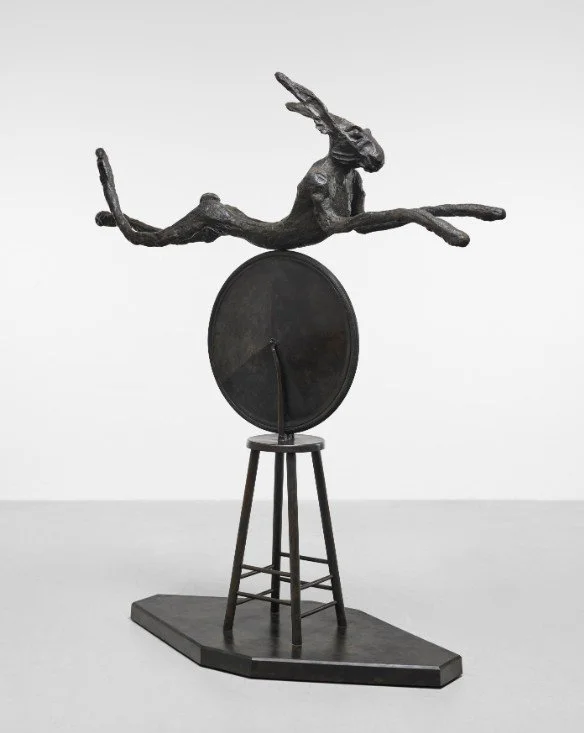
Flanagan often incorporated plinths of different materials into the works themselves, with his hares standing or sitting on them as if to emphasise their human-like nature. Ball and Claw, 1981, highlights this interplay of materials by referencing sculptures made in classical antiquity and the Renaissance period. The artist draws attention to the plinth’s functionality by reclaiming it as a sculptural component with a carved claw. Belying their heavy materiality, the bronze hares look curiously weightless, leaping gracefully, boxing or sitting pensively, in the instance of Thinker on Rock +x, 1997, which is installed on the large balcony of the gallery, in allusion to Auguste Rodin’s Le Penseur, 1904. In Pirate Wheel, 2005, Flanagan makes humorous reference to Marcel Duchamp’s Bicycle Wheel, 1913, which comprised an upturned wheel attached to a wooden stool, and is credited as his first readymade. The spiralling wheel was an essential feature of the original work and points to both artists’ shared interest in pataphysics. In reconstructing Duchamp’s artwork and casting it in bronze, Flanagan creates an objective copy, in which the tyre tracks and manufacturing details are retained. He then transforms the work into a stand for a hare, sculpted with his own hands, evident through the indexical mark of his thumbprints.
Through his avant-garde use of materials, Flanagan binds together elements of language, poetry, references to pataphysics, and art historical lineage. His work with sheet metal and later cast bronze allowed him to make both direct marks by cutting and bending, as well as indirectly by casting bronze. The symbolism of the spiral, which moves clockwise and anticlockwise simultaneously, is also manifested though material existence. It is found in our thumbprint as well as in snails and other molluscs, and their fossils in mineralogy and geology. Clay, stones and rocks have their own characteristics that needed to be seen as such, aided and assisted through the artist’s hand and eye, enabling the beholder’s perceptual encounter with the material itself, rather than imposing a new logic.
1 B. Flanagan, ‘SCRIPT’, in Art Spectrum London, exh. cat. Alexandra Palace, London; London: Arts Council, 1971.