BERLINDE DE BRUYCKERE: SAME OLD, SAME OLD
GALLERIA CONTINUA is pleased to host in San Gimignano one of the most powerful and widely recognized voices of the contemporary art scene, Berlinde De Bruyckere. For more than thirty years, the Belgian artist has established an oeuvre in which the body, often portrayed as a hybrid entity with human, animal and plant features, speaks the language of desire, suffering, and transformation.
January 24 – April 19, 2026
Her works are metaphorical images that convey horror and beauty, violence and tenderness, wounds and healing, generating an overwhelming sense of human connection. The exhibition presented in San Gimignano, titled Same Old, Same Old, brings together a substantial selection of drawings along with several sculptures from the early days of her artistic practice. Spanning her production from 1987 to the present, these works explore the human experience in all its complexity-vulnerability, existential solitude, the desire for protection and connection, the precariousness of existence, and the fragility of the body-transforming them into symbols of lived experience and collective memory.
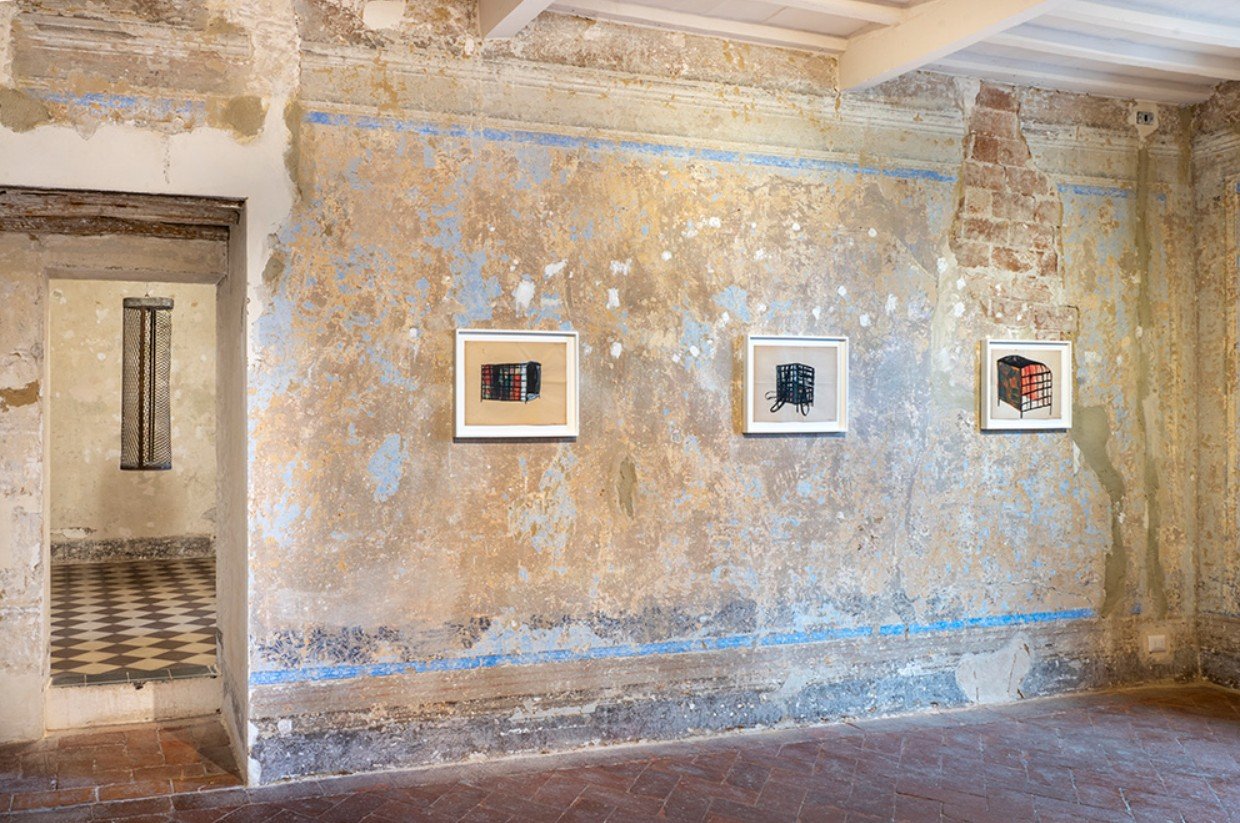
The title of this solo exhibition highlights a central aspect of the artist's practice: the thematic continuity that runs through her work from the 1990s to the present. The repetition of visual motifs across decades-from the iron cages and colourful blankets of her early works to more recent pieces made with disintegrating blankets and topics like the Arcangelo, enprisoned under a The heavy cloak of animal skin -suggests that many of the major narratives of crisis, violence, and forced displacement have not come to an end, but have instead become embedded in our everyday experience. title, Same Old, Same Old, thus becomes an acknowledgment of this painful cyclical reality. Art emerges as a space in which to confront it with emotional intensity and awareness.
As Valentino Catricalà writes in the De catalogue produced on the occasion of Frieze Masters, Berlinde De Bruyckere (Gli Ori, 2025) to be presented by the author together with Carlo Falciani and the artist on the day of the opening Bruyckere's body is not only a physical, cultural, and spiritual entity, but also a political act: the interpretation of a new social body that exists in a delicate balance between absence and presence, between a given physical structure and continual metamorphosis. One might speak of the "formless," in the sense proposed by Bataille, not merely as a philosophical concept but, as we shall see, as a driving force in our present-an act of reflection and action toward a new human condition, both existential and political. The artist, in fact, dismantles the body-animal or human-not only as an existential or biological entity, but as a political one, as a site upon which power, control, and social dynamics are exercised. Her work speaks to us about ourselves and about our existence today, about the possibility not only of breaking apart and reassembling, but of constructing new forms of corporeality and, consequently, new social bodies. It is no coincidence that the artist draws inspiration from disruptive events in which our societies have seen every notion of identity and civic order radically collapse. As in the past, so too today we live in a time in which our societies as we have conceived them culturally and politically-are in crisis, bringing the same images and fears back to the surface. We must begin again from the body, the artist tells us, a new body, no longer defined by stasis but by continual metamorphosis.
Berlinde De Bruyckere makes no distinction between animate and inanimate objects; every material she uses assumes a pose or a characteristic of a living organism.
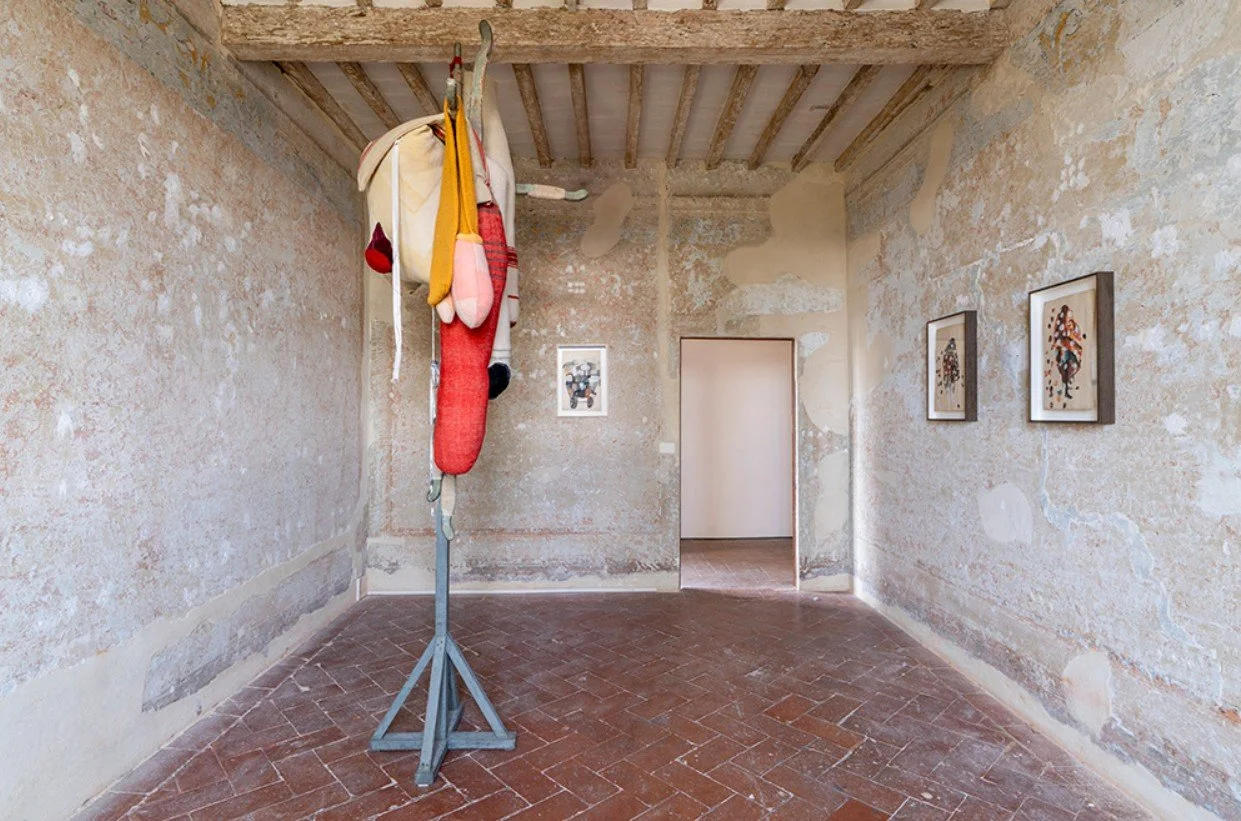
These organisms are never fully resolved, appearing instead as if in a state of becoming, suspended within an ongoing process of transformation. In some instances the sculptures are placed beneath glass cases; in others they are suspended from the ceiling; and in still others, as with the works on view Zonder Titel I, 2000-2025 and Zonder Titel II, 2000-2025, they rest on wooden supports, in this case resembling easels or hat stands. These supports become an integral part of the works, contributing to their conceptual construction. The human body becomes more distinct in Spreken, 1999.
Beneath a thick layer of blankets-which conceals any defining features or physiognomy-two human figures are hidden.
Turned toward one another, they appear to interact within an intimate, protected space. The expressiveness of the figures is conveyed not through the face, but through posture and material.