
PHILIPPE PARRENO: NOOR
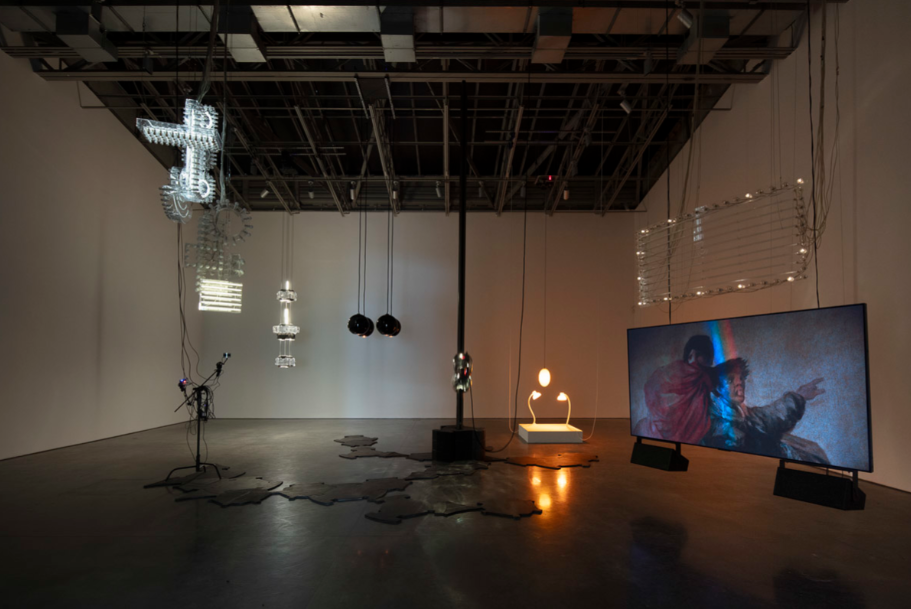
GLADSTONE presents Noor, an exhibition by Philippe Parreno that pivots to light, a long-standing medium in his practice, as the constitutive element.
May 13 - June 26, 2026
Parreno’s exhibitions are studies in sentience, with individual objects and videos seemingly aware of their own existence. These elements act as separate entities and are in dialogue with one another, as well as with the environment they inhabit. In this, Parreno’s shows have been compared to living organisms— mutable, interdependent, and generative. And, like life itself, his presentations are durational, performing according to syncopated rhythms that are often algorithmically determined so that one object responds to another in ever-changing sequences.
In his most recent exhibitions at the Haus der Kunst, Munich, and Leeum Museum of Art, Seoul (KLKM-KN), Parreno used voice—the aural phenomenon of vocal communication—as the connective tissue uniting all elements and activating the dramaturgy among them. Illuminated light is the structural leitmotif of the show, integrating the distinct objects in the presentation and creating its very ambience. Parreno has worked with light as a material for years; it is a potent
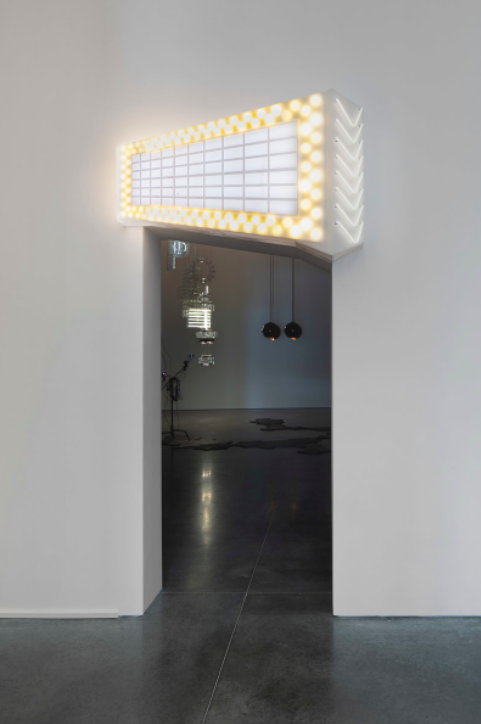
genetic strand in the DNA of his work. The signature, illuminated marquees—ghostly theatrical signposts—are now synonymous with his practice, as are the videos constructed from lightemitting pixels. And the specially crafted light fixtures manifest across a range of designs, from hanging to floor based, from mobile to stationary, are increasingly present in his exhibitions, functioning as glowing protagonists in the mise-en-scène that is his art.
Noor, the title of the exhibition, is an Arabic and Persian word for light and is used here by Parreno to invoke the philosophy of the ancient Persian mystic Shihāb al-Dīn Abū al-Futūḥ Yaḥyā ibn Ḥabash ibn Amīrak al-Suhrawardī (YYNM-ZY), who formulated an emanationist cosmology, in which the universe flows from a Supreme Light of Lights. All of creation is thus manifest as light,
which gradates according to its place within the strata of cosmic architecture. The nearer it gets to what we term “reality,” light plateaus, becoming a horizontal phenomenon through which thought is formed, a realm in which matter and spirit intersect.
Also included in the exhibition is La Quinta del Sordo, a ML-minute filmic meditation on the final home of Francisco Goya, a now-demolished house outside Madrid where the artist realized his famous Black Paintings during the last years before his exile. Rather than treating these works as detached museum objects, Parreno reconstructs the murals in-situ, using digital modeling, sound design, and cinematography to imagine the house as a complex psychological space.
Filmed at the Museo Nacional del Prado, the paintings are depicted in extreme close-up, their surfaces animated by shifting illumination modeled on firelight and candles. Throughout the film, changes in sound and light suggest the slow passage of time: floorboards creak, distant bells drift through open air, and the architecture seems to register its own memory through echo and reverberation. Hovering between historical reconstruction and speculative fiction, the work transforms Goya’s vanished house into an immersive and haunted interior, where image, atmosphere, and space remain inseparable. Noor, with its intermeshed beams of light, cast shadows, and glowing output, is conceived by the artist as a tribute to Barbara Gladstone.