ALICJA KWADE: DIMORA DISLOCATA
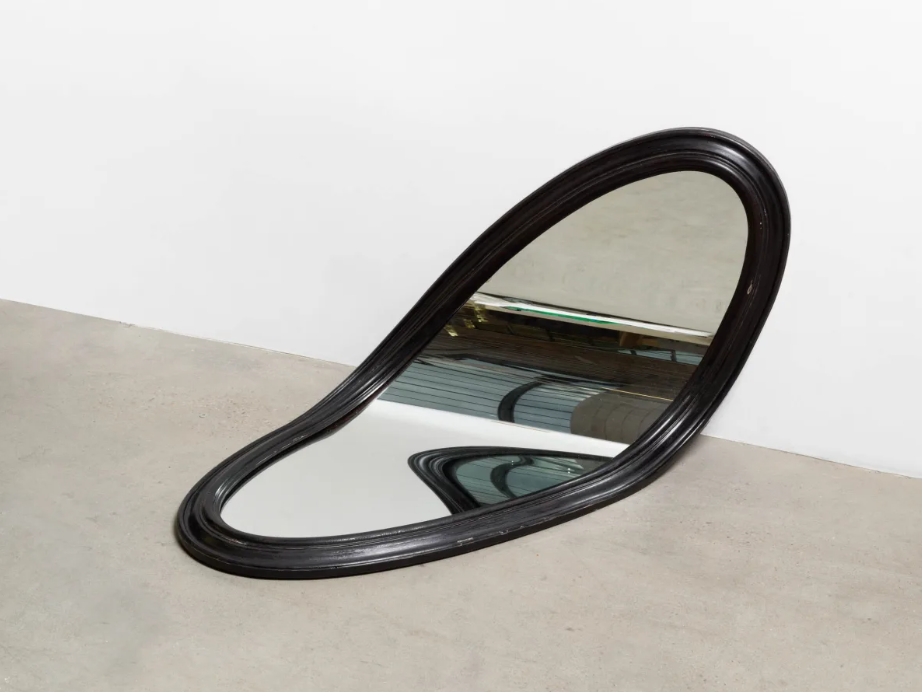
MASSIMODECARLO is pleased to announce Dimora Dislocata, an exhibition by Alicja Kwade specifically conceived for the spaces of Casa Corbellini-Wassermann - her first project with the gallery in Milan.
June 10 - August 1, 2026
Drawing from twenty years of her practice, it brings together a unique selection of works that appear, at first glance, to be ordinary. In the former apartment of Casa CorbelliniWassermann - a space that still carries the memory of the home it once was - they find their perfect setting.
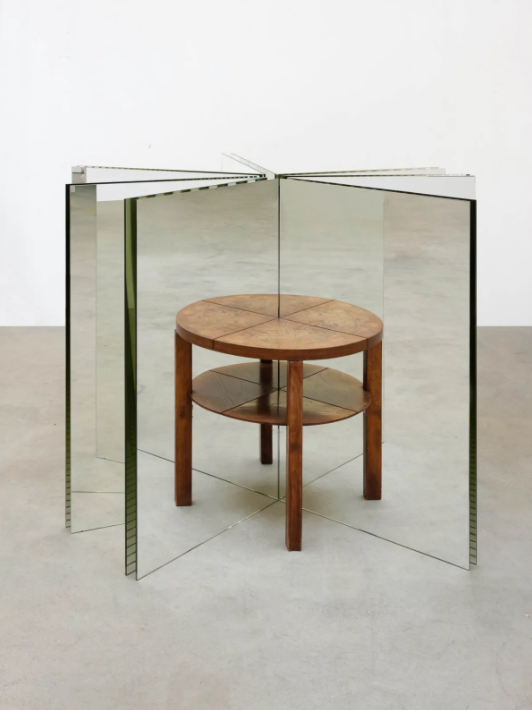
In The Nature of the Physical World, published in 1928, the English physicist Arthur Stanley Eddington proposed that every object exists twice. "Two tables! Yes; there are duplicates of every object about me - two tables, two chairs, two pens." The first table he had always known: solid, coloured, substantial, the unquestioned furniture of daily life. The second had been revealed to him through years of physics - mostly empty space, a temporary agreement between particles that had decided, for the time being, to behave like a surface. Both tables existed. They occupied the same place at the same time, one known to the senses, one known to physics, and between them - that thin, vertiginous gap - the world kept its secrets. Alicja Kwade has spent the better part of twenty years in exactly that gap - inside the most ordinary objects imaginable, attending to what lies within them and beyond them, from the smallest particle to the scale of the universe.
Six years after Eddington wrote those words, on Viale Lombardia, the architect Piero Portaluppi began building a house. The commission came from two families: the Corbellinis and the Wassermanns, heirs to a German pharmaceutical fortune. Among their forebears was August von Wassermann, the bacteriologist who in 1906 had devised the first reliable blood test for syphilis - a method for finding what the body conceals, for making the invisible legible. Portaluppi, who had his own ideas about surfaces and what lies beneath them, gave them exactly the house that followed.
The façade is clad in grey and rose marble, but only at the piano nobile; above, it gives way to plain white plaster, as if the building had spent its grandeur early and was resting. Inside, fifteen varieties of marble - among them verde Roja, bianco di Carrara and rosso di Levanto. Along the garden façade, a helical staircase spirals upward, salvaged from a pavilion Portaluppi had shown at the Triennale di Milano in 1933. The windows are wide and horizontal, hungry for light. The rooms move between austerity and excess never quite deciding what they want to confess.
Casa Corbellini-Wassermann exists in two registers at once - former home and exhibition space, private history and public present. A space suspended between what it was and what it is now, familiar and slightly elsewhere at the same time: a dislocated dwelling - Dimora Dislocata. It is here that Kwade assembled a world.
Walking through these rooms, something has shifted. Objects that appear familiar reveal themselves, on second glance, to be something else entirely - pinned to stillnesses they were never designed for, buckling under weights that have no business being there, standing in the middle of rooms as if they have forgotten what they were originally for. Things have been taken apart and begun again, matter honouring its oldest instinct: not to disappear, only to transform. Letters written in a hand that is and isn't Kwade's. Everything here carries a former life inside it, or a question, or both.
There is something of Giorgio de Chirico and the Pittura Metafisica in these rooms - the object displaced just enough from its context to reveal its enigmatic essence - and something of Arte Povera's conviction that materials carry their own history, that matter, submitted to the right kind of pressure, will always confess what it is actually made of. But the strangeness Kwade finds is not borrowed from the subconscious. It was already there, in the object, in the matter, in the gap between the two tables.
Between every object, in the quality of silence that has gathered in these rooms, something vibrates. The feeling - soft, persistent, impossible to locate precisely - that the apartment has not stopped being an apartment, that the lives lived here have not entirely left but thinned, become permeable, made space. By the time the last room is reached, it is no longer entirely clear what was known coming in, and what has shifted since. A kind of strange dream is produced - like waking in the middle of the night and believing, for a moment, to recognise a person in a chair.