
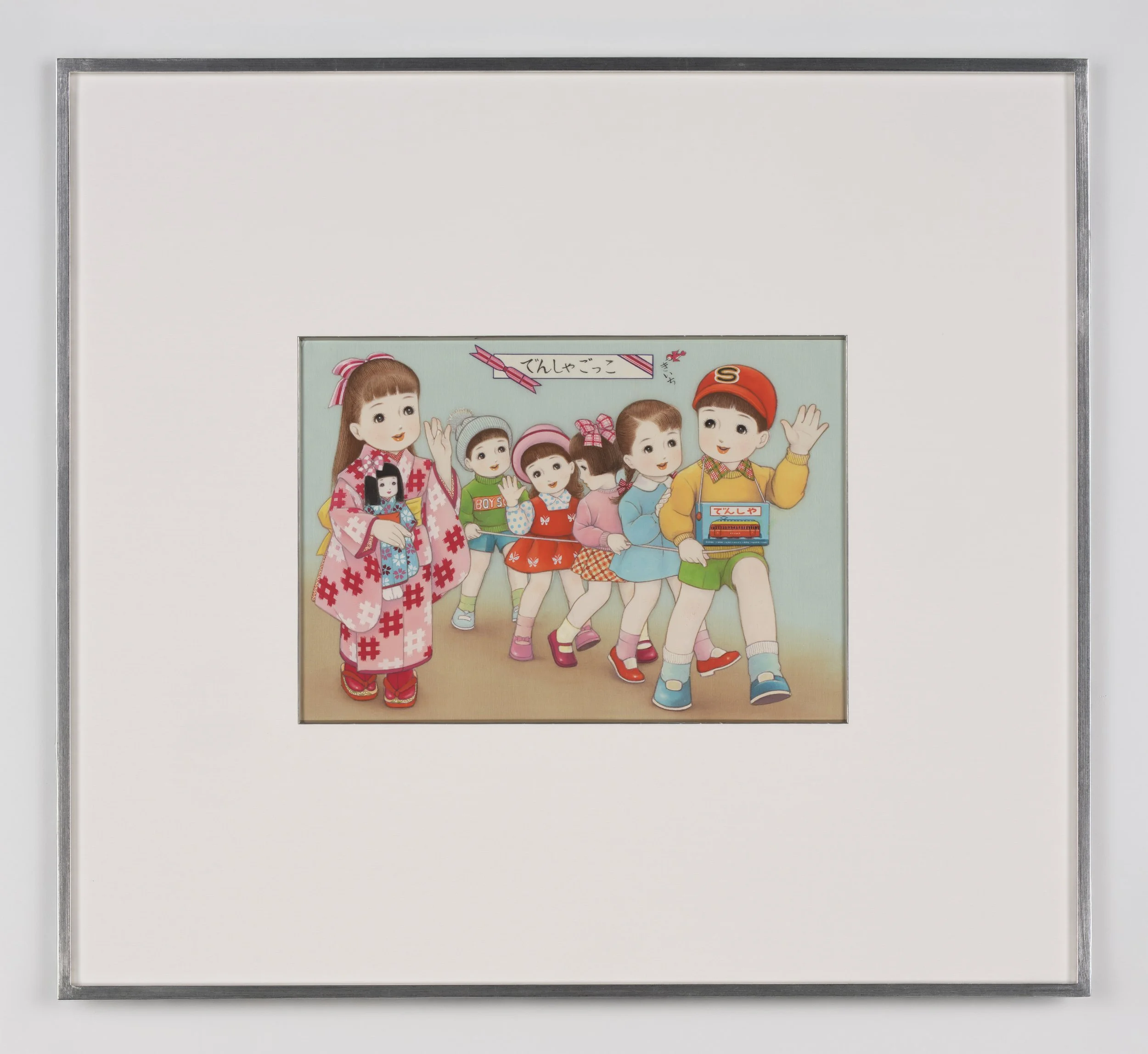
NANZUKA is pleased to present From the Soda Collection a solo exhibition by Kiichi Tsutaya.
October 24 – November 28, 2026
Kiichi Tsutaya, born in 1914 into a family of paper wholesalers in Tokyo’s Tsukiji district, is an artist who gained prominence during Japan’s postwar era as a creator of nurie for young girls. From the Taishō era through the early Shōwa era, Tsutaya spent his formative teenage years immersed in the spirit of freedom characteristic of “Taishō Democracy” (a period of political, social, and cultural liberalism in Japan spanning roughly from 1905 to 1932). Eventually, he became deeply fascinated by artists such as Kashō Takabatake—celebrated for his unique illustrations of bishōjo (beautiful girls) and bishōnen (beautiful, androgynous boys) published in magazines for girls, boys, and women, as well as his bijinga (paintings of beautiful women) works—and Yamakawa Shūhō, renowned as a master of modern bijinga who fused traditional Japanese aesthetics with modernism.
When looking at Tsutaya’s hand-drawn works on silk, viewers will likely be struck by their sheer originality and pioneering spirit. The images of young girls depicted by Tsutaya stand apart from the genre of lyrical painting—represented by Takehisa Yumeji and continuing through artists such as Jun’ichi Nakahara and Kōji Fukiya—that emerged from the Taishō Romanticism era. With their plump facial features, oversized eyes, and low head-to-body ratio, the girls in Tsutaya’s works, characterized by a fully standardized style, served as the prototype of the manga-style characters that would later proliferate in Japan, and can also be interpreted as the origin of modern “Kawaii” culture. In this regard, Takeshi Kudo—curator of the exhibition Bishōjo: Young Pretty Girls in Art History—offers the following explanation in his text “Kiichi Tsutaya’s ‘Nurie’ and ‘Nikuhitsu-ga’—Postwar Japanese Popular Culture and Visual Expression,” contributed to the catalog produced in correspondence to this exhibition at NANZUKA.
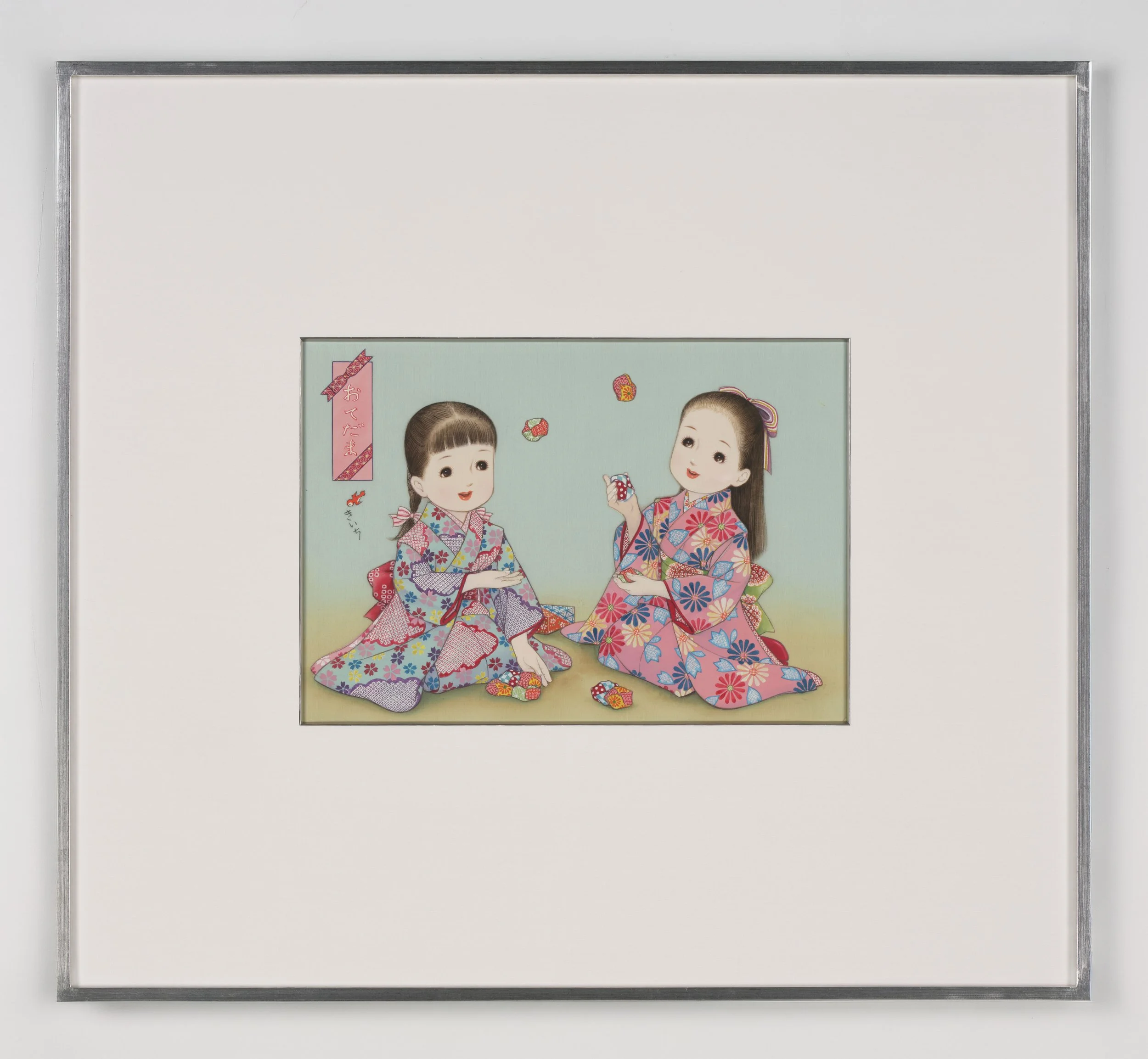
The exhibition features 34 hand-drawn works from the “One Hundred Metamorphoses of Little Girls” series, which Tsutaya actively began producing around 1985, employing the techniques of nihonga. These precious works have been carefully preserved and kept entirely hidden from the public eye by collector Daisuke Soda, who regularly visited Tsutaya’s studio to purchase each piece upon completion. Presented as follows is an excerpt from a comment from Daisuke Soda (Soda Collection) received in relation to this exhibition.
“I believe it was in the spring of 1983 that I first met Mr. Kiichi Tsutaya. By the time I met him, he had largely moved away from working on ‘nurie’ (coloring pictures) and was making a living by producing nihonga (Japanese-style paintings) for occasional commissions. I had originally visited him simply hoping to have a small piece painted for my two daughters’ Shichi-Go-San celebrations (a traditional festival celebrating the growth and well-being of young children). However, I soon found myself captivated by the allure of his artistic universe and thus began my regular visits to his atelier. My relationship with Mr. Kiichi unexpectedly developed from there. [...] Kiichi Tsutaya is not merely a nurie artist. I firmly believe that his exceptional skill, rich sensibility, and the depth of his artistic universe as a nihonga painter is genuinely worthy of high acclaim. [...] I sincerely hope that these works that I have carefully cherished and preserved over the years will be seen by many people, give birth to new encounters, and ensure that Mr. Kiichi’s art is passed on to the next generation.”